. 2019 Apr 24;39(17):3309-3319.
doi: 10.1523/JNEUROSCI.2620-18.2019. Epub 2019 Feb 25.

A Postdecisional Neural Marker of Confidence Predicts Information-Seeking in Decision-Making

Affiliations

A Postdecisional Neural Marker of Confidence Predicts Information-Seeking in Decision-Making

Kobe Desender et al. J Neurosci. .

Abstract

Theoretical work predicts that decisions made with low confidence should lead to increased information-seeking. This is an adaptive strategy because it can increase the quality of a decision, and previous behavioral work has shown that decision-makers engage in such confidence-driven information-seeking. The present study aimed to characterize the neural markers that mediate the relationship between confidence and information-seeking. A paradigm was used in which 17 human participants (9 male) made an initial perceptual decision, and then decided whether or not they wanted to sample more evidence before committing to a final decision and confidence judgment. Predecisional and postdecisional event-related potential components were similarly modulated by the level of confidence and by information-seeking choices. Time-resolved multivariate decoding of scalp EEG signals first revealed that both information-seeking choices and decision confidence could be decoded from the time of the initial decision to the time of the subsequent information-seeking choice (within-condition decoding). No above-chance decoding was visible in the preresponse time window. Crucially, a classifier trained to decode high versus low confidence predicted information-seeking choices after the initial perceptual decision (across-condition decoding). This time window corresponds to that of a postdecisional neural marker of confidence. Collectively, our findings demonstrate, for the first time, that neural indices of confidence are functionally involved in information-seeking decisions.SIGNIFICANCE STATEMENT Despite substantial current interest in neural signatures of our sense of confidence, it remains largely unknown how confidence is used to regulate behavior. Here, we devised a task in which human participants could decide whether or not to sample additional decision-relevant information at a small monetary cost. Using neural recordings, we could predict such information-seeking choices based on a neural signature of decision confidence. Our study illuminates a neural link between decision confidence and adaptive behavioral control.

Keywords: confidence; decision-making; error positivity; information sampling; information-seeking; metacognition.


Figures

Figure 1.
Figure 1.
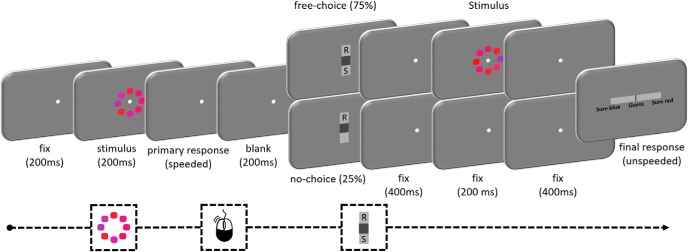
Timeline of an experimental trial. A stimulus was presented for 200 ms, and participants made a speeded response with the mouse, deciding whether the average color of the eight elements was red or blue. On free-choice trials (75%), participants subsequently used a vertical slider to choose either to see the stimulus again in an easier version (by moving the gray cursor toward S) or to give their response (by moving the gray cursor toward R). When the stimulus is shown again, the mean of the eight elements is more clearly red and the variance is smaller (note that the displayed change is exaggerated for illustration purposes). On no-choice trials (25%), participants could only choose to give their response. Finally, on all trials, participants jointly indicated their final response and level of confidence on a horizontal continuous response scale. Being accurate was rewarded (5 points), errors were punished (−5 points), and there was a small cost associated with sampling more information (−1 point).
Figure 2.
Figure 2.
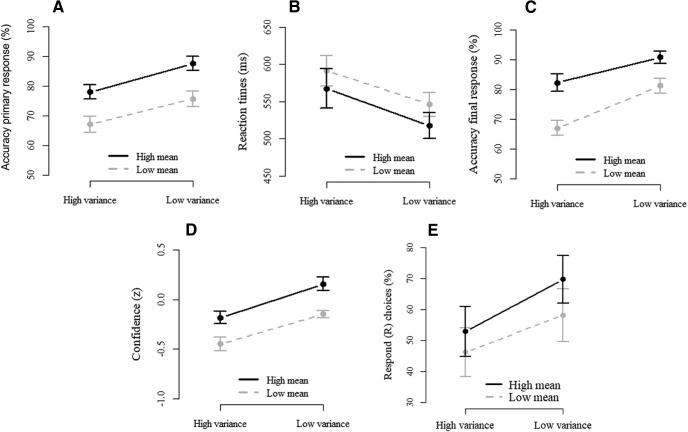
Behavioral performance is modulated by mean and variance. A, Mean accuracy of the primary response (based on all data). B, Median reaction times of the primary response (based on all data). C, Mean accuracy of the final response (based on no-choice data). D, Mean standardized confidence (based on no-choice data). E, The number of trials on which participants waived the see again option (based on free-choice data).
Figure 3.
Figure 3.
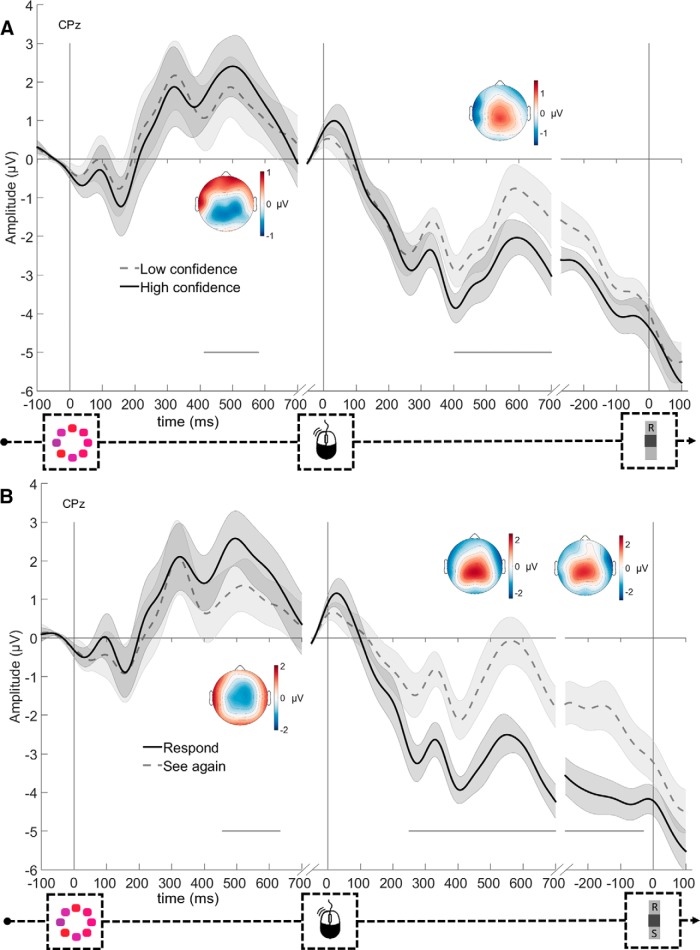
ERPs as a function of confidence (A) and information-seeking choices (B). Head plots represent the difference in scalp distribution during the significant time periods for low-high confidence (A) and see again-respond (B). Gray horizontal lines indicate clusters during which both conditions significantly differ. Shadings represent SEM. High and low confidence is calculated from no-choice data and information-seeking choices from free-choice trials.
Figure 4.
Figure 4.
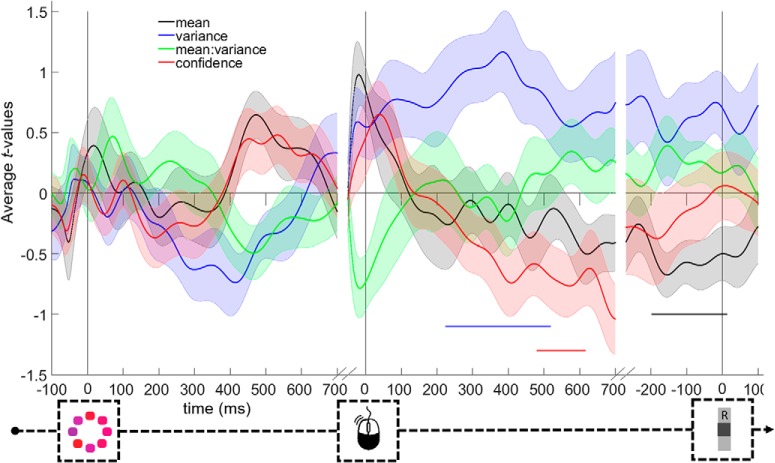
Time-resolved multivariate regression of EEG data by confidence and task difficulty. Horizontal lines indicate clusters significantly differing from 0. Shadings represent SEM.
Figure 5.
Figure 5.
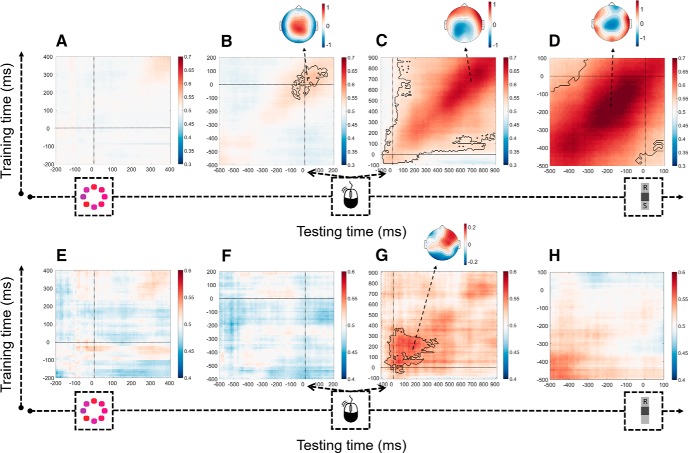
Within-condition decoding of information-seeking choices (A–D) and confidence (E–H). Classifiers were trained and tested on all time points (on correct trials only; steps of 10 ms and a sliding window of 106 ms). Topographies represent the scalp projections obtained from the logistic regression classifier at the training time where classification is maximal. A, B, E, F, Prestimulus baseline (−100 ms until 0 ms). C, D, G, H, Preresponse baseline (−100 ms until 0 ms). Because of this difference in baseline, the regions of significant decoding in B, C and F, G are not identical. Solid black lines indicate significant clusters (p < 0.05). The training times of each panel correspond to the testing time of that panel; for example, t = 0 corresponds to stimulus, response, response, and information-seeking decisions in panels A–D and E–H, respectively.
Figure 6.
Figure 6.
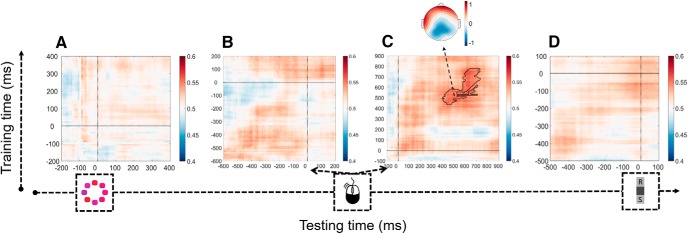
Across-condition decoding of information-seeking choices by confidence, locked to the stimulus (A), the response (B, C) and the information-seeking choice (D). Classifiers are trained on high versus low confidence from no-choice data and tested on see again versus respond decisions from free-choice data (both on correct trials only). Above-chance decoding only occurs postresponse. The same conventions as in Figure 5A–D apply.

References

    1. Badre D, Doll BB, Long NM, Frank MJ (2012) Rostrolateral prefrontal cortex and individual differences in uncertainty-driven exploration. Neuron 73:595–607. 10.1016/j.neuron.2011.12.025 - DOI - PMC - PubMed
    1. Bates DM, Maechler M, Bolker B, Walker S (2015) Fitting linear mixed-effects models using lme4. J Statist Software 67:1–48.
    1. Boldt A, Yeung N (2015) Shared neural markers of decision confidence and error detection. J Neurosci 35:3478–3484. 10.1523/JNEUROSCI.0797-14.2015 - DOI - PMC - PubMed
    1. Boldt A, de Gardelle V, Yeung N (2017a) The impact of evidence reliability on sensitivity and bias in decision confidence. J Exp Psychol Hum Percept Perform 43:1520–1531. 10.1037/xhp0000404 - DOI - PMC - PubMed
    1. Boldt A, Blundell C, De Martino B (2017b) Confidence modulates exploration and exploitation in value-based learning. bioRxiv. Advance online publication. Retrieved December 28, 2017. doi: 10.1101/236026. - DOI - PMC - PubMed

Publication types

LinkOut - more resources