


Amelioration of Alzheimer's disease pathology and cognitive deficits by immunomodulatory agents in animal models of Alzheimer's disease
- PMID: 30804241
- PMCID: PMC6425849
- DOI: 10.4103/1673-5374.251192
Amelioration of Alzheimer's disease pathology and cognitive deficits by immunomodulatory agents in animal models of Alzheimer's disease
Abstract
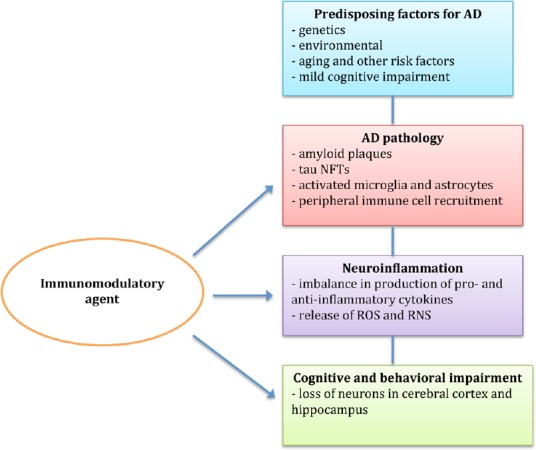
The most common age-related neurodegenerative disease is Alzheimer's disease (AD) characterized by aggregated amyloid-β (Aβ) peptides in extracellular plaques and aggregated hyperphosphorylated tau protein in intraneuronal neurofibrillary tangles, together with loss of cholinergic neurons, synaptic alterations, and chronic inflammation within the brain. These lead to progressive impairment of cognitive function. There is evidence of innate immune activation in AD with microgliosis. Classically-activated microglia (M1 state) secrete inflammatory and neurotoxic mediators, and peripheral immune cells are recruited to inflammation sites in the brain. The few drugs approved by the US FDA for the treatment of AD improve symptoms but do not change the course of disease progression and may cause some undesirable effects. Translation of active and passive immunotherapy targeting Aβ in AD animal model trials had limited success in clinical trials. Treatment with immunomodulatory/anti-inflammatory agents early in the disease process, while not preventive, is able to inhibit the inflammatory consequences of both Aβ and tau aggregation. The studies described in this review have identified several agents with immunomodulatory properties that alleviated AD pathology and cognitive impairment in animal models of AD. The majority of the animal studies reviewed had used transgenic models of early-onset AD. More effort needs to be given to creat models of late-onset AD. The effects of a combinational therapy involving two or more of the tested pharmaceutical agents, or one of these agents given in conjunction with one of the cell-based therapies, in an aged animal model of AD would warrant investigation.
Keywords: Alzheimer's disease; amyloid deposits; animal models; behavioral deficits; cognitive deficits; gliosis; immunomodulatory agents; neuropathology.
Conflict of interest statement
None
Figures
References
-
- Bassani TB, Turnes JM, Moura EL, Bonato JM, Cóppola-Segovia V, Zanata SM, Oliveira RM, Vital MA. Effects of curcumin on short-term spatial and recognition memory, adult neurogenesis and neuroinflammation in a streptozotocin-induced model of dementia of Alzheimer’s type. Behav Brain Res. 2017;335:41–54. - PubMed
LinkOut - more resources
Full Text Sources
Other Literature Sources
Medical
