. 2019 Feb 25;9(1):2677.
doi: 10.1038/s41598-019-39058-9.

Long-duration spaceflight adversely affects post-landing operator proficiency

Affiliations

Long-duration spaceflight adversely affects post-landing operator proficiency

Steven T Moore et al. Sci Rep. .

Abstract

Performance of astronaut pilots during space shuttle landing was degraded after a few weeks of microgravity exposure, and longer-term exposure has the potential to impact operator proficiency during critical landing and post-landing operations for exploration-class missions. Full-motion simulations of operationally-relevant tasks were utilized to assess the impact of long-duration spaceflight on operator proficiency in a group of 8 astronauts assigned to the International Space Station, as well as a battery of cognitive/sensorimotor tests to determine the underlying cause of any post-flight performance decrements. A ground control group (N = 12) and a sleep restriction cohort (N = 9) were also tested to control for non-spaceflight factors such as lack of practice between pre- and post-flight testing and fatigue. On the day of return after 6 months aboard the space station, astronauts exhibited significant deficits in manual dexterity, dual-tasking and motion perception, and a striking degradation in the ability to operate a vehicle. These deficits were not primarily due to fatigue; performance on the same tasks was unaffected after a 30-h period of sleep restriction. Astronauts experienced a general post-flight malaise in motor function and motion perception, and a lack of cognitive reserve apparent only when faced with dual tasks, which had recovered to baseline by four days after landing.


Conflict of interest statement

The authors declare no competing interests.

Figures

Figure 1
Figure 1
The 6 degree-of-freedom motion simulator.
Figure 2
Figure 2
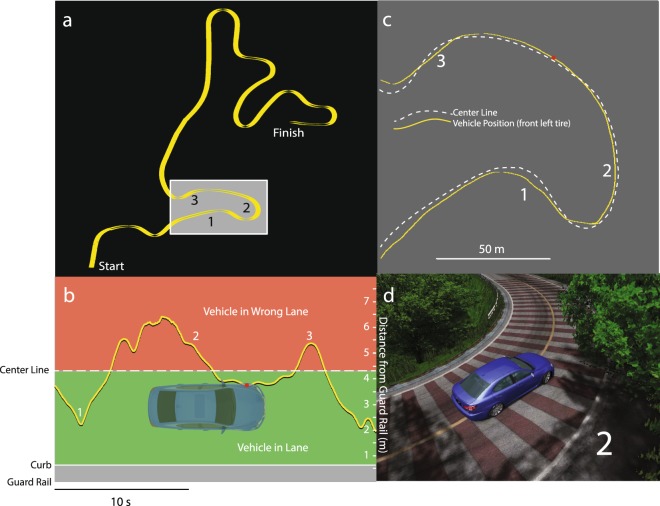
(a) The 3 km mountain course. (bd) The position of the vehicle’s front left tire relative to the center line was acquired to determine deviations into the wrong lane.
Figure 3
Figure 3
(a) Screenshot from the cone driving simulation. (b) Vehicle position data (white trace) and hit cones (red) from a trial.
Figure 4
Figure 4
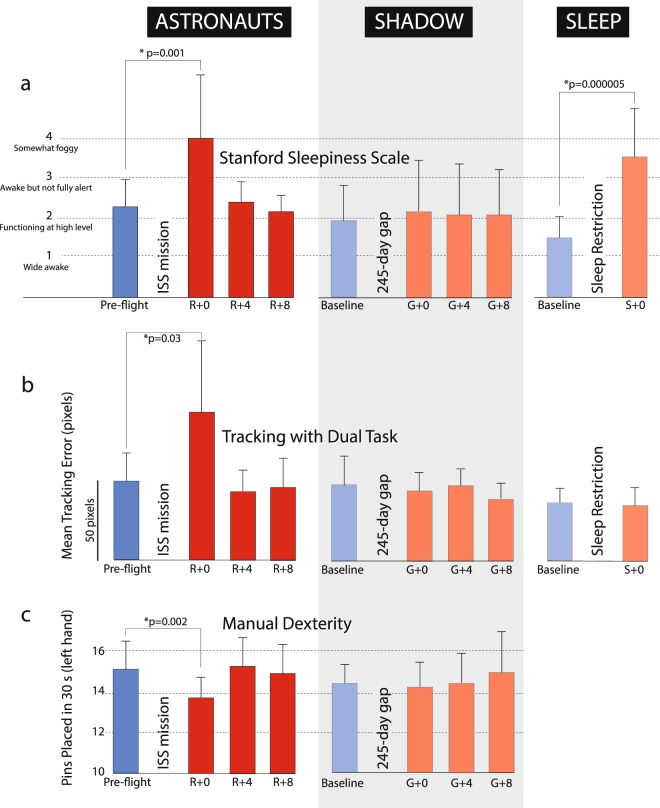
Results from the cognitive/sensorimotor test battery for the astronaut, shadow and sleep groups. (a) Subjective sleepiness rating. (b) Mean tracking error during dual tasking. (c) Manual dexterity (Purdue Pegboard test).
Figure 5
Figure 5
The motion perception task. (a) Power spectrum of roll cabin motion (dashed line – a sum of seven sinusoids) and subject response using the control stick to indicate gravitational vertical (green trace). The peak input response in roll (b) and pitch (c) at each of the seven frequencies.
Figure 6
Figure 6
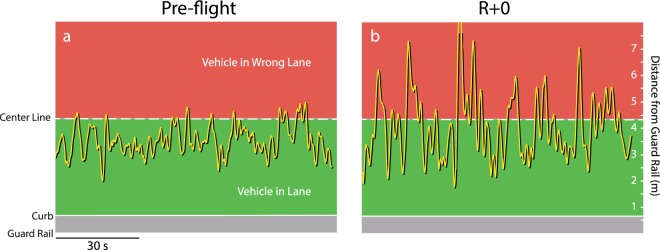
A comparison of pre-flight (a) and landing day (b) lane control during the mountain driving simulation in an astronaut subject.
Figure 7
Figure 7
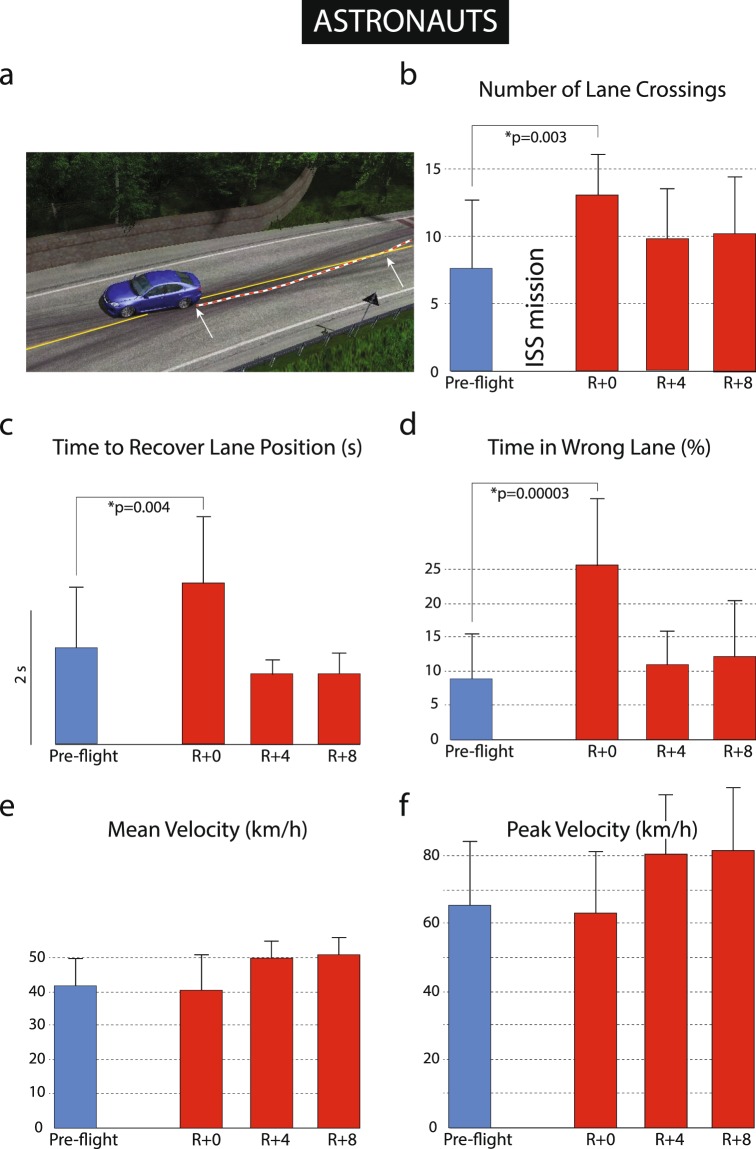
Performance on the 3 km mountain driving simulation for the astronaut group. (a) Lane deviations were assessed; (b) number of lane crossings, (c) time to recover lane position, (d) percent time in wrong lane, (e) mean and (f) peak vehicle velocity.
Figure 8
Figure 8
Time to recover lane position in the (a) astronaut, (b) shadow and (c) sleep-restricted groups.

References

    1. Wood SJ, Paloski WH, Clark JB. Assessing Sensorimotor Function Following ISS with Computerized Dynamic Posturography. Aerosp Med Hum Perform. 2015;86:A45–A53. doi: 10.3357/AMHP.EC07.2015. - DOI - PubMed
    1. Lee SMC, Feiveson AH, Stein S, Stenger MB, Platts SH. Orthostatic Intolerance After ISS and Space Shuttle Missions. Aerosp Med Hum Perform. 2015;86:A54–A67. doi: 10.3357/AMHP.EC08.2015. - DOI - PubMed
    1. Trappe S, et al. Exercise in space: human skeletal muscle after 6 months aboard the International Space Station. J Appl Physiol. 2009;106:1159–1168. doi: 10.1152/japplphysiol.91578.2008. - DOI - PubMed
    1. Moore ST, et al. Head-eye coordination during simulated orbiter landing. Aviat Space Environ Med. 2008;79:888–898. doi: 10.3357/ASEM.2209.2008. - DOI - PubMed
    1. Ellis, S. R. Collision in space: Human factors such as inadequate visual displays and operator fatigue played significant roles in the collision of space station Mir and progress 234. (Advanced Displays and Spatial Perception Laboratory, Human Information Processing Research Branch), Moffett Field, CA, (2004).

Publication types