


Reduced caterpillar damage can benefit plant bugs in Bt cotton
- PMID: 30804420
- PMCID: PMC6390097
- DOI: 10.1038/s41598-019-38917-9
Reduced caterpillar damage can benefit plant bugs in Bt cotton
Abstract
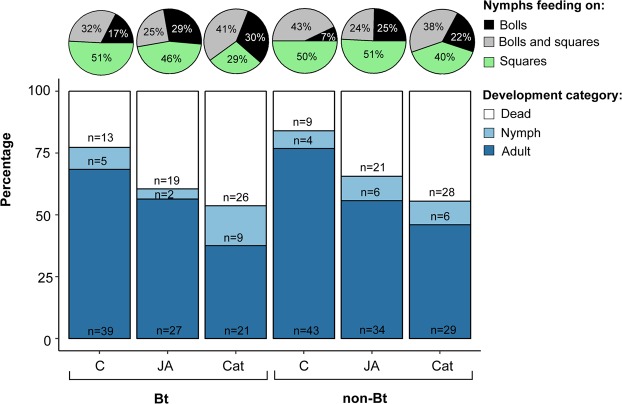
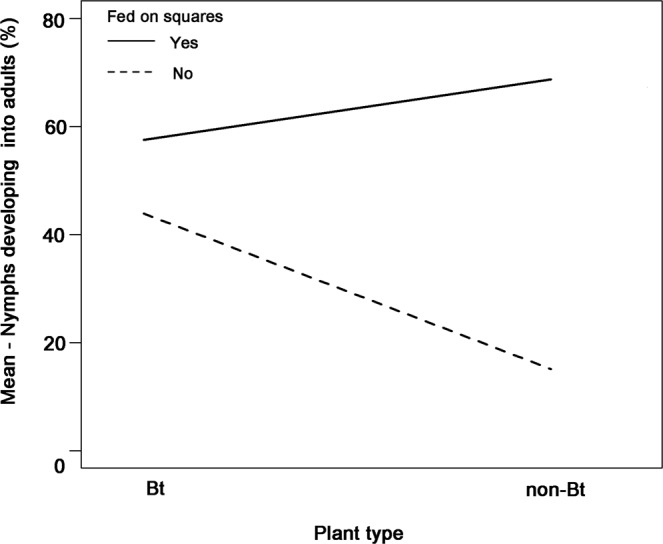
Bt cotton was genetically modified to produce insecticidal proteins targeting Lepidopteran pests and is therefore only minimally affected by caterpillar damage. This could lead to reduced levels of inherent, systemically inducible defensive compounds in Bt cotton which might benefit other important cotton herbivores such as plant bugs. We studied the effects of plant defense induction on the performance of the plant bug Lygus hesperus by caging nymphs on different food sources (bolls/squares) of Bt and non-Bt cotton which were either undamaged, damaged by Bt tolerant caterpillars, or treated with jasmonic acid (JA). Terpenoid induction patterns of JA-treated and L. hesperus-damaged plants were characterized for different plant structures and artificial diet assays using purified terpenoids (gossypol/heliocide H1/4) were conducted. Nymphs were negatively affected if kept on plants damaged by caterpillars or sprayed with JA. Performance of nymphs was increased if they fed on squares and by the Bt-trait which had a positive effect on boll quality as food. In general, JA-sprayed plants (but not L. hesperus infested plants) showed increased levels of terpenoids in the plant structures analyzed, which was especially pronounced in Bt cotton. Nymphs were not negatively affected by terpenoids in artificial diet assays indicating that other inducible cotton responses are responsible for the found negative effects on L. hesperus. Overall, genetically engineered plant defenses can benefit plant bugs by releasing them from plant-mediated indirect competition with lepidopterans which might contribute to increasing numbers of hemipterans in Bt cotton.
Conflict of interest statement
The authors declare no competing interests.
Figures

References
-
- ISAAA. Global Status of Commercialized Biotech/GM Crops: 2016. ISAAA Brief No. 52. (ISAAA, Ithaca, USA, 2016).
-
- NASEM. National Academies of Sciences, Engineering, Medicine-Genetically Engineered Crops: Experiences and Prospects (National Academies Press, Washington, USA, 2017). - PubMed
-
- Adamczyk, J. J. & Hubbard, D. Changes in populations of Heliothis virescens (F.) (Lepidoptera: Noctuidae) and Helicoverpa zea (Boddie) (Lepidoptera: Noctuidae) in the Mississippi Delta from 1986 to 2005 as indicated by adult male pheromone traps. J. Cotton Sci. 10, 829–836 (2006).
Publication types
MeSH terms
Substances
LinkOut - more resources
Full Text Sources
