Review
. 2019 Mar;16(3):225-234.
doi: 10.1038/s41592-019-0330-1. Epub 2019 Feb 25.

Methods to study RNA-protein interactions

Affiliations
Review

Methods to study RNA-protein interactions

Muthukumar Ramanathan et al. Nat Methods. 2019 Mar.

Erratum in

Abstract

Noncoding RNA sequences, including long noncoding RNAs, small nucleolar RNAs, and untranslated mRNA regions, accomplish many of their diverse functions through direct interactions with RNA-binding proteins (RBPs). Recent efforts have identified hundreds of new RBPs that lack known RNA-binding domains, thus underscoring the complexity and diversity of RNA-protein complexes. Recent progress has expanded the number of methods for studying RNA-protein interactions in two general categories: approaches that characterize proteins bound to an RNA of interest (RNA-centric), and those that examine RNAs bound to a protein of interest (protein-centric). Each method has unique strengths and limitations, which makes it important to select optimal approaches for the biological question being addressed. Here we review methods for the study of RNA-protein interactions, with a focus on their suitability for specific applications.


Figures
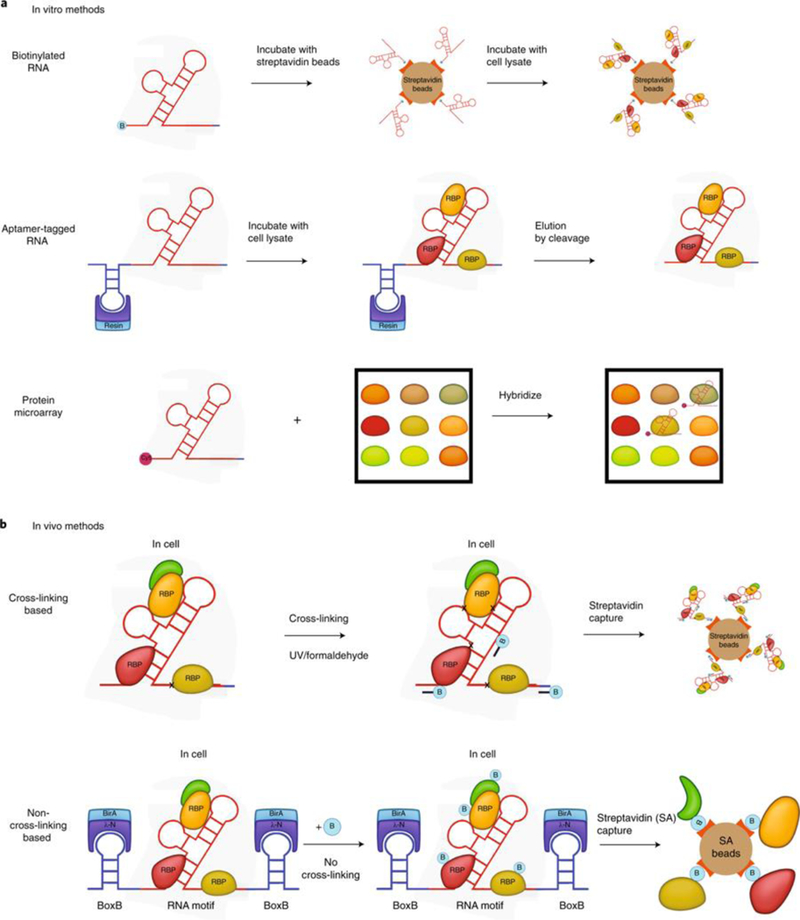
Fig. 1 |
Fig. 1 |. Schematic representation of RNA-centric methods.
a, In vitro methods. Top, schematic of end-biotinylated-RNA pulldown. RNA is synthesized with biotin at the 5′ or 3′ end and combined with streptavidin. Recombinant or cellular-extract proteins bind to RNA. After being washed, the beads are boiled to elute and identify RNA-bound proteins. Middle, schematic of aptamer-tagged-RNA capture (S1, Cys4) methods. The RNA of interest is in vitro-transcribed with an RNA tag (blue). The RNA tag binds RNA (red) to a resin support. Proteins in the cellular extract bind to RNA. After washing steps, RNA complex is eluted with imidazole for Cys4 or biotin for the S1 aptamer method. Bottom, schematic of a protein microarray. RNA is in vitro-transcribed with Cy5. The RNA is then added to a human protein microarray spotted with −9,400 proteins. After washing steps, fluorescence is used to detect and quantitate RNA bound on spotted proteins on the microarray. b, Top, schematic of in vivo cross-linking methods. Cross-linking-based methods use either UV (RAP, PAIR, MS2-BioTRAP, TRIP) or formaldehyde cross-linking (CHART, ChIRP). Biotinylated oligonucleotide probes are hybridized to the RNA of interest, and the RNA and cross-linked proteins are purified for downstream analysis. Bottom, schematic of an in vivo non-cross-linking method (RaPID). BoxB RNA stem loops (blue) flank the RNA sequence of interest (red). RaPID (LN-HA-BirA*) fusion protein binding to BoxB sites leads to biotinylation of proteins associated with the inserted RNA sequence in living cells grown in biotin-containing media. Streptavidin beads are used to capture biotinylated protein.
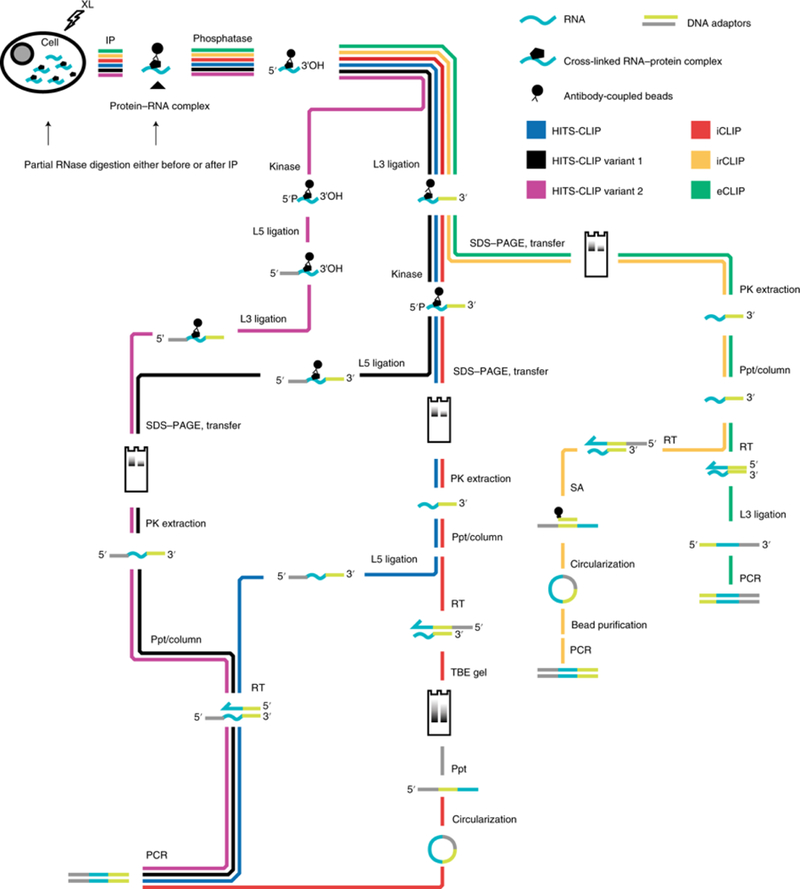
Fig. 2 |
Fig. 2 |. Subway map of CLIP protocols, from immunoprecipitation to PCR.
The chart highlights steps of various representative CLIP-seq protocols. Not all steps are included. XL, UV cross-link; IP, immunopurification; phosphatase, removal of 3′ phosphate; kinase, addition of 5′ phosphate; RT, reverse transcription; L3, 3′ adaptor ligation to RNA or DNA; L5, 5′ adaptor ligation; PK extraction, proteinase K extraction from nitrocellulose membrane; Ppt/column, alcohol precipitation or column cleanup of nucleic acid; TBE, Tris-borate-EDTA; SA, streptavidin.

References

    1. Zhu X Seeing the yin and yang in cell biology. Mol. Biol. Cell 21, 3827–3828 (2010). - PMC - PubMed
    1. Mayr C Regulation by 3′-untranslated regions. Annu. Rev. Genet. 51, 171–194 (2017). - PubMed
    1. Moore MJ From birth to death: the complex lives of eukaryotic mRNAs. Science 309, 1514–1518 (2005). - PubMed
    1. Allerson CR, Cazzola M & Rouault TA Clinical severity and thermodynamic effects of iron-responsive element mutations in hereditary hyperferritinemia-cataract syndrome. J. Biol. Chem. 274, 26439–26447 (1999). - PubMed
    1. Batista PJ & Chang HY Long noncoding RNAs: cellular address codes in development and disease. Cell 152, 1298–1307 (2013). - PMC - PubMed

Publication types