


Evaluating the Role of PTEN Promoter Methylation in Patients Predisposed to Hypercoagulable States via Methylation Specific PCR
- PMID: 30805404
- PMCID: PMC6374066
Evaluating the Role of PTEN Promoter Methylation in Patients Predisposed to Hypercoagulable States via Methylation Specific PCR
Abstract
Background: Hypercoagulable states (HS) can result from several different inherited and acquired disease conditions that cause abnormalities in the genes, proteins and cellular factors involved in the coagulation cascade. Novel insight into the molecular mechanisms involved in the coagulation pathways can provide a framework to develop improved therapeutics to treat patients with coagulation disorders. Therefore, investigating the genetic abnormalities present in patients with coagulation disorders can offer critical insight into disease pathogenesis. Our study aimed to assess the promoter methylation patterns of the phosphatase and tensin homologue (PTEN) gene as a potential underlying factor involved in HS.
Methods: To measure the differences between the mRNA expression of PTEN in HS patients and healthy individuals we used qRT-PCR. Following bisulfite conversion, the promoter methylation status was analyzed using methylation specific PCR. The two-tailed student t-test was used to analyze the quantitative data. The data was considered statistically significant with a p value <0.05.
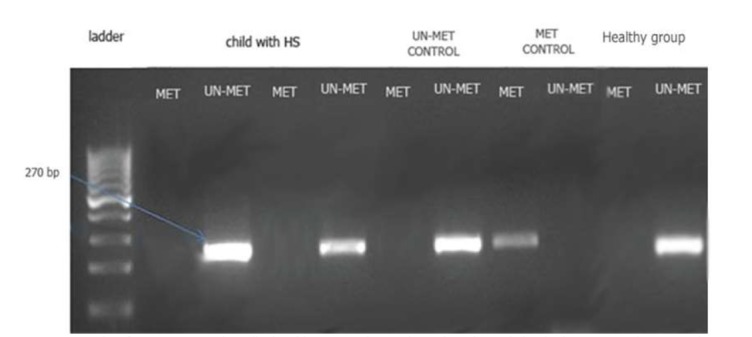
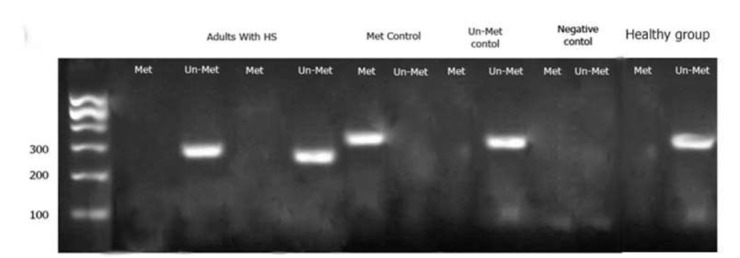
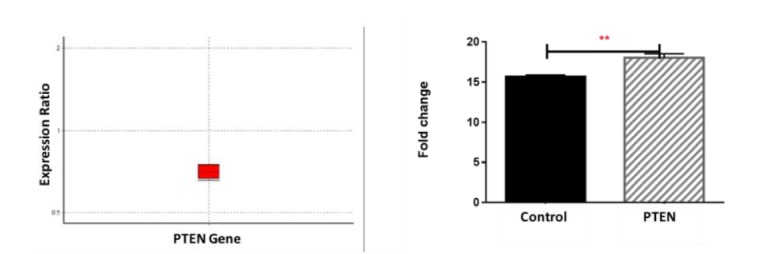
Results: Our findings reveal PTEN to be down-regulated by 30% in the blood samples of HS patients when compared to healthy controls. The MSP data showed the PTEN promoter region to be un-methylated in both patients and healthy individuals.
Conclusion: Since no differences in the methylation patterns of the PTEN gene was found between HS patients and controls, this suggests that DNA methylation of the PTEN promoter may not be a significant contributing epigenetic modification involved in the development HS. However, MSP may not be able to detect subtle changes in DNA methylation status. Thus, using an alternative high resolution technique may more accurately indicate differences in the PTEN promoter methylation status in HS patients.
Keywords: Hyperquagulable State; PTEN; Promoter methylation.
Figures
References
-
- Rak J, Joanne LY, Luyendyk J, Mackman N. Oncogenes, trousseau syndrome, and cancer-related changes in the coagulome of mice and humans. Cancer research. 2006;66(22):10643–6. - PubMed
-
- Rickles FR, Edwards RL. Activation of blood coagulation in cancer: Trousseau's syndrome revisited. Blood. 1983;62(1):14–31. - PubMed
-
- Joanne LY, May L, Lhotak V, Shahrzad S, Shirasawa S, Weitz JI, et al. Oncogenic events regulate tissue factor expression in colorectal cancer cells: implications for tumor progression and angiogenesis. Blood. 2005;105(4):1734–41. - PubMed
-
- Versteeg HH, Ruf W, editors. Emerging insights in tissue factor-dependent signaling events. Seminars in thrombosis and hemostasis. 2006 Copyright©2006 by Thieme Medical Publishers, Inc., 333 Seventh Avenue, New York, NY 10001, USA. - PubMed
LinkOut - more resources
Full Text Sources
Research Materials