


Desire for Continued Pessary Use Among Women of Hispanic and Non-Hispanic Ethnic Backgrounds for Pelvic Floor Disorders
- PMID: 30807423
- PMCID: PMC9969967
- DOI: 10.1097/SPV.0000000000000652
Desire for Continued Pessary Use Among Women of Hispanic and Non-Hispanic Ethnic Backgrounds for Pelvic Floor Disorders
Abstract
Objective: This study aimed to describe the association between patient ethnicity/race and desire to continue using a pessary for the treatment of pelvic floor disorders.
Methods: We performed a secondary analysis of a randomized trial among women presenting for pessary fitting. The primary outcome was the desire to continue using a pessary at 3 months. Bacterial vaginosis by Nugent score and vaginal symptoms (discharge, itching, pain, sores) were also evaluated. Logistic or multiple linear regression was performed with correction for body mass index, education level, parity, Charlson Comorbidity Index, and randomization to TrimoSan gel.
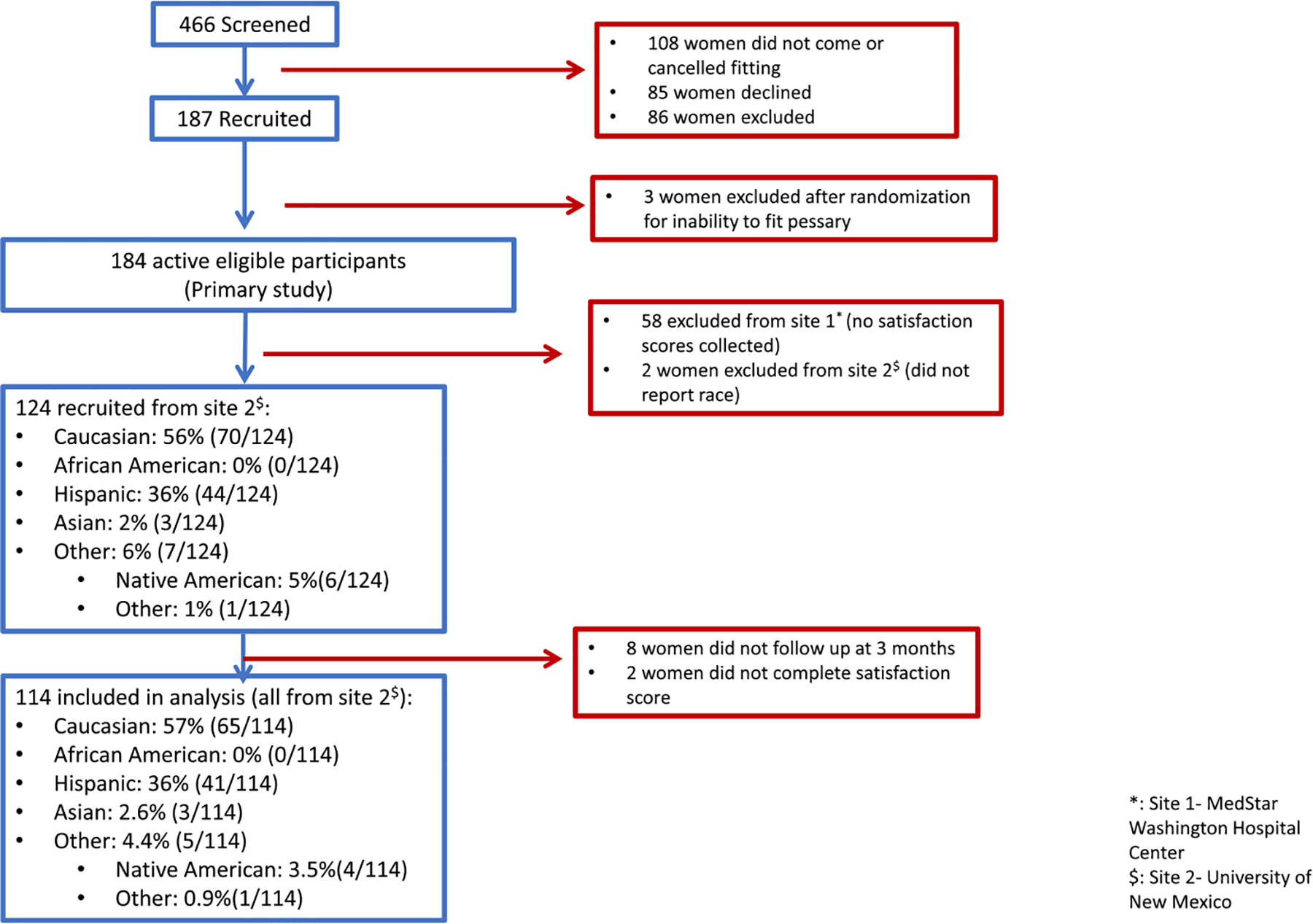
Results: One hundred fourteen women (41 Hispanic and 73 non-Hispanic) were eligible for this analysis. Women self-identified as white (65/114; 57%), Hispanic (41/114, 36%), Asian (3/114; 2.6%), Native American (4/114; 3.5%), and "other" (1/114, 0.9%) race, with no self-identified African American women (0/114) meeting the inclusion criteria. No significant difference in desire to continue pessary use was found between Hispanic and non-Hispanic women (58.5% vs 63%; P = 0.69; corrected odds ratio [cOR], 1.11; 95% confidence interval [CI], 0.43-2.90) or across races (P = 0.89). Hispanic women had significantly higher risk of bacterial vaginosis (34% vs 16%; P = 0.04; cOR, 2.91; 95% CI, 1.01-8.39), higher Nugent scores (5.4 ± 2.3 vs 4.3 ± 2.3; P = 0.02; corrected coefficient, 1.10; 95% CI, 0.10-2.10), and more vaginal pain (17.1% vs 2.8%; P = 0.01; cOR, 9.14; 95% CI, 1.37-61.17) at 3 months.
Conclusions: Despite increased vaginal pain and vaginal microbiome disturbances in Hispanic women using a pessary, no significant differences in the desire to continue using the pessary existed.
Trial registration: ClinicalTrials.gov NCT01471457.
Figures
References
-
- Patel M, Mellen C, O’Sullivan DM, et al. Impact of pessary use on prolapse symptoms, quality of life, and body image. Am J Obstet Gynecol 2010; 202(5):499.e491–499.e494. - PubMed
-
- Cheung RY, Lee JH, Lee LL, et al. Vaginal pessary in women with symptomatic pelvic organ prolapse: a randomized controlled trial. Obstet Gynecol 2016;128(1):73–80. - PubMed
-
- Cundiff GW, Weidner AC, Visco AG, et al. A survey of pessary use by members of the American urogynecologic society. Obstet Gynecol 2000; 95(6 Pt 1):931–935. - PubMed
Publication types
MeSH terms
Associated data
Grants and funding
LinkOut - more resources
Full Text Sources
Medical
