


Engineering the AAV capsid to evade immune responses
- PMID: 30807882
- PMCID: PMC7117822
- DOI: 10.1016/j.copbio.2019.01.002
Engineering the AAV capsid to evade immune responses
Abstract
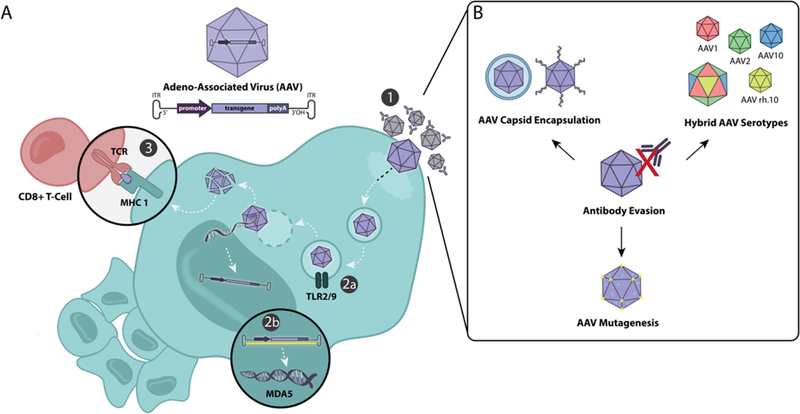
Gene therapy is progressively emerging as a promising and powerful therapeutic modality, and adeno-associated virus (AAV) is a major delivery vehicle for such therapies. Among the most significant challenges that limit AAV's utility, however, is the immune response it elicits. Antibodies elicited by prior exposure to natural virus or vector can bind to an AAV vector, preventing it from entering the cell. Furthermore, even if AAV manages to infect a target cell, these cells can then be attenuated by lymphocytes. Improvements in our understanding of how the immune system responds to AAV have guided engineering of the capsid to reduce those responses, yielding capsid variants that are much stealthier and more effective. This review summarizes recent advances in understanding the immune response to AAV as well as highlights engineering methods that enhance AAV's potential as a gene therapy vector.
Copyright © 2019. Published by Elsevier Ltd.
Figures
References
-
- O. of the Commissioner, “Press Announcements - FDA approves novel gene therapy to treat patients with a rare form of inherited vision loss.” [Online]. Available: https://www.fda.gov/newsevents/newsroom/pressannouncements/ucm589467.htm. [Accessed: 26-Jul-2018].
-
- Mendell JR et al. , “Single-Dose Gene-Replacement Therapy for Spinal Muscular Atrophy,” 10.1056/NEJMoa1706198, 01-Nov-2017 [Online]. Available: https://www.nejm.org/doi/10.1056/NEJMoa1706198?url_ver=Z39.88-2003&rfr_i.... [Accessed: 06-Sep-2018]. - DOI - PubMed
-
- Knipe DM and Howley PM, Fields’ Virology. Lippincott Williams & Wilkins, 2007.
Publication types
MeSH terms
Grants and funding
LinkOut - more resources
Full Text Sources
Other Literature Sources
