


Difference and relation between adolescents' and their parents or caregivers' reported oral health-related quality of life related to orthodontic treatment: a prospective cohort study
- PMID: 30808364
- PMCID: PMC6390370
- DOI: 10.1186/s12955-019-1094-0
Difference and relation between adolescents' and their parents or caregivers' reported oral health-related quality of life related to orthodontic treatment: a prospective cohort study
Abstract
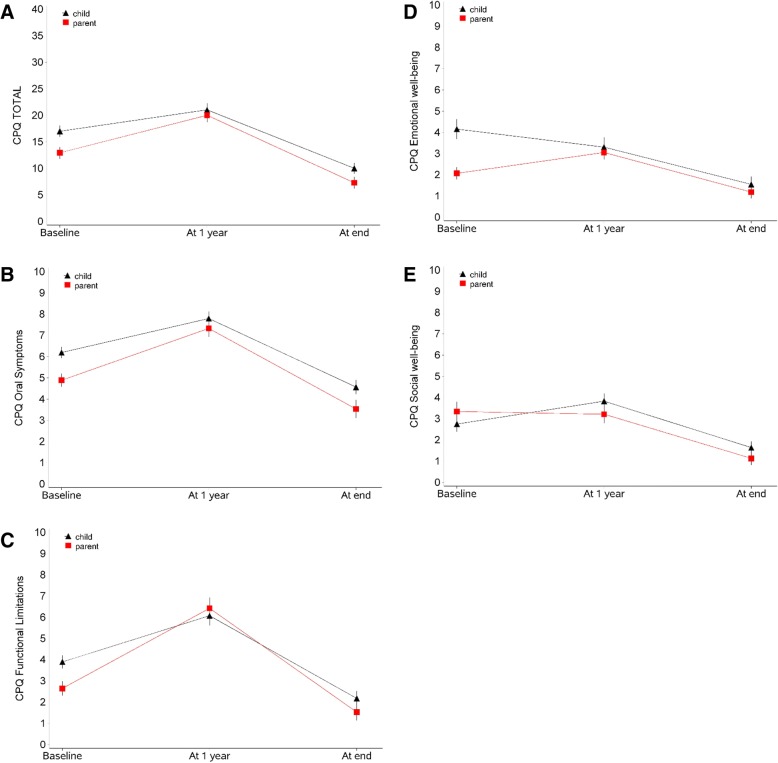
Background: Parents/caregivers play an important role in deciding whether their children will undergo orthodontic treatment or not. Their perceptions also have an influence on other choices involving orthodontic treatment. The purpose of this study was to investigate the difference and correlation between the ratings given by children and their parents or caregivers on their oral health-related quality of life (OHRQoL) before, during and after orthodontic treatment.
Methods: In this ongoing observational prospective cohort study, 498 children aged 11 to 16 years-old and one of their parents/caregivers completed questionnaires before (T0), 1 year after start (T1) and 1 month after the end of orthodontic treatment (T2). OHRQoL was scored by using the Child Perception Questionnaire (CPQ11-14) and the Parental-Caregiver Perception questionnaire (P-CPQ). The self-perception of oral aesthetics was evaluated with the Oral Aesthetic Subjective Impact Scale (OASIS) in addition to the aesthetic component (AC) of the Index of Orthodontic Treatment Need (IOTN). Spearman correlations, Mann-Whitney U-tests and linear models were used to analyze the longitudinal data.
Results: At T0, the ratings of parents/caregivers were significantly lower for the total CPQ as well as for the subdomains of oral symptoms, functional limitations and emotional well-being. Parents/caregivers also scored significantly lower at T2 for the total CPQ and the subdomain of oral symptoms. The relations between the scores of children and their parents/caregivers were significant at all three time points, as were the changes in scores, but all of them were at most moderate in size. Parents/caregivers scored significantly lower for OASIS than their children at all time points and only at baseline a significant, weak correlation was found.
Conclusion: The reports of parents/caregivers should be seen as important complementary information in OHRQoL research.
Trial registration: This study was approved by the Medical Ethical Commitee of the University Hospitals Leuven and the Katholieke Universiteit Leuven (ML5739), Leuven, Belgium, on the 12th of May of 2009, with the registration number S51642. All procedures performed are in accordance with the ethical standards of the institutional and/or national research committees and with the 1964 Declaration of Helsinki and its later amendments or comparable ethical standards.
Keywords: Adolescents; Oral health-related quality of life; Orthodontics; Parent-child agreement; Prospective cohort study.
Conflict of interest statement
Ethics approval and consent to participate
This study was approved by the medical ethical committee of the University Hospitals Leuven and the Katholieke Universiteit Leuven (ML5739), Leuven, Belgium, on 12 May of 2009 as S51642. All procedures performed are in accordance with the ethical standarts of the institutional and/or national research committee and with the 1964 Declaration of Helsinki and its later amendments or comparable ethical standards.
Consent for publication
An informed consent was obtained in written from all individual participants and their parents/caregivers included in the study prior to data collection.
Competing interests
The authors declare that they have no competing interests.
Publisher’s Note
Springer Nature remains neutral with regard to jurisdictional claims in published maps and institutional affiliations.
Figures
References
-
- Varni JW, Seid M, Kurtin PS. PedsQL™ 4.0: Reliability and Validity of the Pediatric Quality of Life Inventory™ Version 4.0 Generic Core Scales in Healthy and Patient Populations. Med Care. 2001;39:800–12. - PubMed
Publication types
MeSH terms
LinkOut - more resources
Full Text Sources
Medical
Miscellaneous
