Review
. 2019 Feb 26;7(1):31.
doi: 10.1186/s40168-019-0620-y.

A review of 10 years of human microbiome research activities at the US National Institutes of Health, Fiscal Years 2007-2016

Collaborators
Review

A review of 10 years of human microbiome research activities at the US National Institutes of Health, Fiscal Years 2007-2016

NIH Human Microbiome Portfolio Analysis Team. Microbiome. .

Abstract

The National Institutes of Health (NIH) is the primary federal government agency for biomedical research in the USA. NIH provides extensive support for human microbiome research with 21 of 27 NIH Institutes and Centers (ICs) currently funding this area through their extramural research programs. This analysis of the NIH extramural portfolio in human microbiome research briefly reviews the early history of this field at NIH, summarizes the program objectives and the resources developed in the recently completed 10-year (fiscal years 2007-2016) $215 M Human Microbiome Project (HMP) program, evaluates the scope and range of the $728 M NIH investment in extramural human microbiome research activities outside of the HMP over fiscal years 2012-2016, and highlights some specific areas of research which emerged from this investment. This analysis closes with a few comments on the technical needs and knowledge gaps which remain for this field to be able to advance over the next decade and for the outcomes of this research to be able to progress to microbiome-based interventions for treating disease and supporting health.

Keywords: Animal models; Fast Track Action Committee on Mapping the Microbiome (FTAC-MM); Human Microbiome Project (HMP); Human disease; Metagenomics; Microbiome; Microbiota; NIH funding; National Microbiome Initiative (NMI).


Conflict of interest statement

Competing interests

The authors declare that they have no competing interests. The views expressed in this manuscript are those of the authors and not of the NIH or HHS.

Publisher’s Note

Springer Nature remains neutral with regard to jurisdictional claims in published maps and institutional affiliations.

Figures
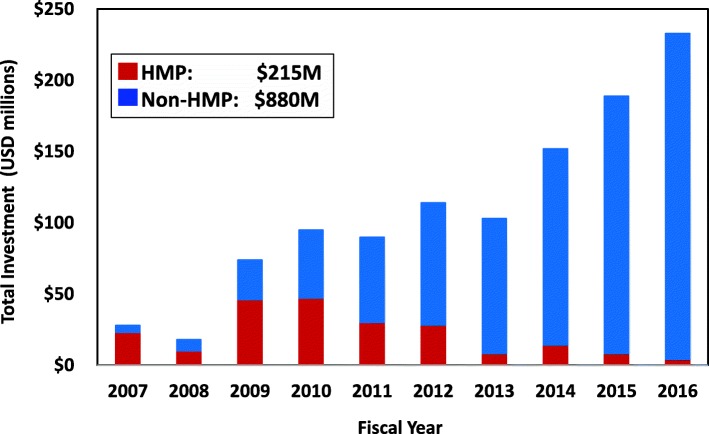
Fig. 1
Fig. 1
Annual NIH investment in human microbiome research, FY2007–2016. NIH investment for extramural human microbiome research support depicted as annual sums of all microbiome projects included in NHMPAG portfolio analysis; data for FY2007–2012 period taken from earlier portfolio analyses. The annual sum of HMP program projects shown separately from the annual sum of all non-HMP supported projects. Over FY2007–2016, the HMP awards totaled $215M and all non-HMP awards totaled $880M
Fig. 2
Fig. 2
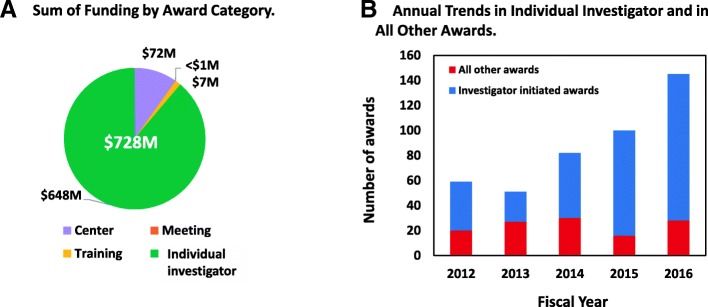
NIH human microbiome grant awards by award type, FY2012–2016. a Depicts the sum of all NIH microbiome grants over fiscal years 2012–2016, which totaled $728M. These awards were subdivided into the four award categories of individual investigator-initiated, center, training, and meeting grants. b Depicts annual trends in the number of individual investigator-initiated awards versus awards for all of the other award categories combined
Fig. 3
Fig. 3
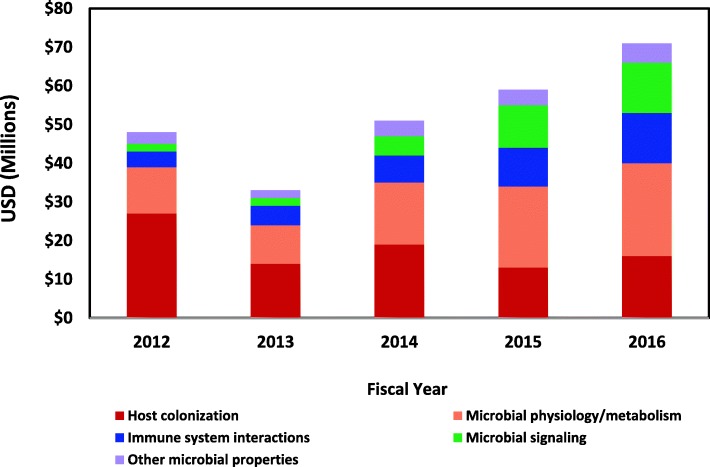
Annual trends in projects on the basic biology of and host/microbe interactions within the human microbiome, FY2012–2016. Annual trends in non-disease focused microbiome projects depicted; the sum of these projects over fiscal years 2012–2016 was $262M. These projects have been subdivided into four broad topics which included studies of microbial colonization of the host, physiology, and metabolism of microbial members of the microbiome, host immune system interactions with microbes, and microbial signaling between members of the microbiome and between host and microbe. Projects that focused on three additional broad topics of microbial properties were combined and depicted under “Other properties”
Fig. 4
Fig. 4
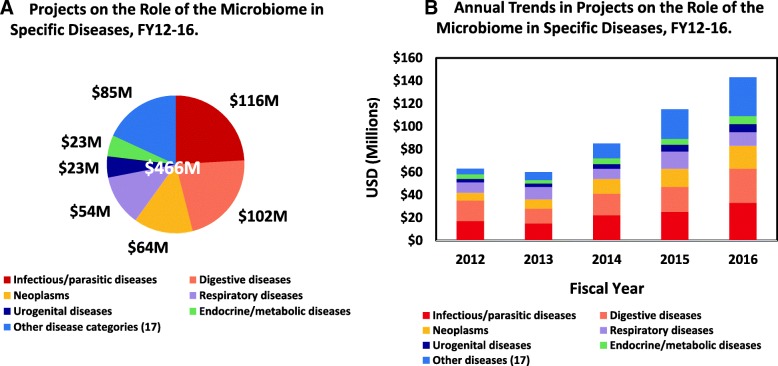
NIH projects on the role of the microbiome in specific diseases, FY2012–2016. a Depicts the sum of all disease-focused microbiome projects over fiscal years 2012–2016, which totaled $466M. These projects have been subdivided into six major ICD-10 chapter-level disease categories which included A00-B99 infectious/parasitic diseases, K00-K95 digestive diseases, C00-D49 neoplasms, J00-J99 respiratory diseases, N00-N99 genitourinary diseases, and E00-E89 endocrine/metabolic diseases. Projects that focused on 17 additional ICD-10 chapter disease categories were summed as “Other.” b Depicts annual trends in these disease-focused microbiome projects
Fig. 5
Fig. 5
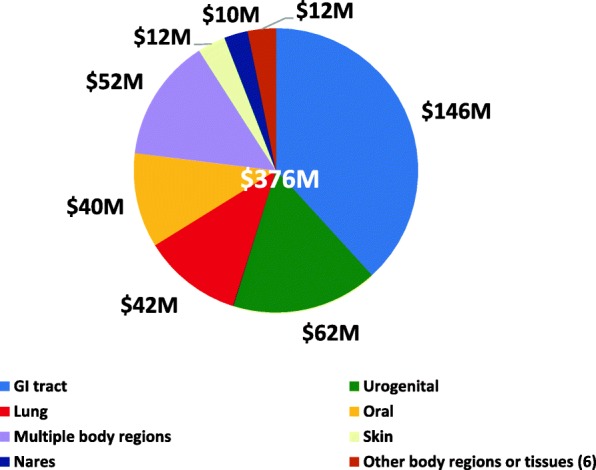
Body regions investigated in microbiome projects with human cohorts, FY2012–2016. This figure depicts human cohort studies of the microbiome, which totaled $376M over fiscal years 2012–2016. Six major body regions were investigated in these studies with human cohorts, and included gastrointestinal tract, urogenital tract, lung, oral, nares, and skin. Some cohort studies included the simultaneous study of multiple body regions and were noted as “Multiple body regions.” Those studies which focused on six additional body regions or tissues (blood, ear, eye, liver, cardiovascular system, central nervous system) were combined into ‘Other’
Fig. 6
Fig. 6
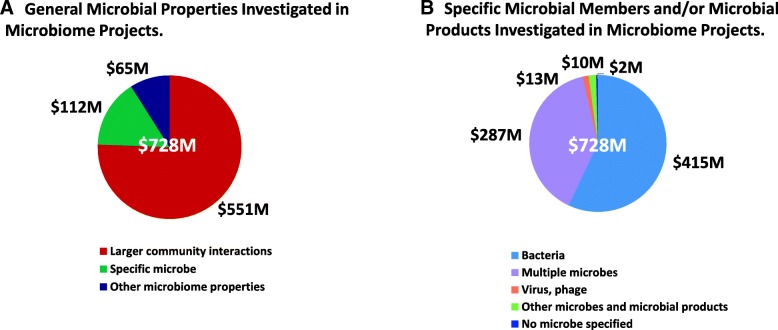
Microbial features investigated in the microbiome projects, FY2012–2016. a Depicts the general microbial properties investigated in the projects, which were subdivided into three broad categories of larger microbial community interactions, specific microbe-microbe interactions in the microbial community and other microbiome properties (i.e., microbe-microbe interactions, biofilms, microbial products). b Depicts the specific microbial member(s) of the microbiome and/or microbial products which were the primary focus of the projects. The four specific categories included bacteria, bacteriophage or eukaryotic virus, interactions between multiple members in the microbiome, and other microbes (i.e., archaea or fungi) and/or specific microbial products. Some projects did not specify a particular microbe in the study
Fig. 7
Fig. 7
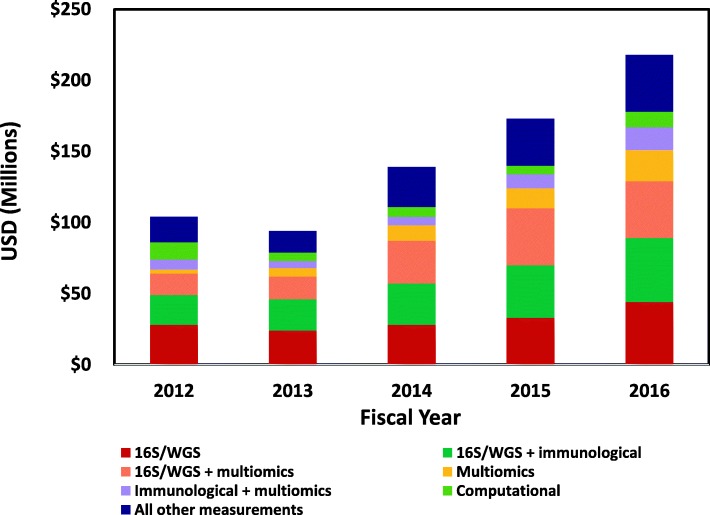
Annual trends in the types of microbiome and related data collected in projects, FY2012–2016. This figure depicts trends in the primary microbiome and related data collected in these projects. These data have been categorized into one of six main types and include data from 16S rRNA gene sequence analysis, data from 16S analysis combined with data from immunological analyses, data from 16S analysis combined with data from microbiome multiomic (e.g., transcriptomic, proteomic, metabolomic) analyses, data from microbiome multiomic analyses alone, and data from microbiome multiomic analyses combined with data from immunological analyses. Computational data included modeling outputs, and data from computational or statistical analyses of pre-existing data. All other data types were combined into “All other measurements”
Fig. 8
Fig. 8
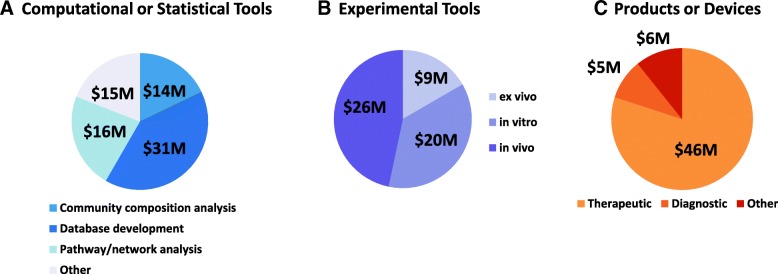
Technology development in the microbiome projects, FY2012–2016. This figure depicts the three main technology categories of computational/statistical tools, experimental tools and products/devices developed in the microbiome projects, which summed $188M over fiscal years 2012–2016. a Depicts computational/statistical tool development further subdivided into methods for microbial community composition analysis, microbial and microbial community metabolic pathway/network analysis and database development. Other computational analyses were combined under “Other.” b Depicts experimental tool development further subdivided into ex vivo, in vivo or in vitro tools. c Depicts product/device development further subdivided into therapeutic, diagnostic or other products/devices

References

    1. Paster BJ, Boches SK, Galvin JL, Ericson RE, Lau CN, Levanos A VA, et al. Bacterial diversity in human subgingival plaque. J. Bacteriol. 2001;183(12):3770–83. 10.1128/JB.183.12.3770-3783.2001 - PMC - PubMed
    1. Aas JA, Paster BJ, Stokes LN, Olsen I, Dewhirst FE. Defining the normal bacterial flora of the oral cavity. J. Clinical Microbiol. 2005;43(11):5721–32. 10.1128/JCM.43.11.5721-5732.2005 - PMC - PubMed
    1. Dewhirst FE, Chen T, Izard J, Paster BJ, Tanner ACR, Yu W, et al. The human oral microbiome. J. Bacteriol. 2010;192(19):5002–17. 10.1128/JB.00542-10 - PMC - PubMed
    1. Hooper LV, Falk PG, Gordon JI. Analyzing the molecular foundations of commensalism in the mouse intestine. Curr Opin Microbiol. 2000;3(1):79–85. doi: 10.1016/S1369-5274(99)00055-7. - DOI - PubMed
    1. Ley RE, Turnbaugh PJ, Klein S, Gordon JI. Microbial ecology: human gut microbes associated with obesity. Nature. 2006;444(7122):1022–3.10.1038/4441022a - PubMed

MeSH terms