


Disruption of poly (3-hydroxyalkanoate) depolymerase gene and overexpression of three poly (3-hydroxybutyrate) biosynthetic genes improve poly (3-hydroxybutyrate) production from nitrogen rich medium by Rhodobacter sphaeroides
- PMID: 30808422
- PMCID: PMC6390342
- DOI: 10.1186/s12934-019-1088-y
Disruption of poly (3-hydroxyalkanoate) depolymerase gene and overexpression of three poly (3-hydroxybutyrate) biosynthetic genes improve poly (3-hydroxybutyrate) production from nitrogen rich medium by Rhodobacter sphaeroides
Abstract
Background: Due to various environmental problems, biodegradable polymers such as poly (3-hydroxybutyrate) (PHB) have gained much attention in recent years. Purple non-sulfur (PNS) bacteria have various attractive characteristics useful for environmentally harmless PHB production. However, production of PHB by PNS bacteria using genetic engineering has never been reported. This study is the first report of a genetically engineered PNS bacterial strain with a high PHB production.
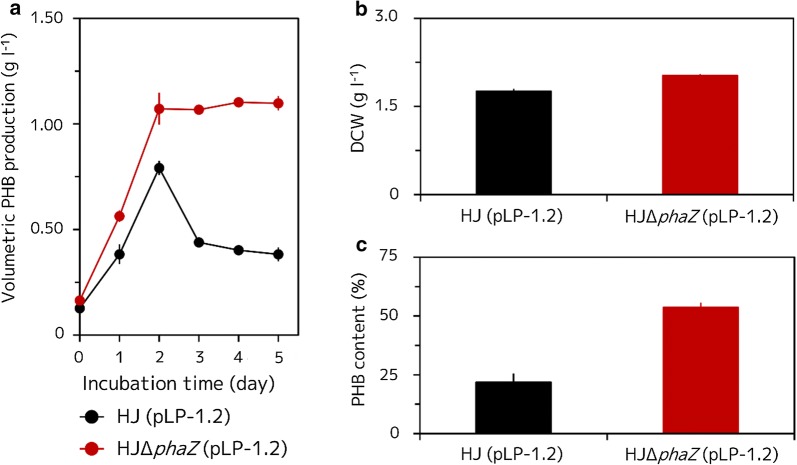
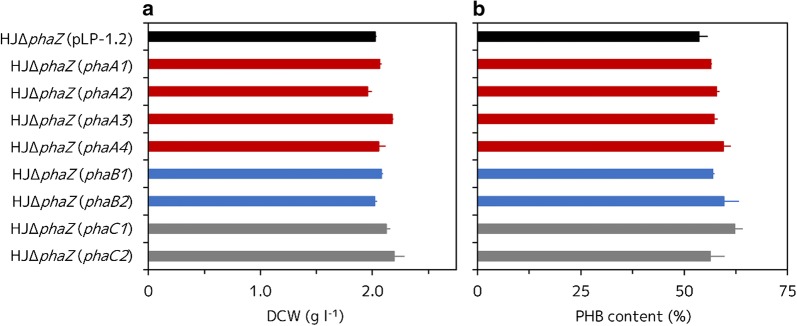
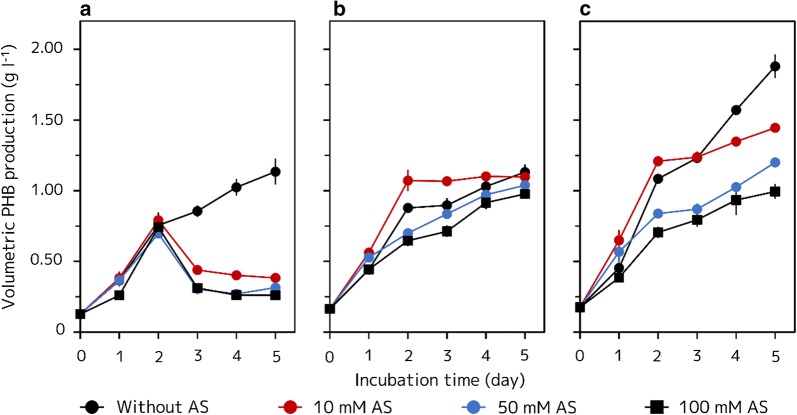
Results: We constructed a poly (3-hydroxyalkanoate) depolymerase (phaZ) gene-disrupted Rhodobacter sphaeroides HJ strain. This R. sphaeroides HJΔphaZ (pLP-1.2) strain showed about 2.9-fold higher volumetric PHB production than that of the parent HJ (pLP-1.2) strain after 5 days of culture. The HJΔphaZ strain was further improved for PHB production by constructing strains overexpressing each of the eight genes including those newly found and annotated as PHB biosynthesis genes in the KEGG GENES Database. Among these constructed strains, all of gene products exhibited annotated enzyme activities in the recombinant strain cells, and HJΔphaZ (phaA3), HJΔphaZ (phaB2), and HJΔphaZ (phaC1) showed about 1.1-, 1.1-, and 1.2-fold higher volumetric PHB production than that of the parent HJΔphaZ (pLP-1.2) strain. Furthermore, we constructed a strain that simultaneously overexpresses all three phaA3, phaB2, and phaC1 genes; this HJΔphaZ (phaA3/phaB2/phaC1) strain showed about 1.7- to 3.9-fold higher volumetric PHB production (without ammonium sulfate; 1.88 ± 0.08 g l-1 and with 100 mM ammonium sulfate; 0.99 ± 0.05 g l-1) than those of the parent HJ (pLP-1.2) strain grown under nitrogen limited and rich conditions, respectively.
Conclusion: In this study, we identified eight different genes involved in PHB biosynthesis in the genome of R. sphaeroides 2.4.1, and revealed that their overexpression increased PHB accumulation in an R. sphaeroides HJ strain. In addition, we demonstrated the effectiveness of a phaZ disruption for high PHB accumulation, especially under nitrogen rich conditions. Furthermore, we showed that PNS bacteria may have some unidentified genes involved in poly (3-hydroxyalkanoates) (PHA) biosynthesis. Our findings could lead to further improvement of environmentally harmless PHA production techniques using PNS bacteria.
Keywords: Acetoacetyl-CoA reductase; Acetyl-CoA acetyltransferase; Poly (3-hydroxyalkanoate) depolymerase; Poly (3-hydroxyalkanoate) polymerase; Poly (3-hydroxyalkanoates); Poly (3-hydroxybutyrate); Rhodobacter sphaeroides.
Figures



References
-
- Hazer DB, Kılıçay E, Hazer B. Poly(3-hydroxyalkanoate)s: diversification and biomedical applications: a state of the art review. Mater Sci Eng C. 2012;32:637–647. doi: 10.1016/j.msec.2012.01.021. - DOI
-
- Preusting H, van Houten R, Hoefs A, van Langenberghe EK, Favre-Bulle O, Witholt B. High cell density cultivation of Pseudomonas oleovorans: growth and production of poly (3-hydroxyalkanoates) in two-liquid phase batch and fed-batch systems. Biotechnol Bioeng. 1993;41:550–556. doi: 10.1002/bit.260410507. - DOI - PubMed
MeSH terms
Substances
Grants and funding
LinkOut - more resources
Full Text Sources
Other Literature Sources
Research Materials
