Checks and Balances in Bacterial Cell Division
- PMID: 30808703
- PMCID: PMC6391918
- DOI: 10.1128/mBio.00149-19
Checks and Balances in Bacterial Cell Division
Erratum in
-
Erratum for den Blaauwen and Luirink, "Checks and Balances in Bacterial Cell Division".mBio. 2019 Apr 16;10(2):e00615-19. doi: 10.1128/mBio.00615-19. mBio. 2019. PMID: 30992356 Free PMC article. No abstract available.
Abstract
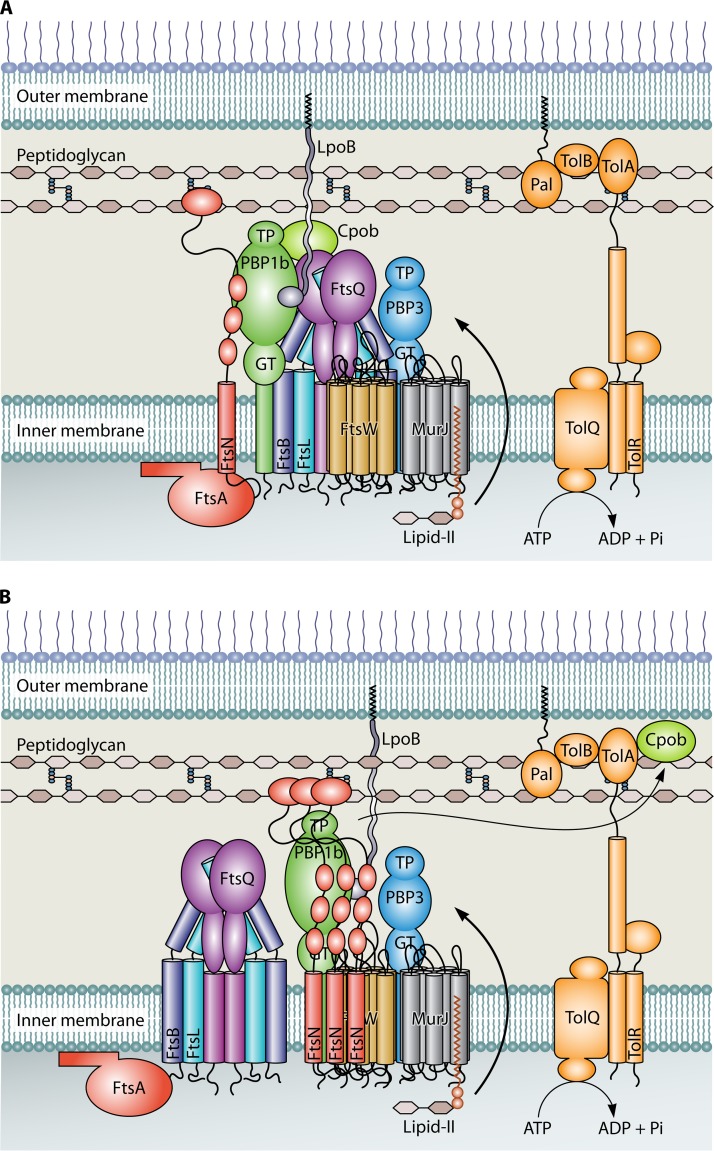
Assembly of the division machinery in Gram-negative and Gram-positive bacteria occurs in two time-dependent steps. First, the FtsZ proto-ring localizes at midcell including some FtsN molecules. Subsequently, the proteins that catalyze and regulate septal peptidoglycan (PG) synthesis are recruited including among others, the FtsBLQ-PB1B-FtsW-PBP3 complex. Further accumulation of FtsN finally allows initiation of cell division. It was known that FtsA and FtsQLB somehow prevented this initiation. Recently, A. Boes, S. Olatunji, E. Breukink, and M. Terrak (mBio 10:e01912-18, 2019, https://doi.org/10.1128/mBio.01912-18) reported that this is caused by inhibition of the activity of the PG synthases by FtsBLQ, which has to be outcompeted by accumulation of the PBP1b activating FtsN. This supports a central structural as well as regulatory role for the FtsBLQ protein complex that is conserved only in prokaryotes, making it an attractive target for antibiotic development.
Keywords: Escherichia coli; cell division; divisome; peptidoglycan.
Copyright © 2019 den Blaauwen and Luirink.
Figures
Comment on
-
Regulation of the Peptidoglycan Polymerase Activity of PBP1b by Antagonist Actions of the Core Divisome Proteins FtsBLQ and FtsN.mBio. 2019 Jan 8;10(1):e01912-18. doi: 10.1128/mBio.01912-18. mBio. 2019. PMID: 30622193 Free PMC article.
References
Publication types
MeSH terms
Substances
LinkOut - more resources
Full Text Sources
Molecular Biology Databases