


Bio-psychosocial factors of children and adolescents with internet gaming disorder: a systematic review
- PMID: 30809270
- PMCID: PMC6374886
- DOI: 10.1186/s13030-019-0144-5
Bio-psychosocial factors of children and adolescents with internet gaming disorder: a systematic review
Abstract
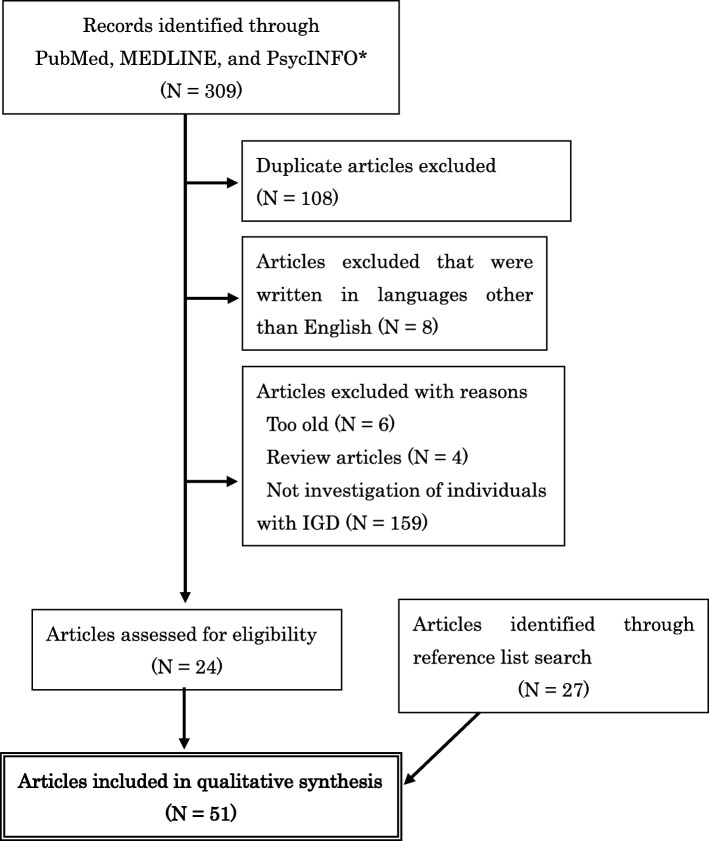
Previous large-scale studies suggest that internet gaming disorder (IGD) among children and adolescents has become an important public concern. Minors are known to be particularly susceptible to problematic internet gaming use owing to age-related underdevelopment of cognitive control. It has been shown that precursors of addictions appear during adolescence; therefore, prevention efforts must be established targeting minors who have their first experience with addictive substances and behaviors during pubescence. Since the DSM-5 classification of IGD in 2013, studies on IGD have drastically increased in number. Thus, we performed an updated review of studies of IGD in children and adolescents to assess the clinical implications of IGD. The search included all publication years, using PubMed, MEDLINE, and PsycINFO. Across studies, the presence of IGD had a negative effect on sleep and schoolwork in minors. Additionally, family factors, including the quality of parent-child relationships, were important social factors in minors with IGD. Brain imaging studies indicate that impaired cognitive control in minors with IGD is associated with abnormal function in the prefrontal cortex and striatum. Persistent pathological online game use from childhood may aggravate abnormal brain function; therefore, preventive care and early intervention are increasingly important. Although extant research supports the effectiveness of cognitive behavioral therapy for minors with IGD, effective psychological intervention for minors with IGD is an urgent issue that requires further research. This review, which presents updated findings of IGD in minors, is expected to contribute to the development of future research and be useful in clinical practice in the field of child and adolescent psychiatry.
Keywords: Adolescents; Children; Internet gaming disorder.
Conflict of interest statement
Not applicable.Not applicable.The authors declare that they have no competing interests.Springer Nature remains neutral with regard to jurisdictional claims in published maps and institutional affiliations.
Figures
References
-
- American Psychiatric Association . Diagnostic and Statistical Manual of Mental Disorders: DSM-5. Washington, DC: American Psychiatric Association; 2013.
-
- Young K. Internet addiction: the emergence of a new clinical disorder. CyberPsychol. Behav. 1998;1:237–244. doi: 10.1089/cpb.1998.1.237. - DOI
Publication types
LinkOut - more resources
Full Text Sources
