


Reversible homolytic activation of water via metal-ligand cooperativity in a T-shaped Ni(ii) complex
- PMID: 30809351
- PMCID: PMC6354739
- DOI: 10.1039/c8sc03719a
Reversible homolytic activation of water via metal-ligand cooperativity in a T-shaped Ni(ii) complex
Abstract
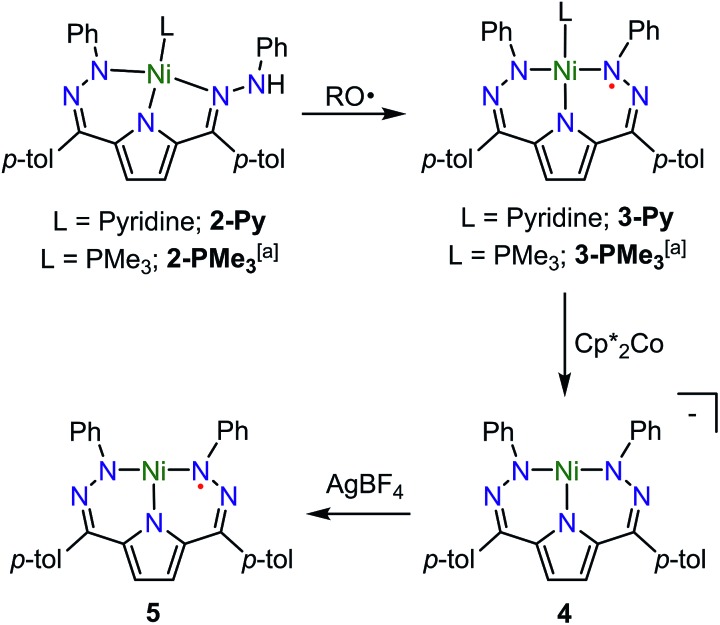
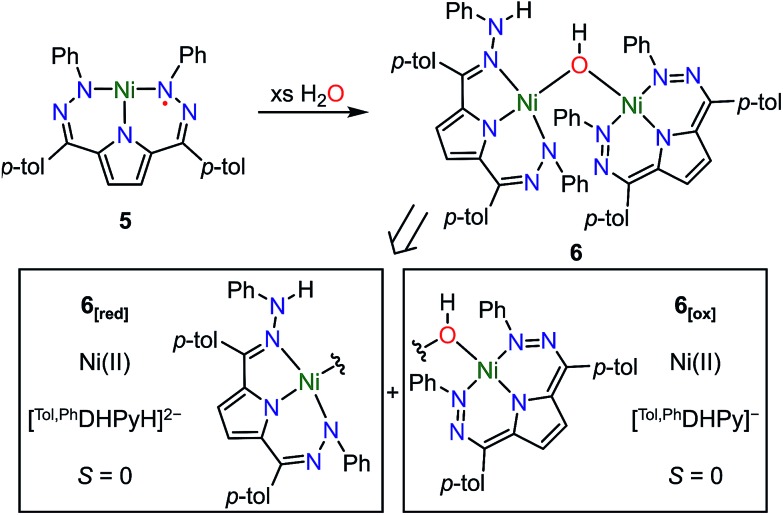
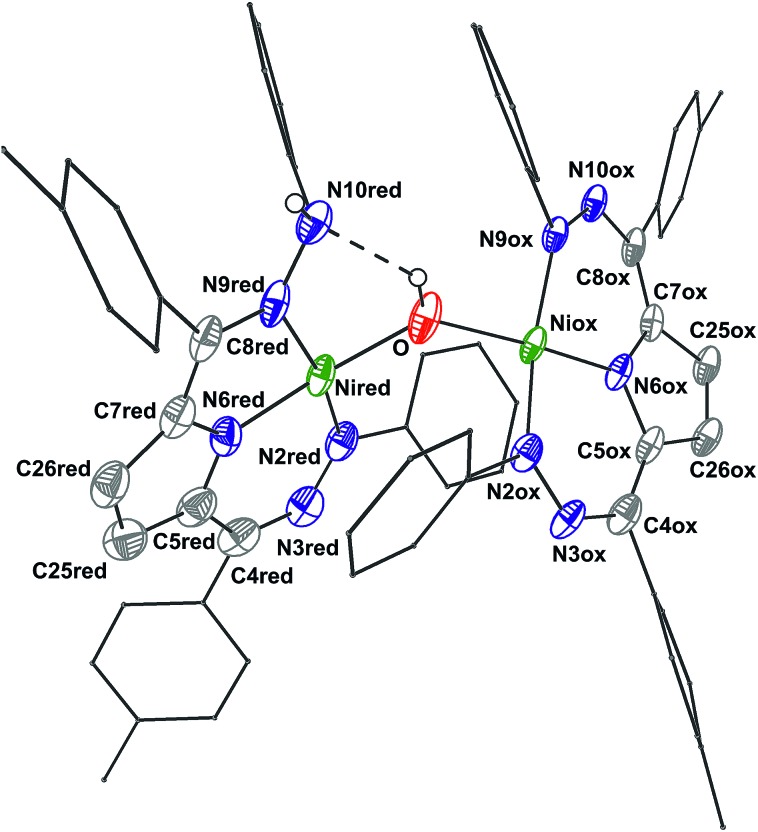
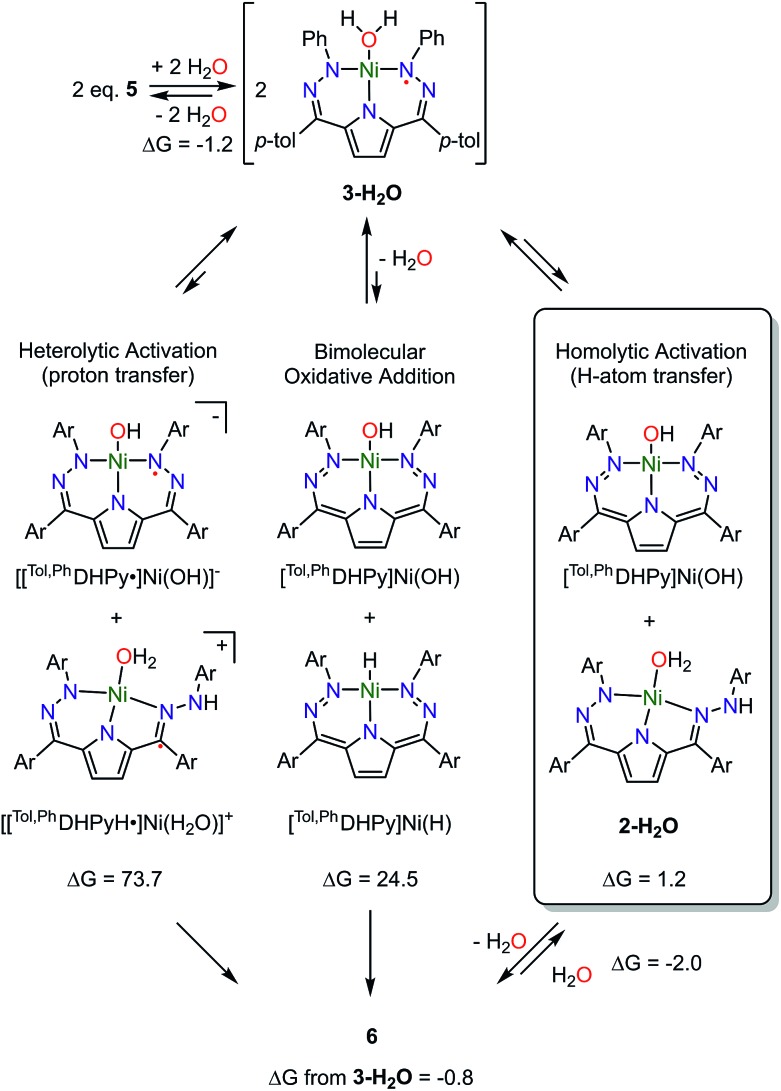
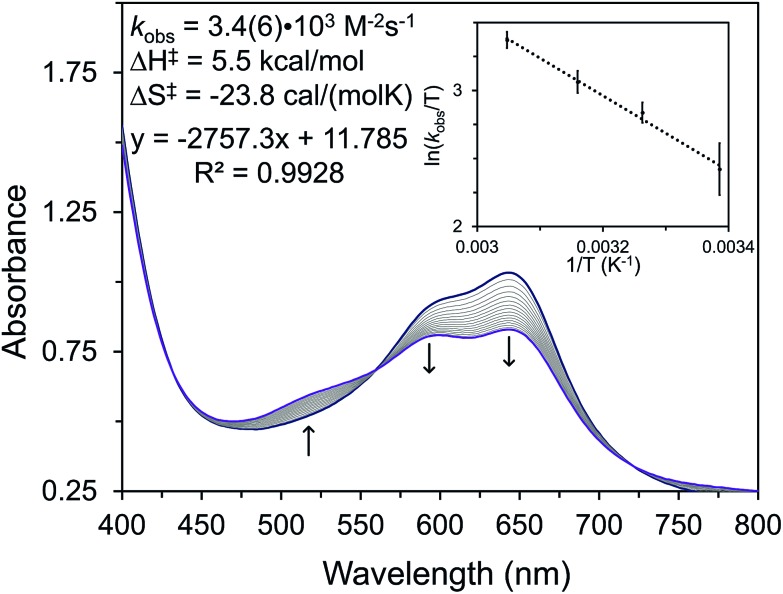
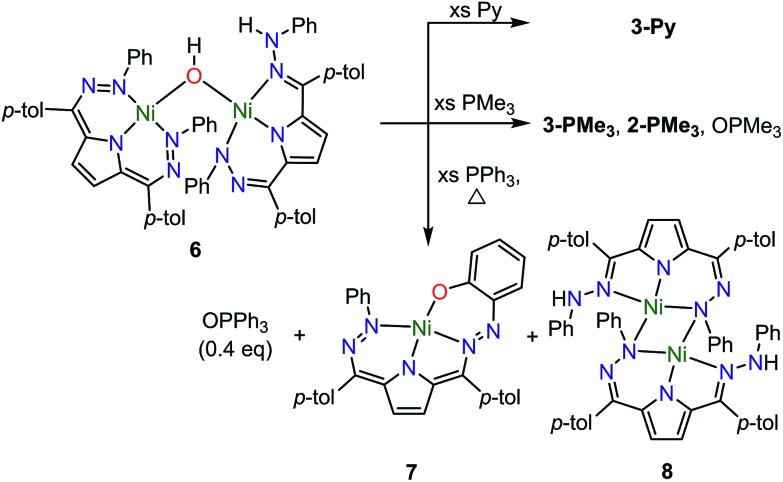
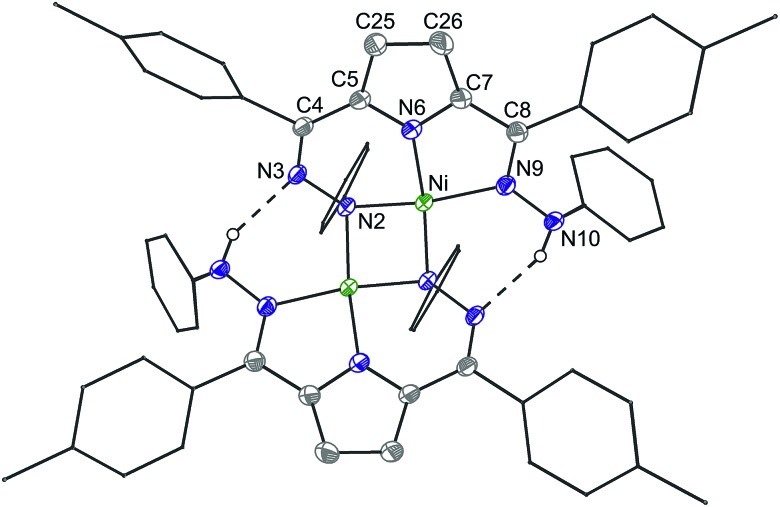
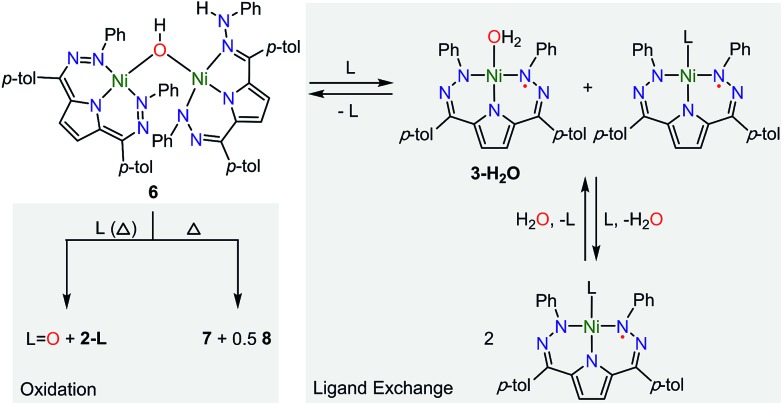
A T-shaped Ni(ii) complex [Tol,PhDHPy]Ni has been prepared and characterized. EPR spectra and DFT calculations of this complex suggest that the electronic structure is best described as a high-spin Ni(ii) center antiferromagnetically coupled with a ligand-based radical. This complex reacts with water at room temperature to generate the dimeric complex [Tol,PhDHPy]Ni(μ-OH)Ni[Tol,PhDHPyH] which has been thoroughly characterized by SXRD, NMR, IR and deuterium-labeling experiments. Addition of simple ligands such as phosphines or pyridine displaces water and demonstrates the reversibility of water activation in this system. The water activation step has been examined by kinetic studies and DFT calculations which suggest an unusual homolytic reaction via a bimetallic mechanism. The ΔH ‡, ΔS ‡ and KIE (k H/k D) of the reaction are 5.5 kcal mol-1, -23.8 cal mol-1 K-1, and 2.4(1), respectively. In addition to the reversibility of water addition, this system is capable of activating water towards net O-atom transfer to substrates such as aromatic C-H bonds and phosphines. This reactivity is facilitated by the ability of the dihydrazonopyrrole ligand to accept H-atoms and illustrates the utility of metal ligand cooperation in activating O-H bonds with high bond dissociation energies.
Figures

References
-
- Stanley G. G., Aubry D. A., Bridges N., Barker B., Courtney B. Prepr. Pap.–Am. Chem. Soc., Div. Fuel Chem. 2004;49:712–713.
- Navarro R. M., Peña M. A., Fierro J. L. G. Chem. Rev. 2007;107:3952–3991. - PubMed
- Hintermann L., Labonne A. Synthesis. 2007;2007:1121–1150.
- Nising C. F., Bräse S. Chem. Soc. Rev. 2008;37:1218. - PubMed
- Walter M. G., Warren E. L., McKone J. R., Boettcher S. W., Mi Q., Santori E. A., Lewis N. S. Chem. Rev. 2010;110:6446–6473. - PubMed
- Brewster T. P., Ou W. C., Tran J. C., Goldberg K. I., Hanson S. K., Cundari T. R., Heinekey D. M. ACS Catal. 2014;4:3034–3038.
- Brewster T. P., Goldberg J. M., Tran J. C., Heinekey D. M., Goldberg K. I. ACS Catal. 2016;6:6302–6305.
-
-
For some examples featuring ligand protonation see:
- Gunanathan C., Milstein D. Chem. Rev. 2014;114:12024–12087. - PubMed
- Comanescu C. C., Iluc V. M. Organometallics. 2014;33:6059–6064.
- Tseng K.-N. T., Kampf J. W., Szymczak N. K. ACS Catal. 2015;5:5468–5485.
- Tondreau A. M., Michalczyk R., Boncella J. M. Organometallics. 2017;36:4179–4183.
- Comanescu C. C., Iluc V. M. Polyhedron. 2018;143:176–183.
- Kosanovich A. J., Shih W.-C., Ozerov O. V. Inorg. Chem. 2018;57:545–547. - PubMed
-
-
- Luo Y.-R., Handbook of Bond Dissociation Energies in Organic Compounds, CRC Press, 2002.
-
- Hillhouse G. L., Bercaw J. E. J. Am. Chem. Soc. 1984;106:5472–5478.
- Burn M. J., Fickes M. G., Hartwig J. F., Hollander F. J., Bergman R. G. J. Am. Chem. Soc. 1993;115:5875–5876.
- Blum O., Milstein D. J. Am. Chem. Soc. 2002;124:11456–11467. - PubMed
- Fafard C. M., Adhikari D., Foxman B. M., Mindiola D. J., Ozerov O. V. J. Am. Chem. Soc. 2007;129:10318–10319. - PubMed
- Ozerov O. V. Chem. Soc. Rev. 2009;38:83–88. - PubMed
- Piers W. E. Organometallics. 2011;30:13–16.
- McCarthy S. M., Lin Y.-C., Devarajan D., Chang J. W., Yennawar H. P., Rioux R. M., Ess D. H., Radosevich A. T. J. Am. Chem. Soc. 2014;136:4640–4650. - PubMed
- Robinson T. P., De Rosa D. M., Aldridge S., Goicoechea J. M. Angew. Chem., Int. Ed. 2015;54:13758–13763. - PMC - PubMed
-
- Jonas R. T., Stack T. D. P. J. Am. Chem. Soc. 2002;124:83–96. - PubMed
- Roth J. P., Mayer J. M. Inorg. Chem. 1999;38:2760–2761. - PubMed
- Hoover J. M., Ryland B. L., Stahl S. S. J. Am. Chem. Soc. 2013;135:2357–2367. - PMC - PubMed
- Estes D. P., Grills D. C., Norton J. R. J. Am. Chem. Soc. 2014;136:17362–17365. - PubMed
- Tarantino K. T., Miller D. C., Callon T. A., Knowles R. R. J. Am. Chem. Soc. 2015;137:6440–6443. - PMC - PubMed
- Bezdek M. J., Guo S., Chirik P. J. Science. 2016;354:730–733. - PubMed
- Bhattacharya P., Heiden Z. M., Wiedner E. S., Raugei S., Piro N. A., Kassel W. S., Bullock R. M., Mock M. T. J. Am. Chem. Soc. 2017;139:2916–2919. - PubMed
- Bezdek M. J., Chirik P. J. Angew. Chem., Int. Ed. 2018;130:2246–2250.
LinkOut - more resources
Full Text Sources
Research Materials
