Lower rotational inertia and larger leg muscles indicate more rapid turns in tyrannosaurids than in other large theropods
- PMID: 30809441
- PMCID: PMC6387760
- DOI: 10.7717/peerj.6432
Lower rotational inertia and larger leg muscles indicate more rapid turns in tyrannosaurids than in other large theropods
Abstract
Synopsis: Tyrannosaurid dinosaurs had large preserved leg muscle attachments and low rotational inertia relative to their body mass, indicating that they could turn more quickly than other large theropods.
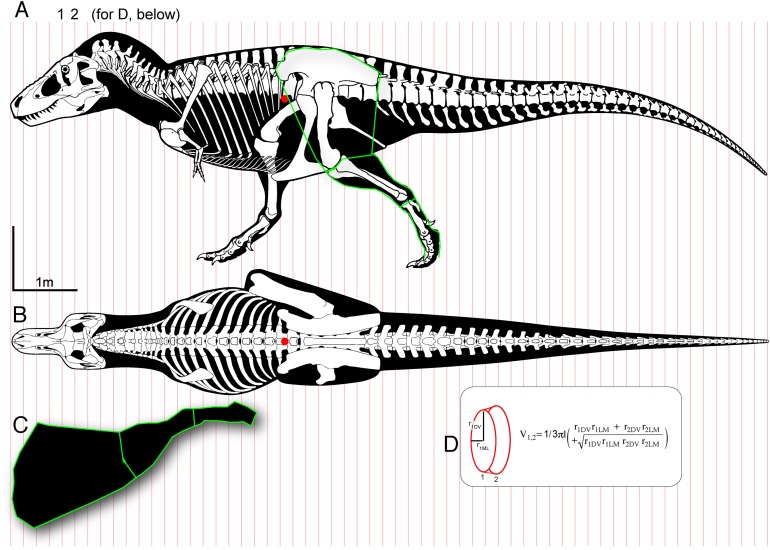
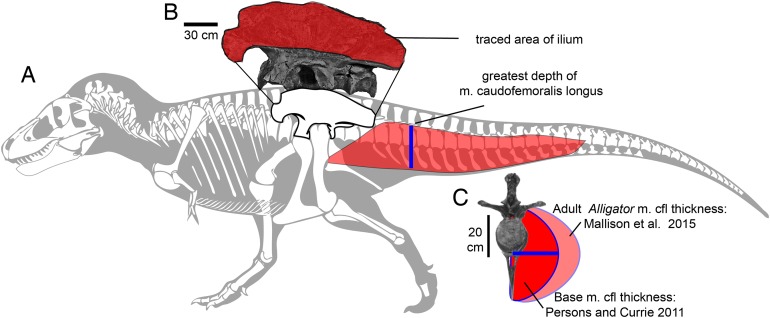
Methods: To compare turning capability in theropods, we regressed agility estimates against body mass, incorporating superellipse-based modeled mass, centers of mass, and rotational inertia (mass moment of inertia). Muscle force relative to body mass is a direct correlate of agility in humans, and torque gives potential angular acceleration. Agility scores therefore include rotational inertia values divided by proxies for (1) muscle force (ilium area and estimates of m. caudofemoralis longus cross-section), and (2) musculoskeletal torque. Phylogenetic ANCOVA (phylANCOVA) allow assessment of differences in agility between tyrannosaurids and non-tyrannosaurid theropods (accounting for both ontogeny and phylogeny). We applied conditional error probabilities a(p) to stringently test the null hypothesis of equal agility.
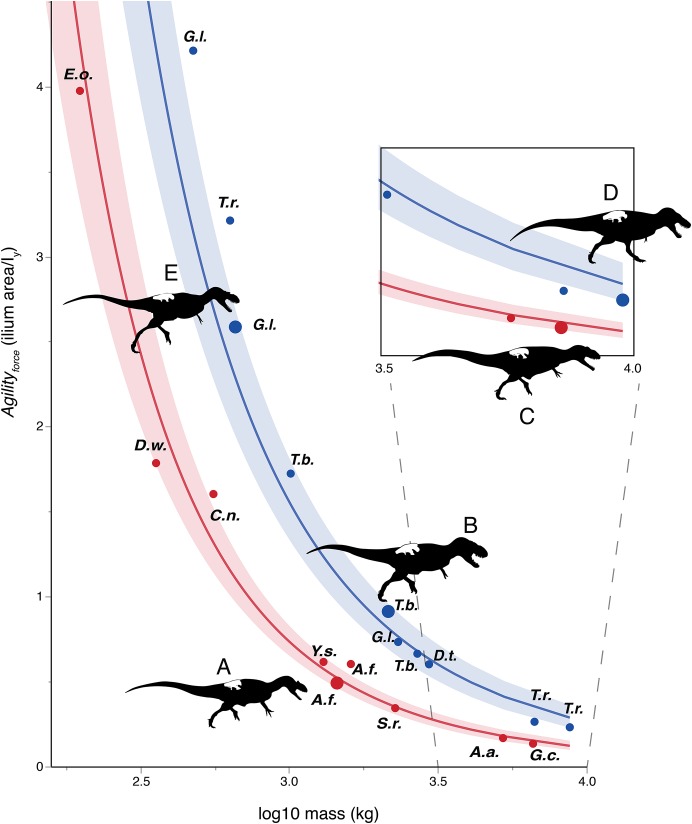
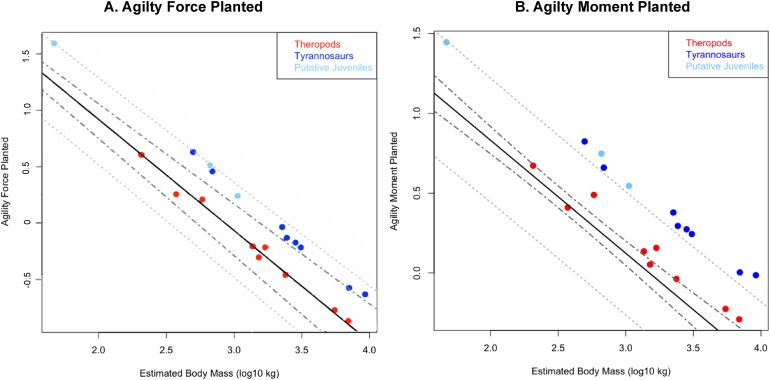
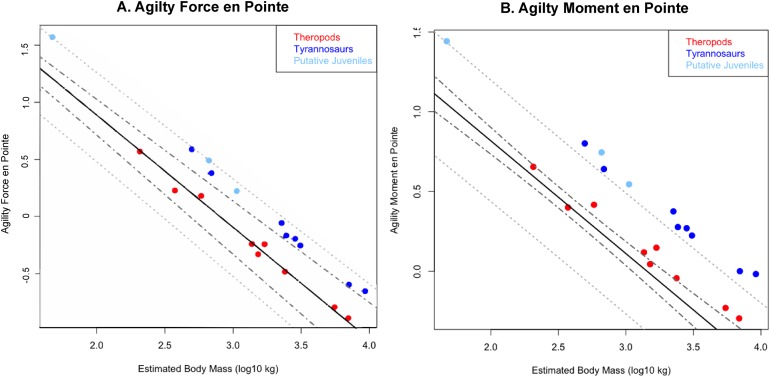
Results: Tyrannosaurids consistently have agility index magnitudes twice those of allosauroids and some other theropods of equivalent mass, turning the body with both legs planted or pivoting over a stance leg. PhylANCOVA demonstrates definitively greater agilities in tyrannosaurids, and phylogeny explains nearly all covariance. Mass property results are consistent with those of other studies based on skeletal mounts, and between different figure-based methods (our main mathematical slicing procedures, lofted 3D computer models, and simplified graphical double integration).
Implications: The capacity for relatively rapid turns in tyrannosaurids is ecologically intriguing in light of their monopolization of large (>400 kg), toothed dinosaurian predator niches in their habitats.
Keywords: Agility; Biomechanics; Phylogenetic ANCOVA; Predation; Theropoda; Tyrannosauridae.
Conflict of interest statement
The authors declare that they have no competing interests.
Figures
References
-
- Allen V, Paxton H, Hutchinson JR. Variation in center of mass estimates for extant sauropsids and its importance for reconstructing inertial properties of extinct archosaurs. Anatomical Record: Advances in Integrative Anatomy and Evolutionary Biology. 2009;292(9):1442–1461. doi: 10.1002/ar.20973. - DOI - PubMed
-
- Anderson MA, Gieck JH, Perrin D, Weltman A, Rutt R, Denegar C. The relationships among isometric, isotonic, and isokinetic concentric and eccentric quadriceps and hamstring force and three components of athletic performance. Journal of Orthopaedic & Sports Physical Therapy. 1991;14(3):114–120. doi: 10.2519/jospt.1991.14.3.114. - DOI - PubMed
LinkOut - more resources
Full Text Sources