Spontaneous low-frequency fluctuations in the neural system for emotional perception in major psychiatric disorders: amplitude similarities and differences across frequency bands
- PMID: 30810024
- PMCID: PMC6397038
- DOI: 10.1503/jpn.170226
Spontaneous low-frequency fluctuations in the neural system for emotional perception in major psychiatric disorders: amplitude similarities and differences across frequency bands
Abstract
Background: Growing evidence indicates both shared and distinct features of emotional perception in schizophrenia, bipolar disorder and major depressive disorder. In these disorders, alterations in spontaneous low-frequency fluctuations have been reported in the neural system for emotional perception, but the similarities and differences in the amplitude of low-frequency fluctuation (ALFF) across the 3 disorders are unknown.
Methods: We compared ALFF and its signal balance in the neural system for emotional perception at 2 frequency bands (slow-5 and slow-4) in 119 participants with schizophrenia, 100 with bipolar disorder, 123 with major depressive disorder and 183 healthy controls. We performed exploratory Pearson partial correlation analyses to determine the relationship between ALFF signal balance and clinical variables.
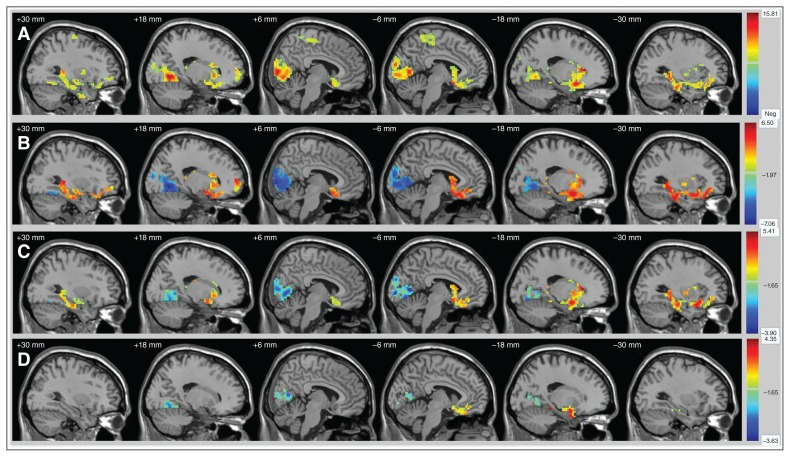
Results: We observed commonalities in ALFF change patterns across the 3 disorders for emotional perception neural substrates, such as increased ALFF in the anterior cerebrum (including subcortical, limbic, paralimbic and heteromodal cortical regions) and decreased ALFF in the posterior visual cortices. Schizophrenia, bipolar disorder and major depressive disorder showed significantly decreased ALFF signal balance in the neural system for emotional perception at both slow-5 and slow-4 frequency bands, with the greatest alterations for schizophrenia, followed by bipolar disorder and major depressive disorder. We found a negative correlation between ALFF signal balance and negative/disorganized symptoms in slow-4 across the 3 disorders.
Limitations: The relatively broad age range in our sample and the cross-sectional study design may not account for our findings.
Conclusion: The extent of the commonalities we observed further support the concept of core neurobiological disruptions shared among the 3 disorders; ALFF signal balance could be an important neuroimaging marker for the diagnosis and treatment of schizophrenia, bipolar disorder and major depressive disorder.
© 2019 Joule Inc. or its licensors
Conflict of interest statement
None declared.
Figures


References
-
- Kraepelin E. Manifestation of insanity. Z Gesamte Neurol Psychiatr. 1920;62:1–29.
-
- American Psychiatric Association. Diagnostic and statistical manual of mental disorders. 1st ed. Washington (DC): APA; 1952.
-
- American Psychiatric Association. Diagnostic and statistical manual of mental disorders. 5th ed. Washington (DC): APA; 2013.
Publication types
MeSH terms
LinkOut - more resources
Full Text Sources
Medical