


Perceived stress and sickness absence: a prospective study of 17,795 employees in Denmark
- PMID: 30810815
- PMCID: PMC6609587
- DOI: 10.1007/s00420-019-01420-9
Perceived stress and sickness absence: a prospective study of 17,795 employees in Denmark
Abstract
Objectives: The aims were to examine (1) the prospective association between perceived stress and sickness absence, and if this association (2) differed by sex, and (3) was stronger when only long-term sickness absence (≥ 31 days) instead of all-length sickness absence (≥ 1 day) was included. Moreover, different cut-points for the length of the sickness absence periods were applied.
Methods: We followed respondents (10,634 women and 7161 men) from the 'Work Environment and Health in Denmark' 2014-survey for up to 18 months in the 'Register of Work Absences' from Statistics Denmark. Perceived stress was measured by a single question: "In the last 2 weeks, how often have you felt stressed?" We used Cox-regression with repeated events, adjusted for age, sector, education, and previous sickness absence.
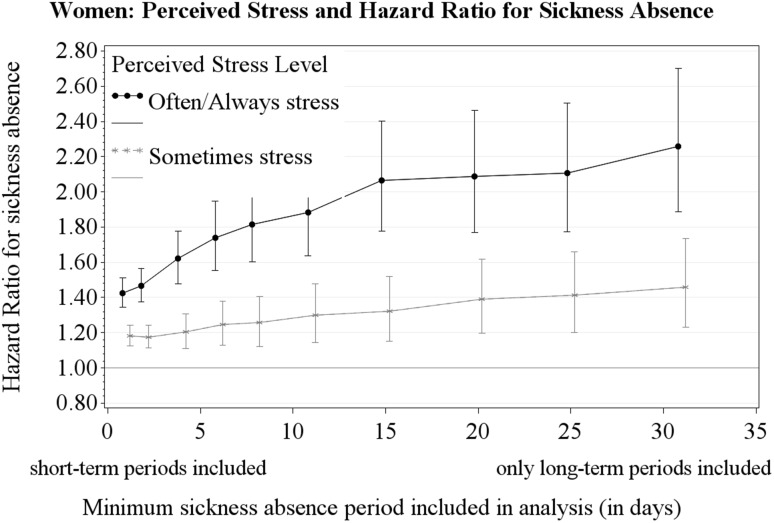
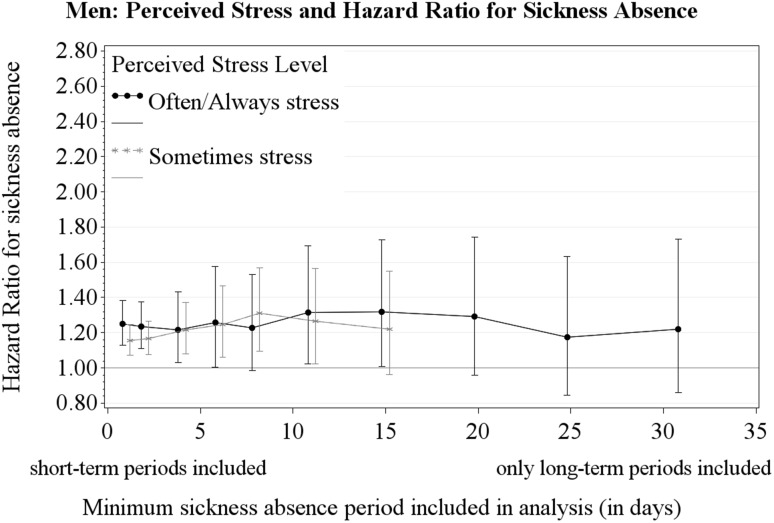
Results: The hazard ratio (HR) for all-length sickness absence (≥ 1 day) for "Often/Always" stress compared to "Seldom/Never" stress was statistically significant among both men (HR = 1.25 [1.13-1.38]) and women (HR = 1.43 [1.34-1.51]). The HR was statistically significant for women (HR = 2.26 [1.89-2.70]), but not for men (HR = 1.22 [0.86-1.73]), when the analyses were restricted to long-term sickness absence (≥ 31 days). The sex-difference was statistically significant. Additional analyses with cut-points at ≥ 2, ≥ 4, ≥ 6, ≥ 8, ≥ 11, ≥ 15, ≥ 20, and ≥ 25 sickness absence days showed that among women, the HR increased gradually with increasing lengths of the sickness absence periods.
Conclusions: The prospective association of perceived stress with risk of sickness absence was stronger among women than men. Among women, perceived stress was more strongly associated with long-term sickness absence than with all-length sickness absence.
Keywords: Long-term sickness absence; Sex difference; Short-term sickness absence; Stress reaction; Stress symptom.
Figures
References
-
- Afifi M. Gender differences in mental health. Singap Med J. 2007;48:385–391. - PubMed
MeSH terms
Grants and funding
LinkOut - more resources
Full Text Sources
Medical
