


The melanocortin pathway and control of appetite-progress and therapeutic implications
- PMID: 30812013
- PMCID: PMC6500576
- DOI: 10.1530/JOE-18-0596
The melanocortin pathway and control of appetite-progress and therapeutic implications
Abstract
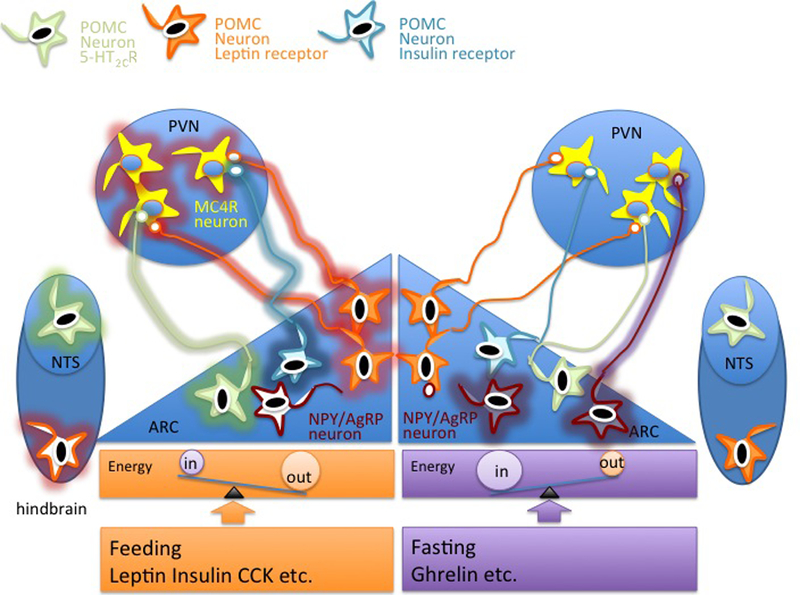
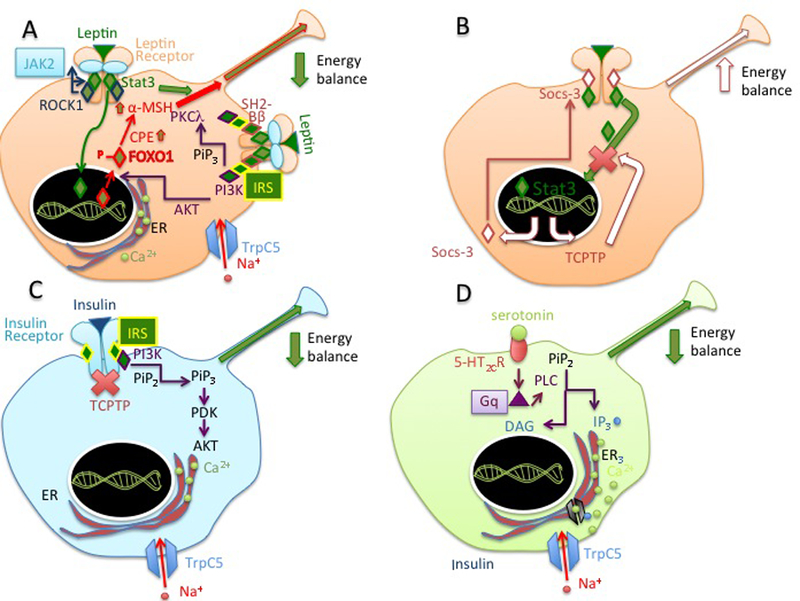
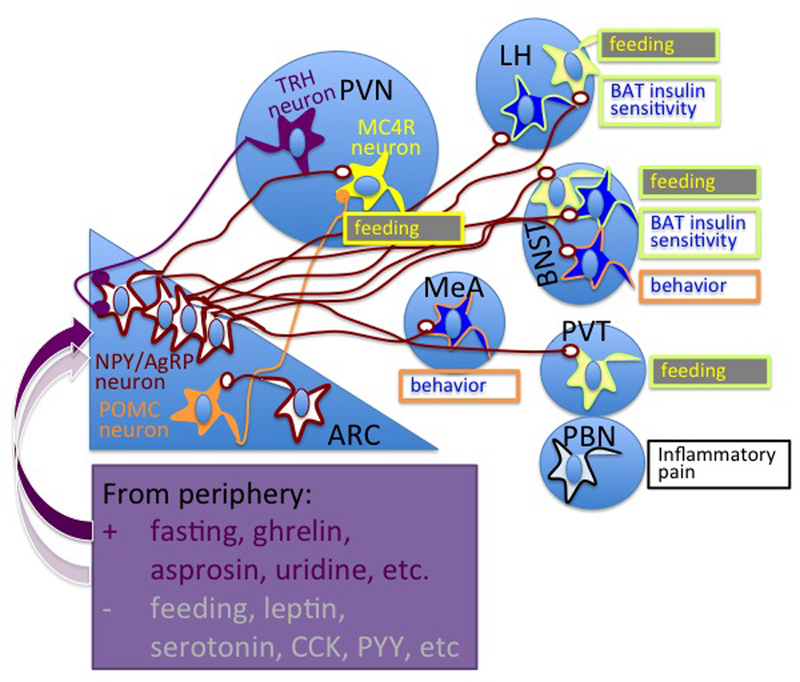
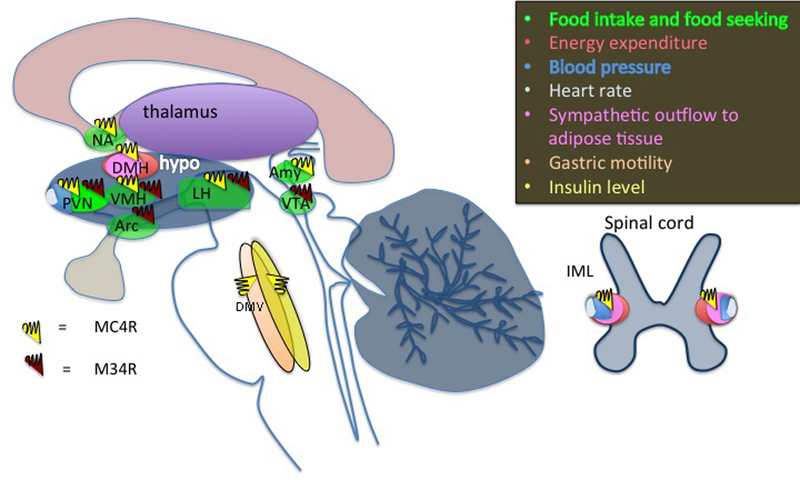
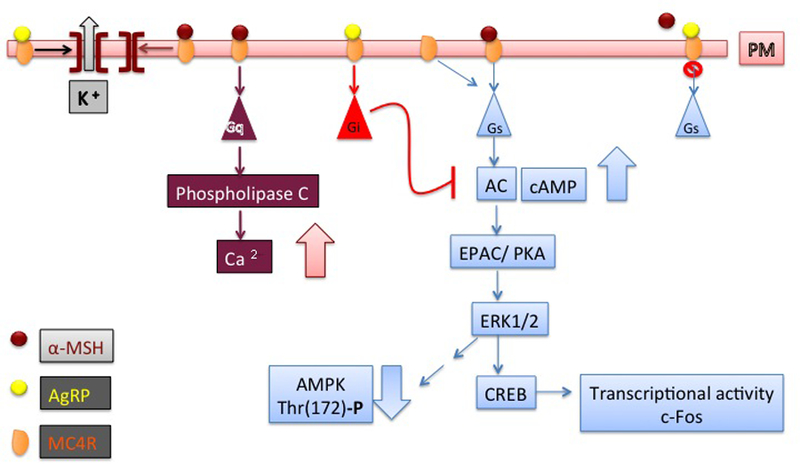
The initial discovery that ob/ob mice become obese because of a recessive mutation of the leptin gene has been crucial to discover the melanocortin pathway to control appetite. In the melanocortin pathway, the fed state is signaled by abundance of circulating hormones such as leptin and insulin, which bind to receptors expressed at the surface of pro-opiomelanocortin (POMC) neurons to promote processing of POMC to the mature hormone α-melanocyte-stimulating hormone (α-MSH). The α-MSH released by POMC neurons then signals to decrease energy intake by binding to melanocortin-4 receptor (MC4R) expressed by MC4R neurons to the paraventricular nucleus (PVN). Conversely, in the 'starved state' activity of agouti-related neuropeptide (AgRP) and of neuropeptide Y (NPY)-expressing neurons is increased by decreased levels of circulating leptin and insulin and by the orexigenic hormone ghrelin to promote food intake. This initial understanding of the melanocortin pathway has recently been implemented by the description of the complex neuronal circuit that controls the activity of POMC, AgRP/NPY and MC4R neurons and downstream signaling by these neurons. This review summarizes the progress done on the melanocortin pathway and describes how obesity alters this pathway to disrupt energy homeostasis. We also describe progress on how leptin and insulin receptors signal in POMC neurons, how MC4R signals and how altered expression and traffic of MC4R change the acute signaling and desensitization properties of the receptor. We also describe how the discovery of the melanocortin pathway has led to the use of melanocortin agonists to treat obesity derived from genetic disorders.
Keywords: AgRP; MC4R; appetite; hypothalamus; leptin; melanocortin.
Conflict of interest statement
Declaration of interest
Authors have no conflicts of interest to disclose.
Figures
References
-
- Adan RAH, Szklarczyk AW, Oosterom J, Brakkee JH, Nijenhuis WAJ, Schaaper WMM, Meloen RH & Gispen WH 1999. Characterization of melanocortin receptor ligands on cloned brain melanocortin receptors and on grooming behavior in the rat. European Journal of Pharmacology 378 249–258. - PubMed
-
- Agosti F, Cordisco Gonzalez S, Martinez Damonte V, Tolosa MJ, Di Siervi N, Schioth HB, Davio C, Perello M & Raingo J 2017. Melanocortin 4 receptor constitutive activity inhibits L-type voltage-gated calcium channels in neurons. Neuroscience 346 102–112. - PubMed
-
- Agosti F, Soto EJL, Cabral A, Castrogiovanni D, Schioth HB, Perello M & Raingo J 2014. Melanocortin 4 receptor activation inhibits presynaptic N-type calcium channels in amygdaloid complex neurons. European Journal of Neuroscience 40 2755–2765. - PubMed
-
- Al-Obeidi F, Castrucci AM, Hadley ME & Hruby VJ 1989a. Potent and prolonged acting cyclic lactam analogues of alpha-melanotropin: design based on molecular dynamics. Journal of Medicinal Chemistry 32 2555–2561. - PubMed
Publication types
MeSH terms
Substances
Grants and funding
LinkOut - more resources
Full Text Sources
Miscellaneous
