. 2019 Feb 27;9(1):2952.
doi: 10.1038/s41598-019-39367-z.

Association between Thalamocortical Functional Connectivity Abnormalities and Cognitive Deficits in Schizophrenia

Affiliations

Association between Thalamocortical Functional Connectivity Abnormalities and Cognitive Deficits in Schizophrenia

Pinhong Chen et al. Sci Rep. .

Abstract

Cognitive deficits are considered a core component of schizophrenia and may predict functional outcome. However, the neural underpinnings of neuropsychological impairment remain to be fully elucidated. Data of 59 schizophrenia patients and 72 healthy controls from a public resting-state fMRI database was employed in our study. Measurement and Treatment Research to Improve Cognition in Schizophrenia (MATRICS) Battery was used to measure deficits of cognitive abilities in schizophrenia. Neural correlates of cognitive deficits in schizophrenia were examined by linear regression analysis of the thalamocortical network activity with scores of seven cognitive domains. We confirmed the combination of reduced prefrontal-thalamic connectivity and increased sensorimotor-thalamic connectivity in patients with schizophrenia. Correlation analysis with cognition revealed that in schizophrenia (1) the thalamic functional connectivity in the bilateral pre- and postcentral gyri was negatively correlated with attention/vigilance and speed of processing (Pearson's r ≤ -0.443, p ≤ 0.042, FWE corrected), and positively correlated with patients' negative symptoms (Pearson's r ≥ 0.375, p ≤ 0.003, FWE corrected); (2) the thalamic functional connectivity in the right cerebellum was positively correlated with speed of processing (Pearson's r = 0.388, p = 0.01, FWE corrected). Our study demonstrates that thalamic hyperconnectivity with sensorimotor areas is related to the severity of cognitive deficits and clinical symptoms, and extends our understanding of the neural underpinnings of "cognitive dysmetria" in schizophrenia.


Conflict of interest statement

The authors declare no competing interests.

Figures
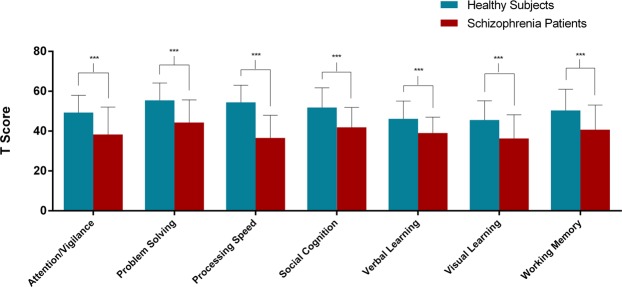
Figure 1
Figure 1
Significantly decreased MATRICS performance in schizophrenia group compared to control group. The results suggested that patients exhibited significantly lower scores on all the cognitive domains of MATRICS. ***Indicates p < 0.001. Error bars represent standard deviation.
Figure 2
Figure 2
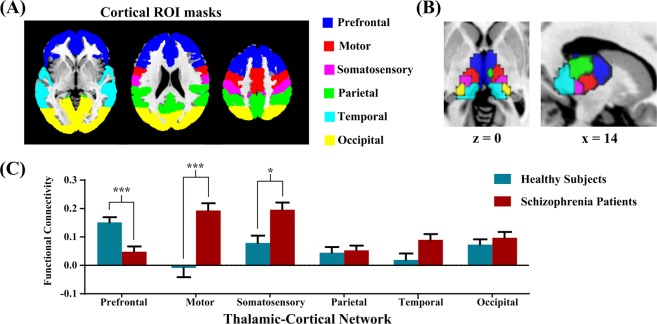
Thalamo-cortical functional connectivity in schizophrenia and healthy subjects. (A) Six cortical ROI masks were overlaid onto the standard MNI brain. (B) Functional thalamic subdivision was created using the winner-takes-all strategy, in which each thalamic voxel was labelled according to the cortical ROI with the highest connectivity strength. (C) Significantly altered thalamocortical connectivity in schizophrenia patients compared to healthy subjects. The patient group showed decreased PFC-thalamic functional connectivity and increased motor-thalamic and somatosensory-thalamic connectivity. *Indicates p < 0.05 and ***Indicates p < 0.001. Error bars represent standard error.
Figure 3
Figure 3
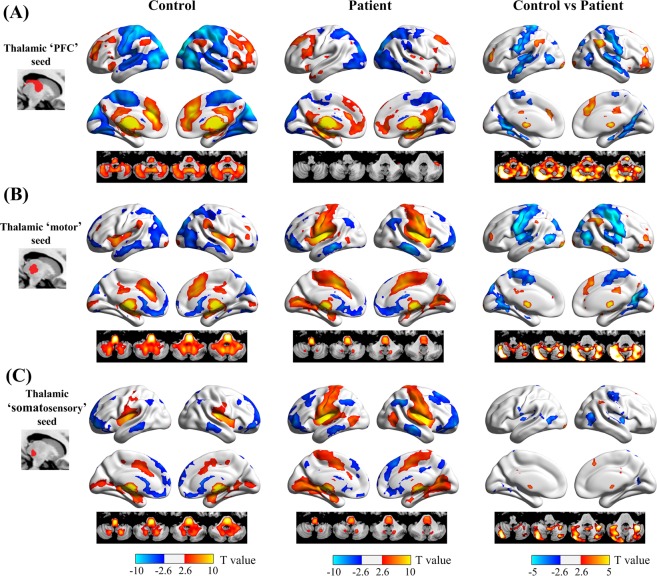
Functional dysconnectivity of the PFC, motor, and somatosensory thalamus seeds in schizophrenia. For the thalamic PFC (A) and motor (B) seeds, patients with schizophrenia showed reduced functional connectivity with the dorsolateral PFC, dorsal anterior cingulate cortex, inferior parietal lobule, and cerebellum (warm colors), and increased functional connectivity with the pre- and postcentral gyri, superior and middle temporal gyri, lateral and medial occipital regions (cold colors), relative to healthy subjects. In contrast, functional connectivity of the thalamus somatosensory seed (C) was mainly restricted to the postcentral gyrus and lateral occipital region.
Figure 4
Figure 4
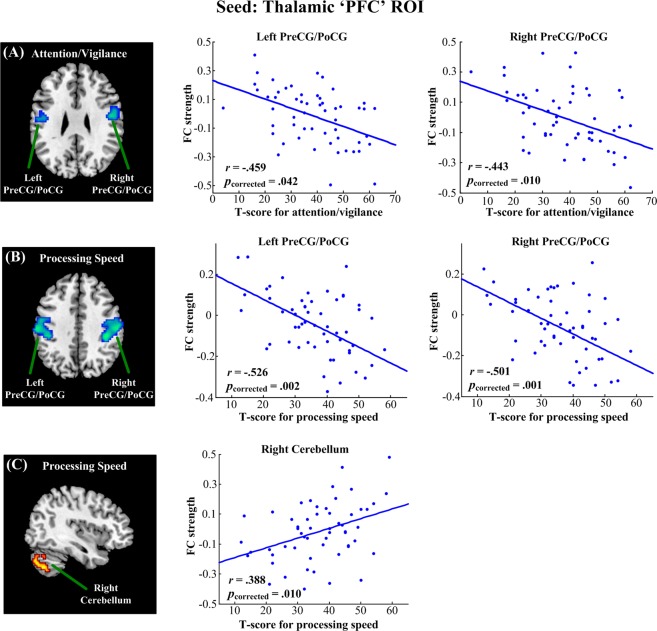
Linear regression analysis between the functional connectivity of the thalamic ‘PFC’ ROI and MATRICS domain scores in schizophrenia. Attention/vigilance was negatively correlated with functional connectivity in the bilateral PreCG/PoCG (A); speed of processing was positively correlated with functional connectivity in the right cerebellum (B) and negatively correlated with functional connectivity in the bilateral PreCG/PoCG (C). All results were thresholded at p < 0.05, corrected for multiple comparisons with family wise error (FWE). PreCG, precentral gyrus; PoCG, postcentral gyrus.
Figure 5
Figure 5
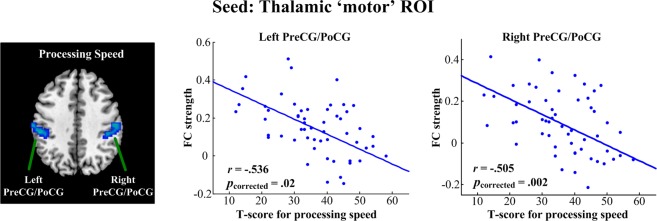
Linear regression analysis between the functional connectivity of thalamic ‘motor’ ROI and MATRICS domain scores in schizophrenia. Speed of processing was negatively correlated with functional connectivity in the PreCG/PoCG. All results were thresholded at p < 0.05, corrected for multiple comparisons with family wise error (FWE). PreCG, precentral gyrus; PoCG, postcentral gyrus.
Figure 6
Figure 6
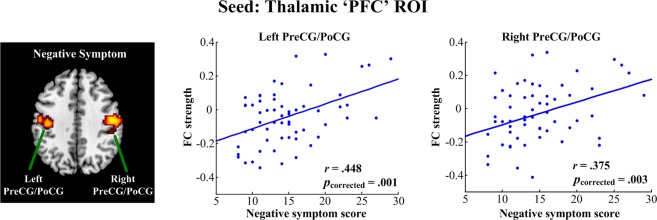
Linear regression analysis between the functional connectivity of the thalamic ‘PFC’ ROI and symptoms in schizophrenia. Patients’ negative symptoms were positively correlated with functional connectivity in the PreCG/PoCG. All results were thresholded at p < 0.05, corrected for multiple comparisons with family wise error (FWE). PreCG, precentral gyrus; PoCG, postcentral gyrus.

References

    1. Kitchen H, Rofail D, Heron L, Sacco P. Cognitive impairment associated with schizophrenia: a review of the humanistic burden. Advances in Therapy. 2012;29:148–162. doi: 10.1007/s12325-012-0001-4. - DOI - PubMed
    1. Keefe, R. S. The longitudinal course of cognitive impairment in schizophrenia: an examination of data from premorbid through posttreatment phases of illness. The Journal of clinical psychiatry.10.4088/JCP.13065su1.02, 75 (Suppl 2), 8–13 (2014). - PubMed
    1. Hoff AL, et al. Longitudinal neuropsychological follow-up study of patients with first-episode schizophrenia. Am J Psychiatry. 1999;156:1336–1341. - PubMed
    1. Keefe RSE, et al. Baseline Neurocognitive Deficits in the CATIE Schizophrenia Trial. Neuropsychopharmacology. 2006;31:2033–2046. doi: 10.1038/sj.npp.1301072. - DOI - PubMed
    1. Saykin AJ, et al. Neuropsychological deficits in neuroleptic naive patients with first-episode schizophrenia. Arch Gen Psychiatry. 1994;51:124–131. doi: 10.1001/archpsyc.1994.03950020048005. - DOI - PubMed

Publication types