


Serum Homocysteine and Behavioral and Psychological Symptoms of Dementia: Is There Any Correlation in Alzheimer's Disease?
- PMID: 30814822
- PMCID: PMC6388428
- DOI: 10.1159/000487068
Serum Homocysteine and Behavioral and Psychological Symptoms of Dementia: Is There Any Correlation in Alzheimer's Disease?
Abstract
Background: There are studies showing the relation between serum B12, folate and Behavioral and Psychological symptoms of Dementia (BPSD) in Alzheimer's disease (AD). Serum levels of these vitamins do not reflect actual disease status and therefore checking the serum Homocysteine level is considered a better test. Homocysteine has been found to be associated with cognitive impairment and various psychiatric disorders.
Purpose: This study was planned to identify the correlation between serum homocysteine levels and BPSD in AD patients.
Methods: AD patients (n = 18) and healthy controls (n = 18) were included in the study. Diagnosis of AD was confirmed using International Classification Disease-10. AD patients were assessed using Mini Mental Status Examination (MMSE), Clinical Dementia Rating scale (CDR), Global Deterioration scale (GDS), and Neuropsychiatric inventory (NPI). Healthy controls were assessed on MMSE and Mini International Neuropsychiatric Interview. Serum homocysteine, vitamin B12, and folate levels were measured in all study subjects.
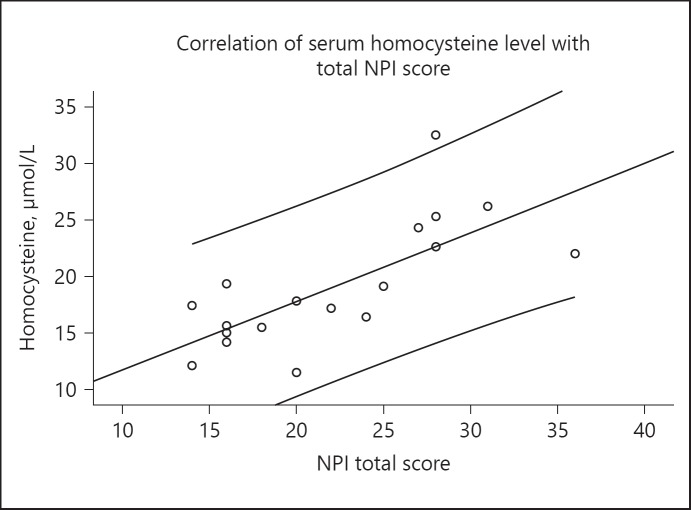
Results: Patients with AD had statistically significant higher serum levels of homocysteine as compared to the control group, while the levels of vitamin B12 and folate did not differ significantly. There was statistically significant positive correlation of serum homocysteine levels with total NPI score as well as with NPI sub-domains particularly delusion, agitation/aggression, and depression/dysphoria. Serum homocysteine levels did not correlate significantly with MMSE, CDR, and GDS scores.
Conclusion: Correlation was observed between serum homocysteine levels and behavioral and psychological symptoms of AD. There is a possibility of etiological role, but the underlying pathophysiological mechanisms need to be elucidated. Whether patients will benefit or not with supplements of vitamin B12 and folate requires further research. This was a cross-sectional study and findings should not be generalized. Further prospective longitudinal studies with a large number of patients are needed.
Keywords: Cognitive dysfunction; Dementia; Hyperhomocysteinemia; Vitamin B12.
Figures
References
-
- Fuentealba RA, Farias G, Scheu J, Bronfman M, Marzolo MP, Inestrosa NC. Signal transduction during amyloid-beta-peptide neurotoxicity: role in Alzheimer disease. Brain Res Brain Res Rev. 2004;47:275–289. - PubMed
-
- Tiwari SC, Soni RM. Alzheimer's disease pathology and oxidative stress: possible therapeutic options. J Alzheimer's Dis Park. 2014;4:1–10.
-
- Tariot PN, Mack JL, Patterson MB, Edland SD, Weiner MF, Fillenbaum G, et al. The behavior rating scale for dementia of the consortium to establish a registry for Alzheimer's disease. The behavioral pathology committee of the consortium to establish a registry for Alzheimer's disease. Am J Psychiatry. 1995;152:1349–1357. - PubMed
LinkOut - more resources
Full Text Sources
