Review
. 2019 Apr;10(2):341-366.
doi: 10.1007/s13300-019-0574-x. Epub 2019 Feb 27.

EADSG Guidelines: Insulin Storage and Optimisation of Injection Technique in Diabetes Management

Affiliations
Review

EADSG Guidelines: Insulin Storage and Optimisation of Injection Technique in Diabetes Management

Silver Bahendeka et al. Diabetes Ther. 2019 Apr.

Abstract

To date, insulin therapy remains the cornerstone of diabetes management; but the art of injecting insulin is still poorly understood in many health facilities. To address this gap, the Forum for Injection Technique and Therapy Expert Recommendations (FITTER) published recommendations on injection technique after a workshop held in Rome, Italy in 2015. These recommendations are generally applicable to the majority of patients on insulin therapy, athough they do not explore alternative details that may be suitable for low- and middle-income countries. The East Africa Diabetes Study Group sought to address this gap, and furthermore to seek consensus on some of the contextual issues pertaining to insulin therapy within the East African region, specifically focusing on scarcity of resources and its adverse effect on the quality of care. A meeting of health care professionals, experts in diabetes management and patients using insulin, was convened in Kigali, Rwanda on 11 March 2018, and the following recommendations were made: (1) insulin should be transported safely, without undue shaking and exposure to high (> 32 °C) temperature environments. (2) Insulin should not be transported below 0 °C. (3) If insulin is to be stored at home for over 2 months, it should be stored at the recommended temperature of 2-8 °C. (4) Appropriate instructions should be given to patients while dispensing insulin. (5) Insulin in use should be kept at room temperature and should never be kept immersed under water. Immersing insulin under water after the vial has been pierced carries a high risk of contamination, leading to loss of potency and likelihood of causing injection abscesses. (6) The shortest available needles (4 mm for pen and 6 mm for insulin syringe) should be preferred for all patients. (7) In routine care, intramuscular injections should be avoided, especially with long-acting insulins, as it may result in severe hypoglycaemia. (8) The practice of slanting the needle excessively should be avoided as it results in sub-epidermal injection of insulin which leads to poor absorption and may cause "tattooing" of the skin and scarring. (9) In patients presenting in a wasted state, with "paper-like skin", injections should, if possible, be initiated with pen injection devices, so as to utilise the 4-mm needle without lifting a skin fold (pinching the skin); otherwise lifting of a skin fold is required, if longer needles are utilised. (10) Reuse of needles and syringes is not recommended. However, as the reuse of syringes and needles is practiced for various reasons, and by many patients, individuals should not be given alarming messages; and usage should be limited to discarding when injections become more painful; but at any rate not to exceed reusing a needle more than 5 times.

Keywords: Cold chain; Diabetes; Injection; Insulin; Low income.


Figures
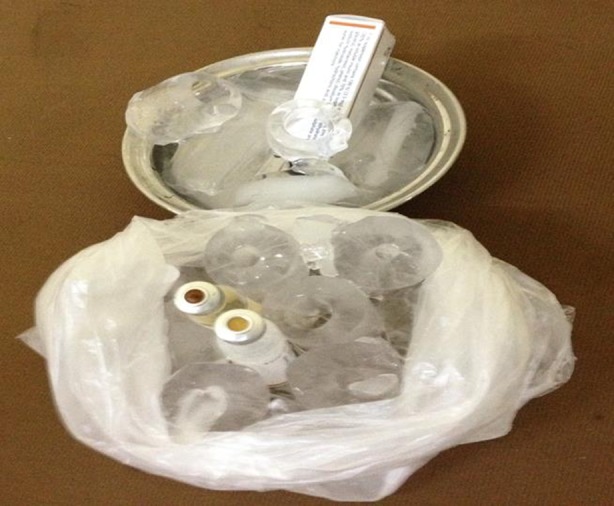
Fig. 1
Fig. 1
This figure shows packaged insulin placed directly on ice cubes. In the top part, the insulin bottles are still in their cardboard box and in the lower one, the insulin bottles have been removed from the packaging. In both cases the method of keeping insulin cool is not recommended as it may result in the insulin freezing. Moreover, the melting water will destroy the labels on the insulin bottles
Fig. 2
Fig. 2
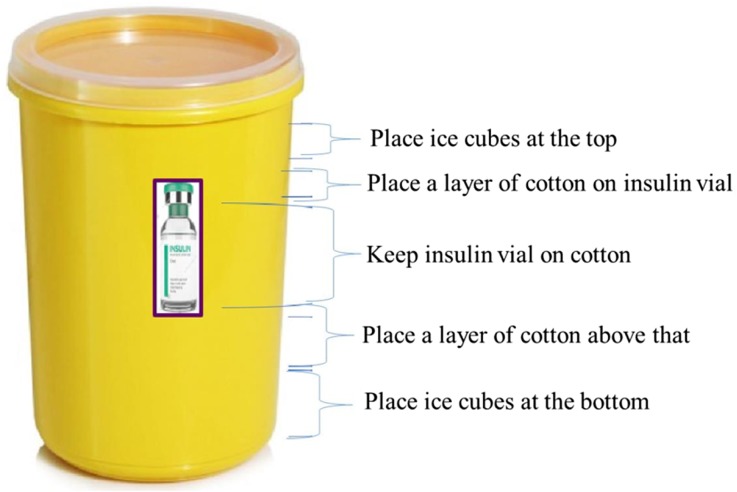
Figure showing a suggested improvised box for the transportation of insulin from the health facility or pharmacy to home. The ice will keep the temperatures favourable for transportation even in the heat of the sun. Furthermore, the cotton layers ensure that the melting ice will not spoil the labels on the insulin, and also act as cushions against undue shaking of insulin during transportation
Fig. 3
Fig. 3
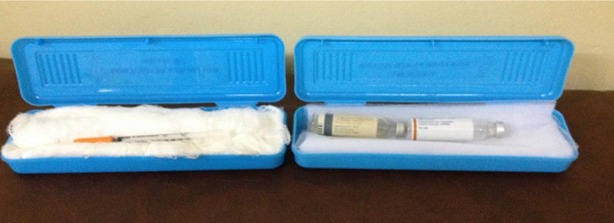
Figure showing plastic containers with cotton. This is an improvised way of keeping insulin and syringes at room temperature (20–30 °C). Insulin and syringes may be transported to work and to school in the same plastic containers
Fig. 4
Fig. 4
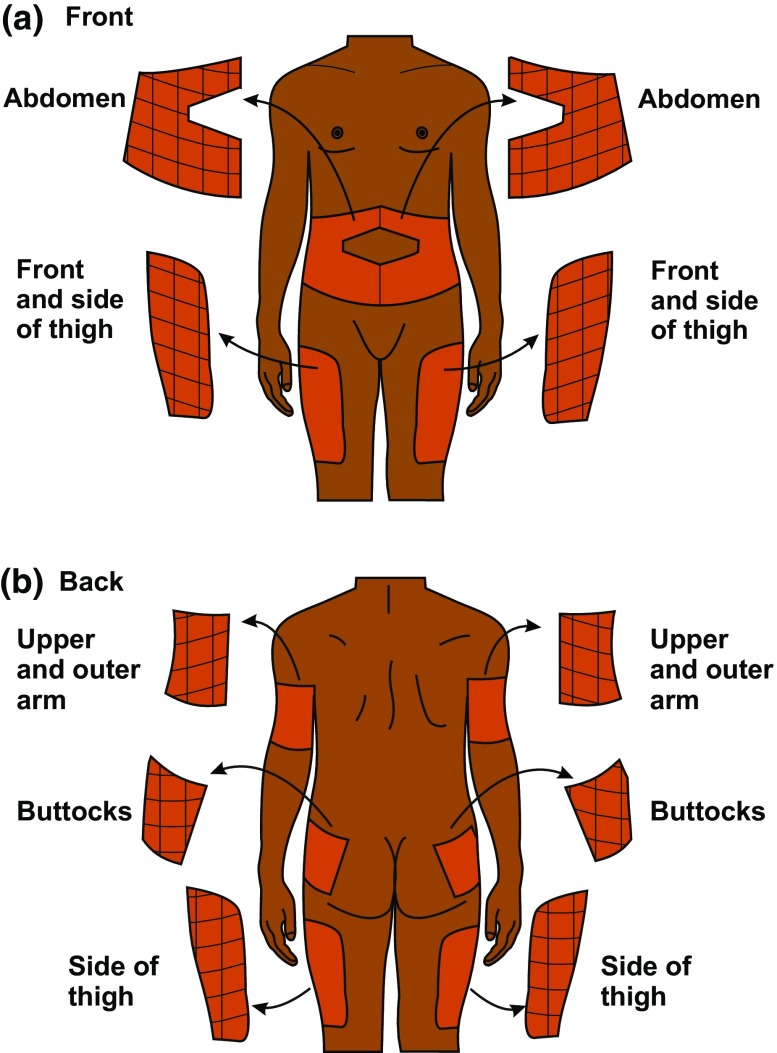
a Figure showing the areas recommended for insulin injections as viewed from the front. They may be divided up into smaller areas, so that each area is injected not more than once a day. b Figure showing the areas recommended for insulin injections as viewed from the back
Fig. 5
Fig. 5
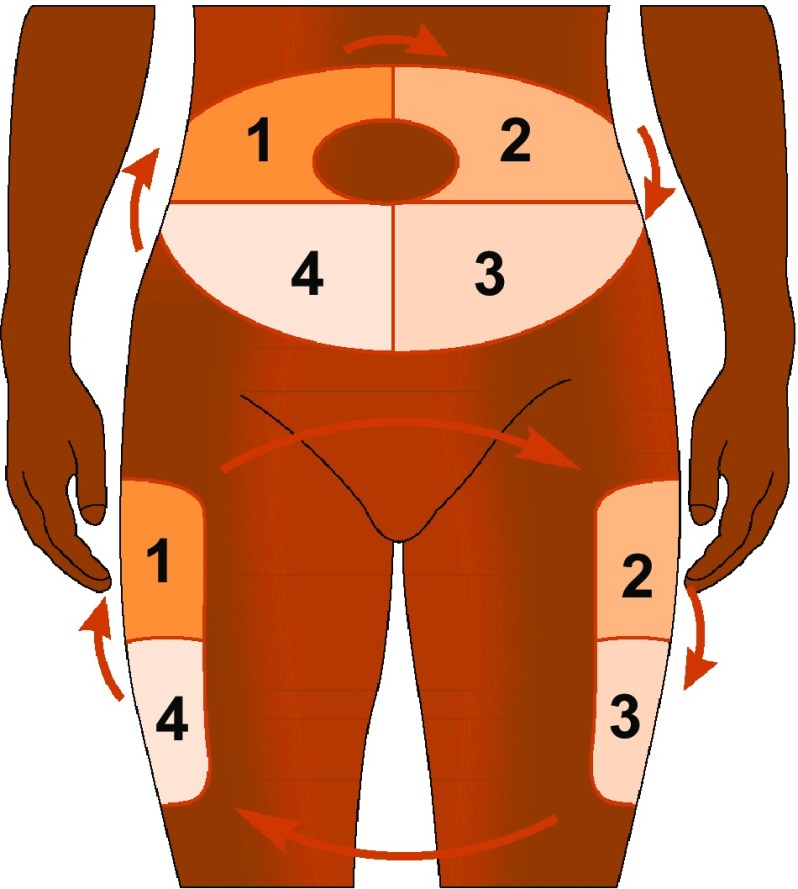
Figure showing a method that can be adopted to rotate insulin injections. The recommendation is to rotate the injections within one site consistently. Here the figure shows the method of rotation on the abdomen in the upper part and the thighs in the lower part
Fig. 6
Fig. 6
The method of lifting up (pinching) a skin fold. The correct way is ticked with green; the wrong ways are crossed with red. Only moderate pressure should be exerted on the skin
Fig. 7
Fig. 7
This figure shows the steps that should be taken when insulin is injected. (1) Hands should be cleaned, and insulin gently mixed if it is the cloudy insulin. (2) The rubber on the bottle should be cleaned with spirit. If spirit is not available, cleaning should be done with water and the rubber dried with a tissue. (3) Air equivalent to the volume of insulin to be drawn, should first be drawn into the syringe, then injected into the bottle containing insulin. This is done to avoid creating a vacuum in the bottle containing insulin. (5) Insulin as required is then drawn into the syringe. (6) Ensure that the correct position of tilting insulin downwards is done, so to avoid drawing insufficient insulin. Insufficient insulin will be drawn if the bottle is not tilted appropriately and the needle sticks above the insulin level. Air bubbles should be removed. (7) The needle is pushed into the skin at 90°. (8) The plunger is advanced down and injection completed. It is recommended to allow the insulin injected to stabilise under the skin, by counting from 0 to 30. (9) The needle and syringe is removed from the skin and discarded into a plastic container, for appropriate disposal as hazardous waste

References

    1. Home P, Riddle M, Cefalu WT, et al. Insulin therapy in people with type 2 diabetes: opportunities and challenges? Diabetes Care. 2014;37(6):1499–1508. doi: 10.2337/dc13-2743. - DOI - PMC - PubMed
    1. Marshall SL, Edidin D, Arena VC, Becker DJ, Bunker CH, Gishoma C, et al. Prevalence and incidence of clinically recognized cases of type 1 diabetes in children and adolescents in Rwanda, Africa. Diabet Med. 2015;32(9):1186–1192. doi: 10.1111/dme.12701. - DOI - PubMed
    1. Bahendeka S, Wesonga R, Mutungi G, Muwonge J, Neema S, Guwatudde D. Prevalence and correlates of diabetes mellitus in Uganda: a population-based national survey. Trop Med Int Health. 2016;21(3):405–416. doi: 10.1111/tmi.12663. - DOI - PubMed
    1. Ministry of Health, Kenya. STEPwise survey for non-comminicable diseases risk factors 2015 Report. 2015. http://www.who.int/ncds/surveillance/steps/kenya/en/. Accessed 23 Dec 2017.
    1. Ngwiri T, Were F, Predieri B, Ngugi P, Iughetti L. Glycemic control in Kenyan children and adolescents with type 1 diabetes mellitus. Int J Endocrinol. 2015;2015:761759. doi: 10.1155/2015/761759. - DOI - PMC - PubMed

LinkOut - more resources