Review
. 2019 Jul;58(7):835-857.
doi: 10.1007/s40262-019-00748-2.

Clinical Pharmacokinetics and Pharmacodynamics of Immune Checkpoint Inhibitors

Affiliations
Review

Clinical Pharmacokinetics and Pharmacodynamics of Immune Checkpoint Inhibitors

Maddalena Centanni et al. Clin Pharmacokinet. 2019 Jul.

Abstract

Immune checkpoint inhibitors (ICIs) have demonstrated significant clinical impact in improving overall survival of several malignancies associated with poor outcomes; however, only 20-40% of patients will show long-lasting survival. Further clarification of factors related to treatment response can support improvements in clinical outcome and guide the development of novel immune checkpoint therapies. In this article, we have provided an overview of the pharmacokinetic (PK) aspects related to current ICIs, which include target-mediated drug disposition and time-varying drug clearance. In response to the variation in treatment exposure of ICIs and the significant healthcare costs associated with these agents, arguments for both dose individualization and generalization are provided. We address important issues related to the efficacy and safety, the pharmacodynamics (PD), of ICIs, including exposure-response relationships related to clinical outcome. The unique PK and PD aspects of ICIs give rise to issues of confounding and suboptimal surrogate endpoints that complicate interpretation of exposure-response analysis. Biomarkers to identify patients benefiting from treatment with ICIs have been brought forward. However, validated biomarkers to monitor treatment response are currently lacking.


Conflict of interest statement

Maddalena Centanni, Dirk Jan A. R. Moes, Iñaki F. Trocóniz, Joseph Ciccolini, and Johan G. Coen van Hasselt have no conflicts of interest to declare related to the contents of this manuscript.

Figures
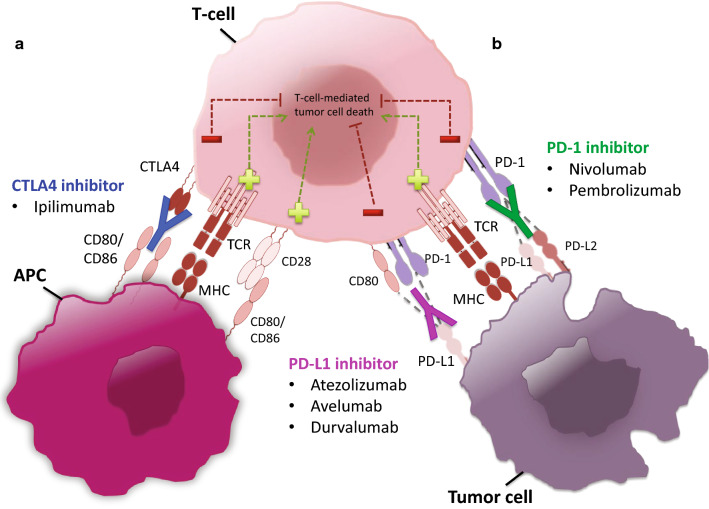
Fig. 1
Fig. 1
Molecular targets of ICIs. Tumor cells have the capacity to override the host immune system and hamper antitumor reaction. One means by which this occurs is by dampening T-cell response. Inhibition of T-cells can transpire at various stages of their antitumor response and arises upon activation of suppressor surface receptors by their respective ligands [114]. ICIs have been tailored to antagonize this reaction by binding to inhibitory proteins involved in the supression of antitumor reactions, thereby liberating the host immune reaction against tumor cells. Priming phase: In the priming phase, naïve T cells in the lymphoid organs become exposed to tumor-specific antigens, resulting in the differentiation of naïve T cells into effector T cells (e.g. Treg, cytotoxic T cells and helper T cells). This represents the initial step of an adaptive reaction against tumor cells, which is supported by the co-stimulatory effect of the CD28 receptor with CD80/86. The effect of CD28 becomes restrained in the presence of the CTLA-4 receptor, which holds a much higher affinity for the CD80/86 ligands. CTLA-4-blocking antibodies hamper this constraint and restore the formation of effector T cells to generate an antitumor response. Moreover, anti-CTLA-4 antibodies might be involved in the depletion of CTLA-4 expressing Treg cells in the tumor microenvironment. Effector phase: In the effector phase, cytotoxic T cells in the tumor microenvironment eliminate tumor cells by means of cell-to-cell communication. This reaction becomes dampened by the interactions between the PD-1 receptor on T cells and PD-L1, or, to a lesser degree, PD-L2, proteins on the surface of tumor cells and host myeloid cells (i.e. macrophages) in the tumor microenvironment [115]. Antagonism of PD-1 or PD-L1 by ICIs maintains T-cell effect and reinstates T-cell response against tumor cells. APC antigen-presenting cell, MHC major histocompatibility complex, TCR T-cell receptor, CD80/86 cluster of differentiation 80/86, Treg regulatory T cell, ICIs immune checkpoint inhibitors, PD-1 programmed death 1, PD-L1 programmed death-ligand 1
Fig. 2
Fig. 2
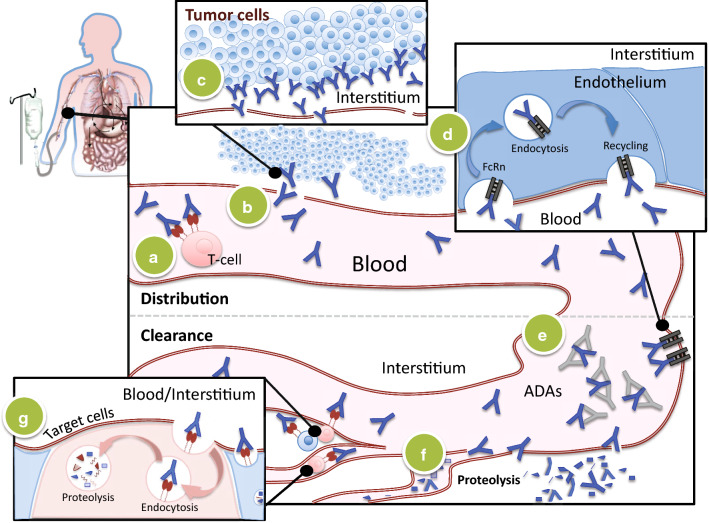
Pharmacokinetics of ICIs. After intravenous administration, ICIs are distributed and metabolized by various routes. Extensive binding to target antigens in the (a) plasma or on (c) tissues, reduces the amount of free ICIs and increases the volume of distribution. (b) Transvascular movement of unbound ICIs is principally governed by means of convection, the magnitude of which is limited by factors such as organ perfusion and endothelial permeability. Within tissues, ICIs become distributed by means of diffusion and convection. (d) The FcRn is responsible for the transport of ICIs back into the vascular system, preventing the intracellular degradation of these drugs and hence prolonging their half-life. (e) On the other hand, the generation of antibodies against ICIs increases clearance. (f) However, the dominant mechanism of ICI clearance remains through proteolytic catabolism, which occurs in both plasma and peripheral tissues. (g) Lastly, the high-affinity interaction between ICIs and surface receptors precipitates an additional clearance route, i.e. that of receptor-mediated endocytosis. ADAs antidrug antibodies, ICIs immune checkpoint inhibitors, FcRn neonatal Fc receptor

References

    1. Brahmer JR, Tykodi SS, Chow LQM, Hwu W-J, Topalian SL, Hwu P, et al. Safety and activity of anti-PD-L1 antibody in patients with advanced cancer. N Engl J Med. 2012;366(26):2455–2465. - PMC - PubMed
    1. Topalian SL, Hodi FS, Brahmer JR, Gettinger SN, Smith DC, McDermott DF, et al. Safety, activity, and immune correlates of anti-PD-1 antibody in cancer. N Engl J Med. 2012;366(26):2443–2454. - PMC - PubMed
    1. Caroline R, Luc T, Igor B, Steven O, Jeffrey W, Claus G, et al. Ipilimumab plus dacarbazine for previously untreated metastatic melanoma. N Engl J Med. 2011;364:2517–2526. - PubMed
    1. Hodi FS, O’Day SJ, McDermott DF, Weber RW, Sosman JA, Haanen JB, et al. Improved survival with ipilimumab in patients with metastatic melanoma. N Engl J Med. 2010;363(8):711–723. - PMC - PubMed
    1. Pardoll DM. The blockade of immune checkpoints in cancer immunotherapy. Nat Rev Cancer. 2012;12:252–264. - PMC - PubMed

Publication types

MeSH terms

Substances

LinkOut - more resources