. 2019 Feb 28;9(1):3120.
doi: 10.1038/s41598-019-40060-4.

Affiliative zygomatic synchrony in co-present strangers

Affiliations

Affiliative zygomatic synchrony in co-present strangers

Yulia Golland et al. Sci Rep. .

Abstract

In social contexts individuals frequently act as social chameleons, synchronizing their responses with those of others. Such synchrony is believed to play an important role, promoting mutual emotional and social states. However, synchrony in facial signals, which serve as the main communicative channel between people, has not been systematically studied. To address this gap, we investigated the social spread of smiling dynamics in a naturalistic social setting and assessed its affiliative function. We also studied whether smiling synchrony between people is linked with convergence in their autonomic and emotional responses. To that aim we measured moment-by-moment changes in zygomatic electromyography and cardiovascular activity in dyads of previously unacquainted participants, who co-viewed and subsequently rated emotional movies. We found a robust, dyad-specific zygomatic synchrony in co-viewing participants. During the positive movie, such zygomatic synchrony co-varied with cardiovascular synchrony and with convergence in positive feelings. No such links were found for the negative movie. Centrally, zygomatic synchrony in both emotional contexts predicted the subsequently reported affiliative feelings of dyad members. These results demonstrate that a naturally unfolding smiling behavior is highly contagious. They further suggest that zygomatic synchrony functions as a social facilitator, eliciting affiliation towards previously unknown others.


Conflict of interest statement

The authors declare no competing interests.

Figures
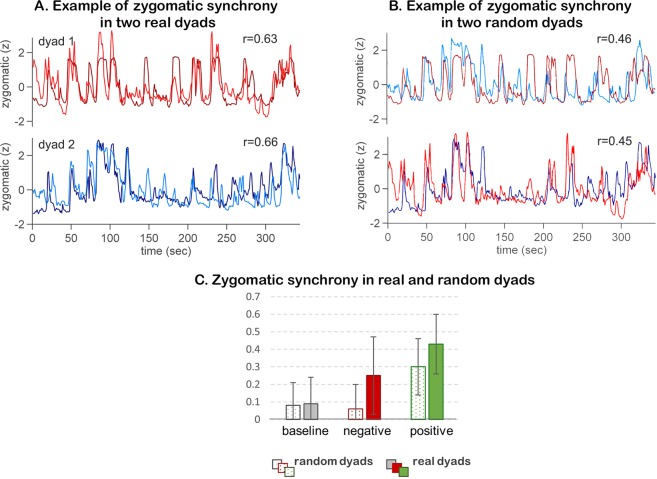
Figure 1
Figure 1
(A) Zygomatic synchrony in two real dyads. Zygomatic EMG responses in two co-viewing dyads (dyad1- red colors, dyad 2 – blue colors) are presented. (B) Zygomatic synchrony in two random dyads. Zygomatic EMG responses in two random dyads, constructed from the (A) dyad members. (B) Average zygomatic synchrony in real and random dyads. Zygomatic synchrony was assessed in real dyads (i.e. participants who viewed the movies together, marked by full bars) and in random dyads (i.e. participants who viewed the same movies but not together, marked by patterned bars), during non-emotional baseline (grey), the negative movie (red) and the positive movie (green) conditions.
Figure 2
Figure 2
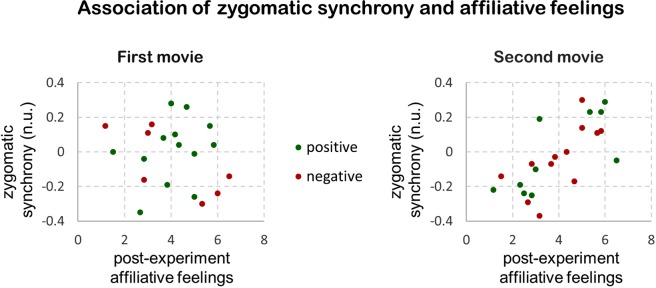
Association of zygomatic synchrony and affiliative feelings. Zygomatic synchrony during the last (ρ = 0.739), but not during the first (ρ = −0.04) presented movie was correlated with post-experiment affiliative feelings of co-viewing participants. Axis y represents zygomatic synchrony indexes, mean-normalized within each emotional condition. Scores arriving from the positive and the negative movies are marked with green and red colors, respectively. n.u. normalized units.

References

    1. Maslow AH. A theory of human motivation. Psychol. Rev. 1943;50:370. doi: 10.1037/h0054346. - DOI
    1. Baumeister RF, Leary MR. The need to belong: desire for interpersonal attachments as a fundamental human motivation. Psychol. Bull. 1995;117:497. doi: 10.1037/0033-2909.117.3.497. - DOI - PubMed
    1. Golland Y, Arzouan Y, Levit-Binnun N. The Mere Co-Presence: Synchronization of Autonomic Signals and Emotional Responses across Co-Present Individuals Not Engaged in Direct Interaction. Plos One. 2015;10:e0125804. doi: 10.1371/journal.pone.0125804. - DOI - PMC - PubMed
    1. Hasson U, Frith CD. Mirroring and beyond: coupled dynamics as a generalized framework for modelling social interactions. Philos. Trans. R. Soc. B Biol. Sci. 2016;371:20150366. doi: 10.1098/rstb.2015.0366. - DOI - PMC - PubMed
    1. Yun, K., Watanabe, K. & Shimojo, S. Interpersonal body and neural synchronization as a marker of implicit social interaction. Sci. Rep. 2 (2012). - PMC - PubMed

Publication types