


Size-based ecological interactions drive food web responses to climate warming
- PMID: 30816635
- PMCID: PMC6849876
- DOI: 10.1111/ele.13235
Size-based ecological interactions drive food web responses to climate warming
Abstract
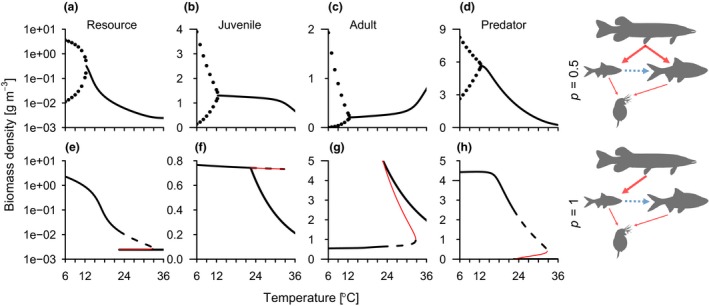
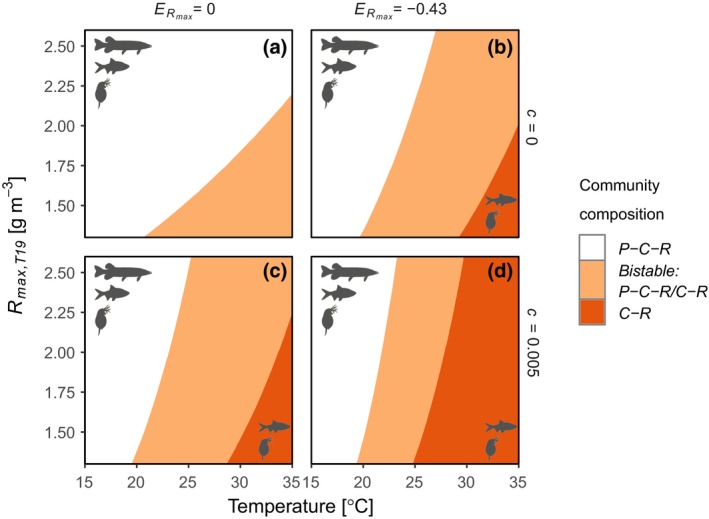
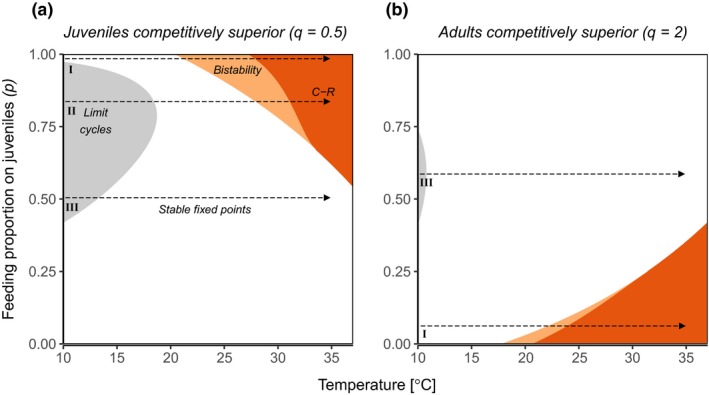
Predicting climate change impacts on animal communities requires knowledge of how physiological effects are mediated by ecological interactions. Food-dependent growth and within-species size variation depend on temperature and affect community dynamics through feedbacks between individual performance and population size structure. Still, we know little about how warming affects these feedbacks. Using a dynamic stage-structured biomass model with food-, size- and temperature-dependent life history processes, we analyse how temperature affects coexistence, stability and size structure in a tri-trophic food chain, and find that warming effects on community stability depend on ecological interactions. Predator biomass densities generally decline with warming - gradually or through collapses - depending on which consumer life stage predators feed on. Collapses occur when warming induces alternative stable states via Allee effects. This suggests that predator persistence in warmer climates may be lower than previously acknowledged and that effects of warming on food web stability largely depend on species interactions.
Keywords: Allee effects; alternative stable states; climate change; community dynamics; size structure; temperature-scaling; trophic interactions.
© 2019 The Authors. Ecology Letters published by CNRS and John Wiley & Sons Ltd.
Figures
References
-
- Angilletta, M.J. & Dunham, A.E. (2003). The temperature‐size rule in ectotherms: simple evolutionary explanations may not be general. Am. Nat., 162, 332–342. - PubMed
-
- Atkinson, D. (1994). Temperature and organism size—A biological law for ectotherms? Adv. Ecol. Res., 25, 1–58.
-
- Bernhardt, J.R. , Sunday, J.M. & O'Connor, M.I. (2018). Metabolic theory and the temperature‐size rule explain the temperature dependence of population carrying capacity. Am. Nat., 192, 687–697. - PubMed
-
- Björnsson, B. & Steinarsson, A. (2002). The food‐unlimited growth rate of Atlantic cod (Gadus morhua). Can. J. Fish Aquat. Sci., 59, 494–502.
Publication types
MeSH terms
Grants and funding
LinkOut - more resources
Full Text Sources
