


Tuning the Thromboinflammatory Response to Venous Flow Interruption by the Ectonucleotidase CD39
- PMID: 30816804
- PMCID: PMC6467508
- DOI: 10.1161/ATVBAHA.119.312407
Tuning the Thromboinflammatory Response to Venous Flow Interruption by the Ectonucleotidase CD39
Abstract
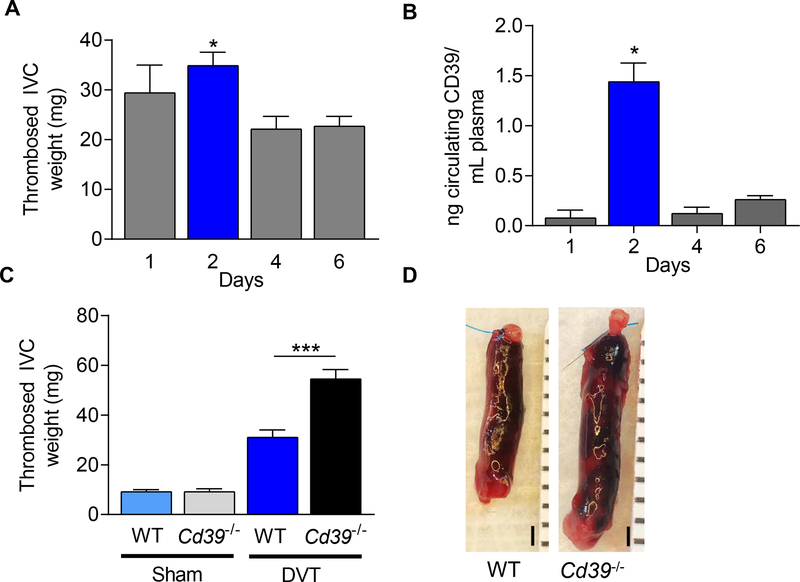
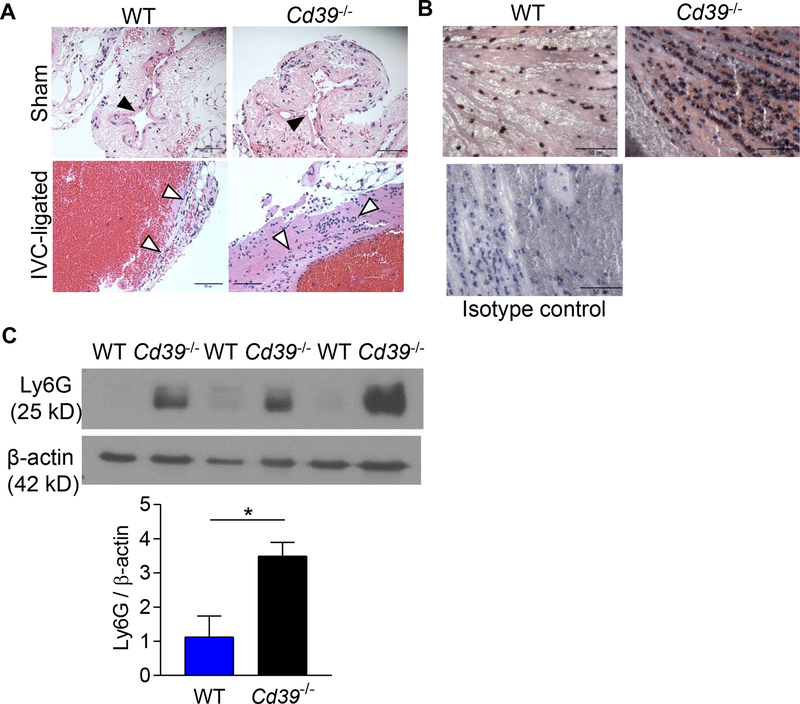
Objective- Leukocyte flux contributes to thrombus formation in deep veins under pathological conditions, but mechanisms that inhibit venous thrombosis are incompletely understood. Ectonucleotide di(tri)phosphohydrolase 1 ( ENTPD1 or Cd39), an ectoenzyme that catabolizes extracellular adenine nucleotides, is embedded on the surface of endothelial cells and leukocytes. We hypothesized that under venous stasis conditions, CD39 regulates inflammation at the vein:blood interface in a murine model of deep vein thrombosis. Approach and Results- CD39-null mice developed significantly larger venous thrombi under venous stasis, with more leukocyte recruitment compared with wild-type mice. Gene expression profiling of wild-type and Cd39-null mice revealed 76 differentially expressed inflammatory genes that were significantly upregulated in Cd39-deleted mice after venous thrombosis, and validation experiments confirmed high expression of several key inflammatory mediators. P-selectin, known to have proximal involvement in venous inflammatory and thrombotic events, was upregulated in Cd39-null mice. Inferior vena caval ligation resulted in thrombosis and a corresponding increase in both P-selectin and VWF (von Willebrand Factor) levels which were strikingly higher in mice lacking the Cd39 gene. These mice also manifest an increase in circulating platelet-leukocyte heteroaggregates suggesting heterotypic crosstalk between coagulation and inflammatory systems, which is amplified in the absence of CD39. Conclusions- These data suggest that CD39 mitigates the venous thromboinflammatory response to flow interruption.
Keywords: P-selectin; endothelial cells; inflammation; leukocytes; venous thrombosis.
Conflict of interest statement
DISCLOSURES
The authors declare no relevant disclosures.
Figures


References
-
- Silverstein MD, Heit JA, Mohr DN, Petterson TM, O’Fallon WM, Melton LJ 3rd. Trends in the incidence of deep vein thrombosis and pulmonary embolism: A 25-year population-based study. Arch Intern Med. 1998;158:585–593 - PubMed
-
- Bureau. USC. Monthly populations estimates for the united states: April 1, 2010 to december 1, 2012. Population Estimates. 2012;2012
-
- Yusuf HR, Tsai J, Atrash HK, Boulet S, Gross SD. Venous thromboembolism in adult hospitalizations-united states, 2007–2009. Atlanta, Ga: U.S. Dept. of Health and Human Services, Centers for Disease Control and Prevention; 2012.
-
- Center for Diseases Control. Venous thromboembolism.2018
-
- Ocak G, Vossen CY, Verduijn M, Dekker FW, Rosendaal FR, Cannegieter SC, Lijfering WM. Risk of venous thrombosis in patients with major illnesses: Results from the mega study. J Thromb Haemost. 2012 - PubMed
Publication types
MeSH terms
Substances
Grants and funding
LinkOut - more resources
Full Text Sources
Medical
Molecular Biology Databases
Research Materials
Miscellaneous
