


Digital Problem-Based Learning in Health Professions: Systematic Review and Meta-Analysis by the Digital Health Education Collaboration
- PMID: 30816846
- PMCID: PMC6416535
- DOI: 10.2196/12945
Digital Problem-Based Learning in Health Professions: Systematic Review and Meta-Analysis by the Digital Health Education Collaboration
Abstract
Background: The use of digital education in problem-based learning, or digital problem-based learning (DPBL), is increasingly employed in health professions education. DPBL includes purely digitally delivered as well as blended problem-based learning, wherein digital and face-to-face learning are combined.
Objective: The aim of this review is to evaluate the effectiveness of DPBL in improving health professionals' knowledge, skills, attitudes, and satisfaction.
Methods: We used the gold-standard Cochrane methods to conduct a systematic review of randomized controlled trials (RCTs). We included studies that compared the effectiveness of DPBL with traditional learning methods or other forms of digital education in improving health professionals' knowledge, skills, attitudes, and satisfaction. Two authors independently screened studies, extracted data, and assessed the risk of bias. We contacted study authors for additional information, if necessary. We used the random-effects model in the meta-analyses.
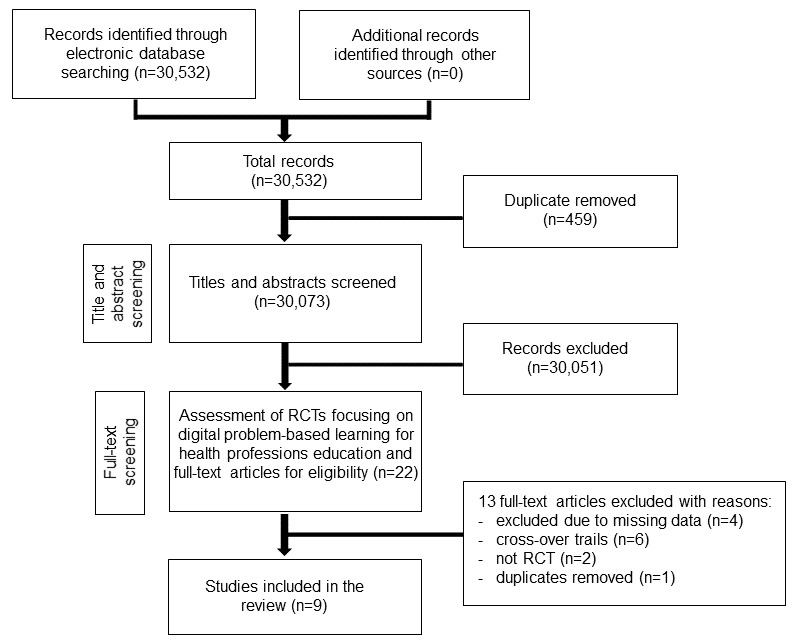
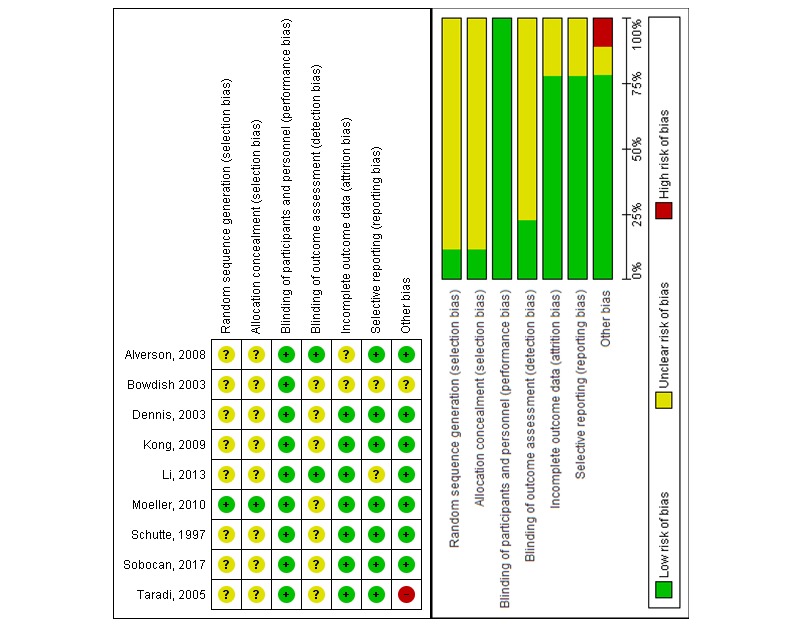
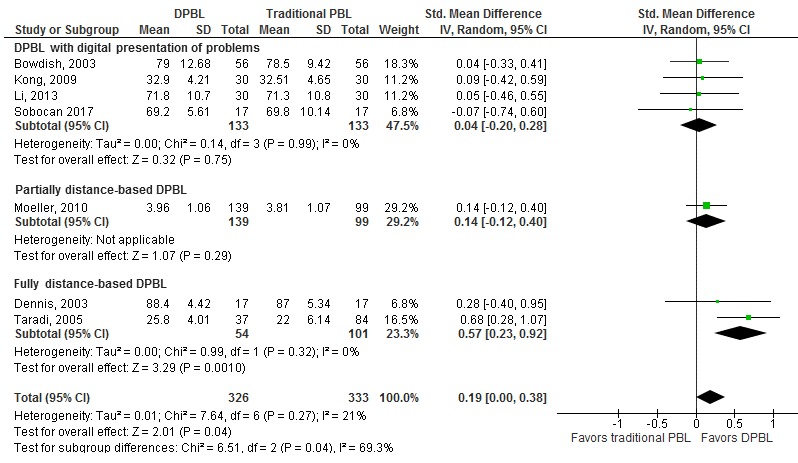
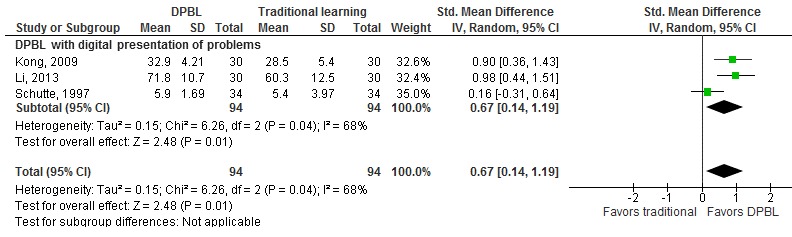
Results: Nine RCTs involving 890 preregistration health professionals were included. Digital technology was mostly employed for presentation of problems. In three studies, PBL was delivered fully online. Digital technology modalities spanned online learning, offline learning, virtual reality, and virtual patients. The control groups consisted of traditional PBL and traditional learning. The pooled analysis of seven studies comparing the effect of DPBL and traditional PBL reported little or no difference in postintervention knowledge outcomes (standardized mean difference [SMD] 0.19, 95% CI 0.00-0.38). The pooled analysis of three studies comparing the effect of DPBL to traditional learning on postintervention knowledge outcomes favored DPBL (SMD 0.67, 95% CI 0.14-1.19). For skill development, the pooled analysis of two studies comparing DPBL to traditional PBL favored DPBL (SMD 0.30, 95% CI 0.07-0.54). Findings on attitudes and satisfaction outcomes were mixed. The included studies mostly had an unclear risk of bias.
Conclusions: Our findings suggest that DPBL is as effective as traditional PBL and more effective than traditional learning in improving knowledge. DPBL may be more effective than traditional learning or traditional PBL in improving skills. Further studies should evaluate the use of digital technology for the delivery of other PBL components as well as PBL overall.
Keywords: effectiveness; medical education; problem-based learning; randomized controlled trials; systematic review.
©Lorainne Tudor Car, Bhone Myint Kyaw, Gerard Dunleavy, Neil A Smart, Monika Semwal, Jerome I Rotgans, Naomi Low-Beer, James Campbell. Originally published in the Journal of Medical Internet Research (http://www.jmir.org), 28.02.2019.
Conflict of interest statement
Conflicts of Interest: None declared.
Figures
References
-
- Lim WK. Dysfunctional problem-based learning curricula: resolving the problem. BMC Med Educ. 2012 Sep 25;12:89. doi: 10.1186/1472-6920-12-89. https://bmcmededuc.biomedcentral.com/articles/10.1186/1472-6920-12-89 1472-6920-12-89 - DOI - PMC - PubMed
-
- Wilder S. Impact of problem-based learning on academic achievement in high school: a systematic review. Educational Review. 2014 Nov 12;67(4):414–435. doi: 10.1080/00131911.2014.974511. - DOI
-
- Yew EHJ, Goh K. Problem-Based Learning: An Overview of its Process and Impact on Learning. Health Professions Education. 2016 Dec;2(2):75–79. doi: 10.1016/j.hpe.2016.01.004. doi: 10.1016/j.hpe.2016.01.004. - DOI
-
- Hervatis V, Kyaw BM, Semwal M, Dunleavy G, Tudor Car L, Zary N. PROSPERO CRD42016045679. 2016. [2019-02-18]. Offline and computer-based eLearning interventions for medical students' education [Cochrane Protocol] http://www.crd.york.ac.uk/PROSPERO/display_record.php?ID=CRD42016045679 .
Publication types
MeSH terms
Grants and funding
LinkOut - more resources
Full Text Sources
