Association of Digital Breast Tomosynthesis vs Digital Mammography With Cancer Detection and Recall Rates by Age and Breast Density
- PMID: 30816931
- PMCID: PMC6512257
- DOI: 10.1001/jamaoncol.2018.7078
Association of Digital Breast Tomosynthesis vs Digital Mammography With Cancer Detection and Recall Rates by Age and Breast Density
Abstract
Importance: Breast cancer screening examinations using digital breast tomosynthesis (DBT) has been shown to be associated with decreased false-positive test results and increased breast cancer detection compared with digital mammography (DM). Little is known regarding the size and stage of breast cancer types detected and their association with age and breast density.
Objective: To determine whether screening examinations using DBT detect breast cancers that are associated with an improved prognosis and to compare the detection rates by patient age and breast density.
Design, setting, and participants: This retrospective analysis of prospective cohort data from 3 research centers in the Population-based Research Optimizing Screening Through Personalized Regimens (PROSPR) consortium included data of women aged 40 to 74 years who underwent screening examinations using DM and DBT from January 1, 2011, through September 30, 2014. Statistical analysis was performed from November 8, 2017, to August 14, 2018.
Exposures: Use of DBT as a supplement to DM at breast cancer screening examination.
Main outcomes and measures: Recall rate, cancer detection rate, positive predictive value, biopsy rate, and distribution of invasive cancer subtypes.
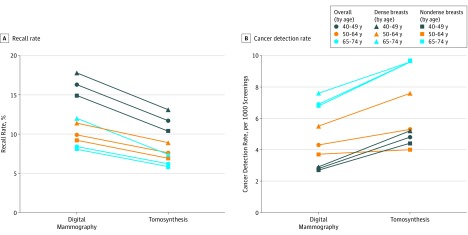
Results: Among 96 269 women (mean [SD] patient age for all examinations, 55.9 [9.0] years), patient age was 56.4 (9.0) years for DM and 54.6 (8.9) years for DBT. Of 180 340 breast cancer screening examinations, 129 369 examinations (71.7%) used DM and 50 971 examinations (28.3%) used DBT. Screening examination with DBT (73 of 99 women [73.7%]) was associated with the detection of smaller, more often node-negative, HER2-negative, invasive cancers compared with DM (276 of 422 women [65.4%]). Screening examination with DBT was also associated with lower recall (odds ratio, 0.64; 95% CI, 0.57-0.72; P < .001) and higher cancer detection (odds ratio, 1.41; 95% CI, 1.05-1.89; P = .02) compared with DM for all age groups even when stratified by breast density. The largest increase in cancer detection rate and the greatest shift toward smaller, node-negative invasive cancers detected with DBT was for women aged 40 to 49 years. For women aged 40 to 49 years with nondense breasts, the cancer detection rate for examinations using DBT was 1.70 per 1000 women higher compared with the rate using DM; for women with dense breasts, the cancer detection rate was 2.27 per 1000 women higher for DBT. For these younger women, screening with DBT was associated with only 7 of 28 breast cancers (25.0%) categorized as poor prognosis compared with 19 of 47 breast cancers (40.4%) when screening with DM.
Conclusions and relevance: The findings suggest that screening with DBT is associated with increased specificity and an increased proportion of breast cancers detected with better prognosis compared with DM. In the subgroup of women aged 40 to 49 years, routine DBT screening may have a favorable risk-benefit ratio.
Conflict of interest statement
Figures
Comment in
-
Breast Cancer Screening Using Digital Breast Tomosynthesis: Not All Mammography Is Equal.JAMA Oncol. 2019 May 1;5(5):642-643. doi: 10.1001/jamaoncol.2018.7056. JAMA Oncol. 2019. PMID: 30816932 No abstract available.
References
Publication types
MeSH terms
Grants and funding
LinkOut - more resources
Full Text Sources
Medical
Research Materials
Miscellaneous