


Natural language processing and machine learning algorithm to identify brain MRI reports with acute ischemic stroke
- PMID: 30818342
- PMCID: PMC6394972
- DOI: 10.1371/journal.pone.0212778
Natural language processing and machine learning algorithm to identify brain MRI reports with acute ischemic stroke
Abstract
Background and purpose: This project assessed performance of natural language processing (NLP) and machine learning (ML) algorithms for classification of brain MRI radiology reports into acute ischemic stroke (AIS) and non-AIS phenotypes.
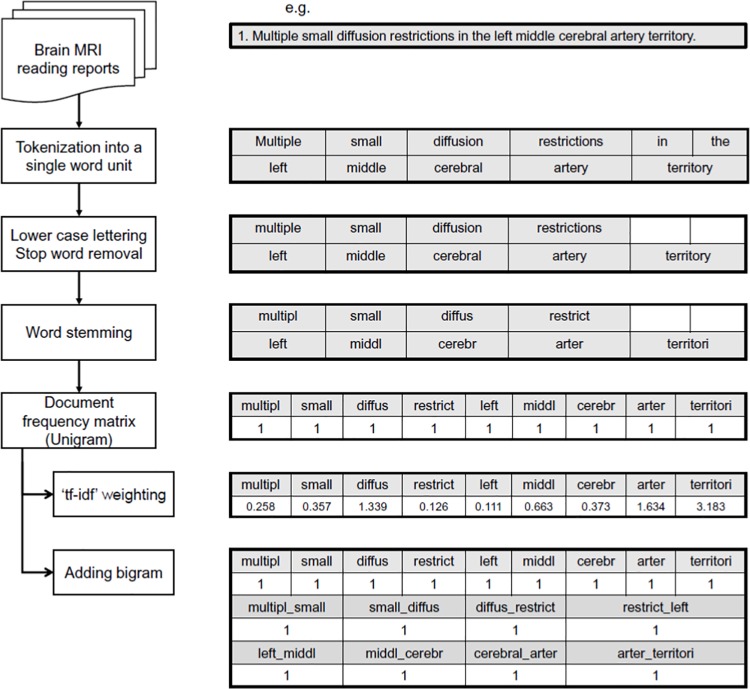
Materials and methods: All brain MRI reports from a single academic institution over a two year period were randomly divided into 2 groups for ML: training (70%) and testing (30%). Using "quanteda" NLP package, all text data were parsed into tokens to create the data frequency matrix. Ten-fold cross-validation was applied for bias correction of the training set. Labeling for AIS was performed manually, identifying clinical notes. We applied binary logistic regression, naïve Bayesian classification, single decision tree, and support vector machine for the binary classifiers, and we assessed performance of the algorithms by F1-measure. We also assessed how n-grams or term frequency-inverse document frequency weighting affected the performance of the algorithms.
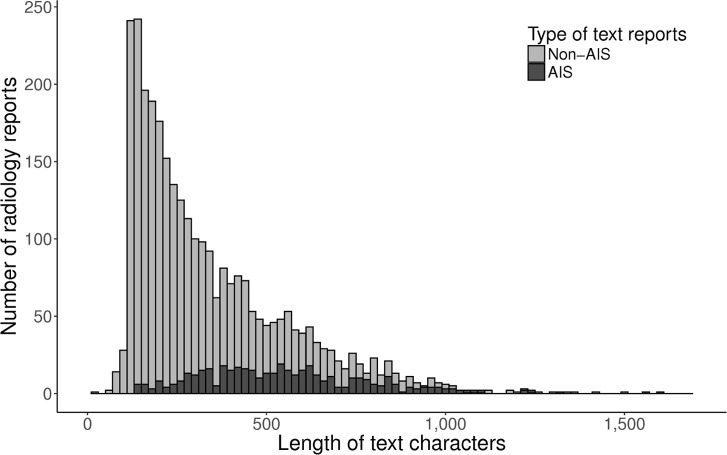
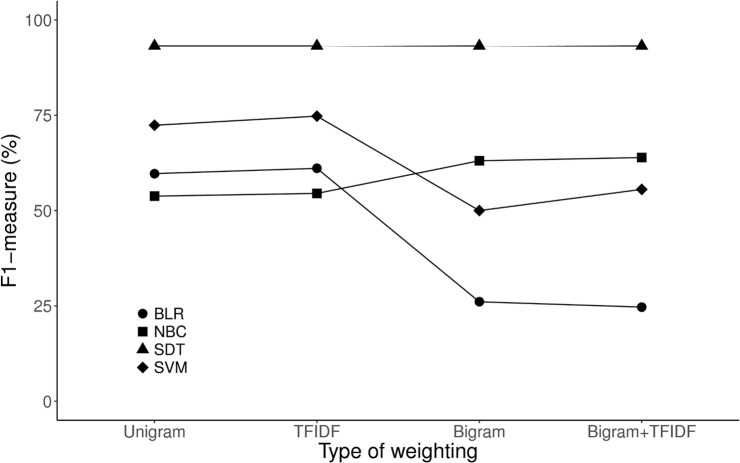
Results: Of all 3,204 brain MRI documents, 432 (14.3%) were labeled as AIS. AIS documents were longer in character length than those of non-AIS (median [interquartile range]; 551 [377-681] vs. 309 [164-396]). Of all ML algorithms, single decision tree had the highest F1-measure (93.2) and accuracy (98.0%). Adding bigrams to the ML model improved F1-mesaure of naïve Bayesian classification, but not in others, and term frequency-inverse document frequency weighting to data frequency matrix did not show any additional performance improvements.
Conclusions: Supervised ML based NLP algorithms are useful for automatic classification of brain MRI reports for identification of AIS patients. Single decision tree was the best classifier to identify brain MRI reports with AIS.
Conflict of interest statement
Drs. Kim, Zhu and Obeid have no competing interests. Dr. Lenert is a member of the Board of Directors of the ATCC. This does not alter the authors' adherence to PLOS ONE policies on sharing data and materials.
Figures
References
-
- GBD 2015 DALYs and HALE Collaborators. Global, regional, and national disability-adjusted life-years (DALYs) for 315 diseases and injuries and healthy life expectancy (HALE), 1990–2015: a systematic analysis for the global burden of disease study 2015. Lancet. 2016;388:1603–1658. 10.1016/S0140-6736(16)31460-X - DOI - PMC - PubMed
-
- GBD 2015 Mortality and Causes of Death Collaborators. Global, regional, and national life expectancy, all-cause mortality, and cause-specific mortality for 249 causes of death, 1980–2015: a systematic analysis for the global burden of disease study 2015. Lancet. 2016;388:1459–1544. 10.1016/S0140-6736(16)31012-1 - DOI - PMC - PubMed
-
- Murray CJ, Ezzati M, Flaxman AD, Lim S, Lozano R, Michaud C, et al. GBD 2010: a multi-investigator collaboration for global comparative descriptive epidemiology. Lancet. 2012;380:2055–2058. - PubMed
Publication types
MeSH terms
Grants and funding
LinkOut - more resources
Full Text Sources
