


Treatment patterns and burden of behavioral disturbances in patients with dementia in the United States: a claims database analysis
- PMID: 30819136
- PMCID: PMC6396493
- DOI: 10.1186/s12883-019-1260-3
Treatment patterns and burden of behavioral disturbances in patients with dementia in the United States: a claims database analysis
Abstract
Background: Although patients with dementia frequently experience neuropsychological symptoms (NPS) such as agitation, which profoundly impacts patients, caregivers, and the healthcare system, few studies have evaluated the associated burden of agitation or agitation-related symptoms in dementia.
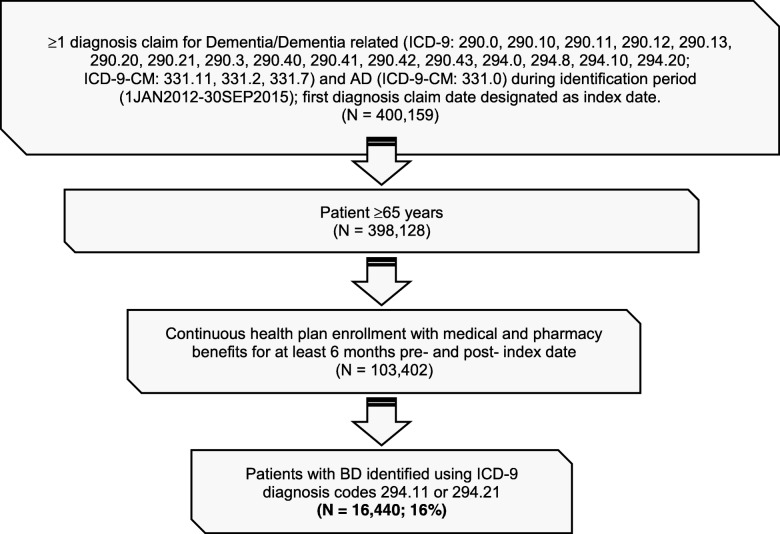
Methods: This retrospective analysis of claims data from the Truven Health MarketScan® database (2012-2015) compared clinical characteristics, treatment patterns, healthcare resource utilization, and costs among patients with dementia with behavioral disturbances (BD) versus patients with dementia without BD. Existing BD diagnosis codes 294.11 or 294.21 were used as a means to identify patients with agitation/agitation-related symptoms.
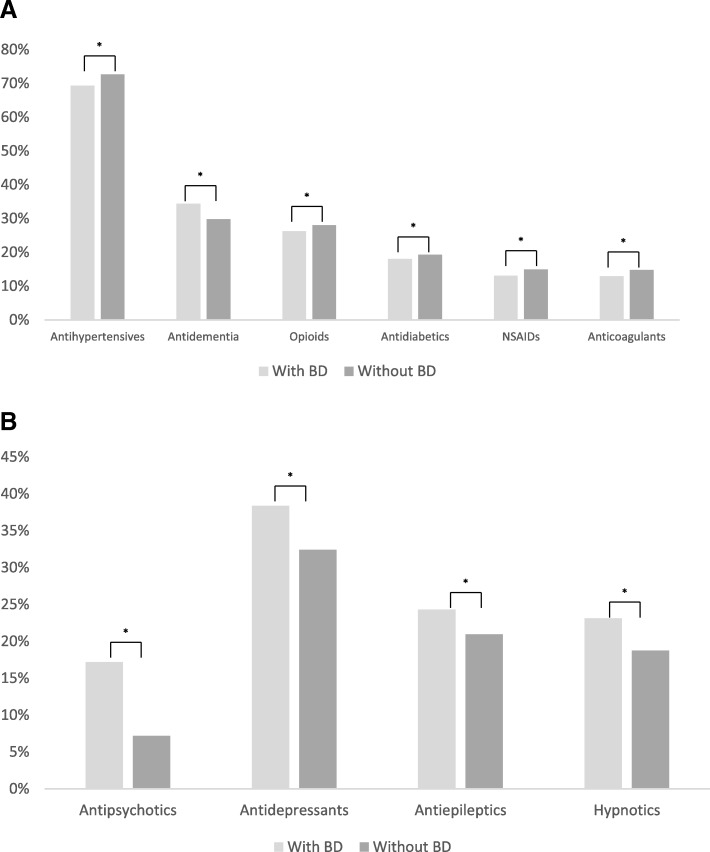
Results: From a starting sample of 6.4 million beneficiaries, 103,402 patients with dementia were identified, of whom 16,440 (16%) had BD during an average of 17 months of follow-up. Patients with BD had significantly more medical and psychiatric comorbidities and greater comedication use (i.e., antidementia drugs, antidepressants, and antipsychotics; all values, P < .0001) compared with patients without BD. A significantly greater number of hospitalizations, hospital days, outpatient hospital/clinic visits, number of skilled nursing visits, and number of patients with hospice visit were reported during follow-up in patients with BD compared with patients without BD (all values, P < 0.0001). Costs were also significantly higher among patients with BD versus those patients without BD ($42,284 vs. $32,640, respectively; P < 0.0001).
Conclusions: Patients with dementia with BD had a higher prevalence of comorbidities, greater use of comedications, and greater healthcare utilization and costs than patients with dementia without BD.
Keywords: Agitation; Alzheimer’s disease; Behavioral disturbances; Burden; Costs; Dementia; Healthcare resource utilization; Neuropsychological symptoms.
Conflict of interest statement
Ethics approval and consent to participate
This study was exempt from review by an institutional review board because the database was compliant with the Health Insurance Portability and Accountability Act and because the data do not include any identifiable patient information. The data used for this study did not involve the interaction or interview with any subjects and the data does not include any individually identifiable data (e.g. does not include names, addresses, social security or medical record numbers or other obvious identifiers) and as such is not research involving human subject as defined at 45 CFR 46.102(f)(2). Furthermore, this study used existing fully de-identified and the investigator(s) cannot be identified, directly or through identifiers linked to subjects and as such is exempt from 45 CFR 46.101(b)(4) from all 45 CFR part 46 requirements.
Consent for publication
Not applicable.
Competing interests
MSA, RS, and RAB are employees of Otsuka America Pharmaceuticals, Inc. AH is an employee of Lundbeck. HF received consulting fees from Lundbeck. Research and editorial support were funded by Otsuka America Pharmaceutical, Inc., Princeton, NJ, USA.
Publisher’s Note
Springer Nature remains neutral with regard to jurisdictional claims in published maps and institutional affiliations.
Figures
References
-
- Alzheimer's Association. 2017 alzheimer's disease facts and figures https://www.opuscare.org/docs/ALZHEIMERS_DISEASE_FACTS_AND_FIGURES.pdf. Accessed 23 June 2017.
-
- World Health Organization (WHO). Dementia. http://www.who.int/mediacentre/factsheets/fs362/en/. Accessed 23 June 2017.
-
- Alzheimer's Association. What is alzheimer's? http://www.alz.org/alzheimers_disease_what_is_alzheimers.asp. Accessed 22 June 2017.
MeSH terms
LinkOut - more resources
Full Text Sources
Medical
