Secular Trends in the Cost of Immunosuppressants after Solid Organ Transplantation in the United States
- PMID: 30819667
- PMCID: PMC6419280
- DOI: 10.2215/CJN.10590918
Secular Trends in the Cost of Immunosuppressants after Solid Organ Transplantation in the United States
Abstract
Background and objectives: Immunosuppressive medications are critical for maintenance of graft function in transplant recipients but can represent a substantial financial burden to patients and their insurance carriers.
Design, setting, participants, & measurements: To determine whether availability of generic immunosuppressive medications starting in 2009 may have alleviated some of that burden, we used Medicare Part D prescription drug events between 2008 and 2013 to estimate the average annualized per-patient payments made by patients and Medicare in a large national sample of kidney, liver, and heart transplant recipients. Repeated measures linear regression was used to determine changes in payments over the study period.
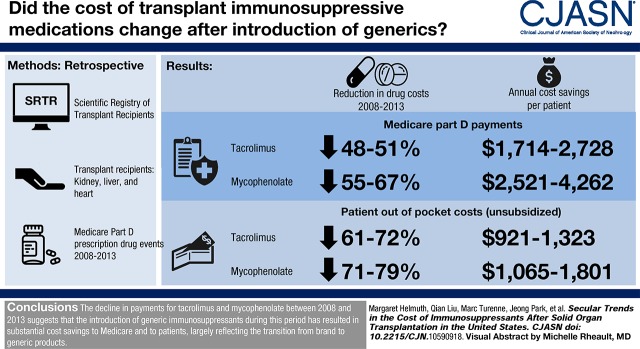
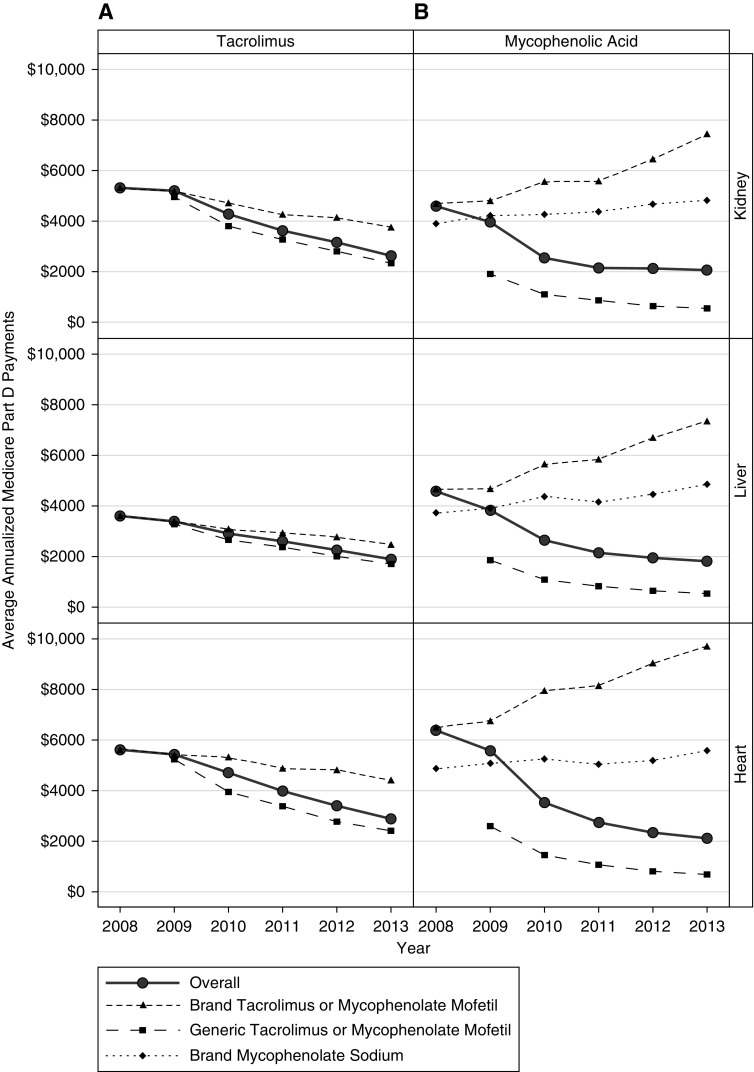
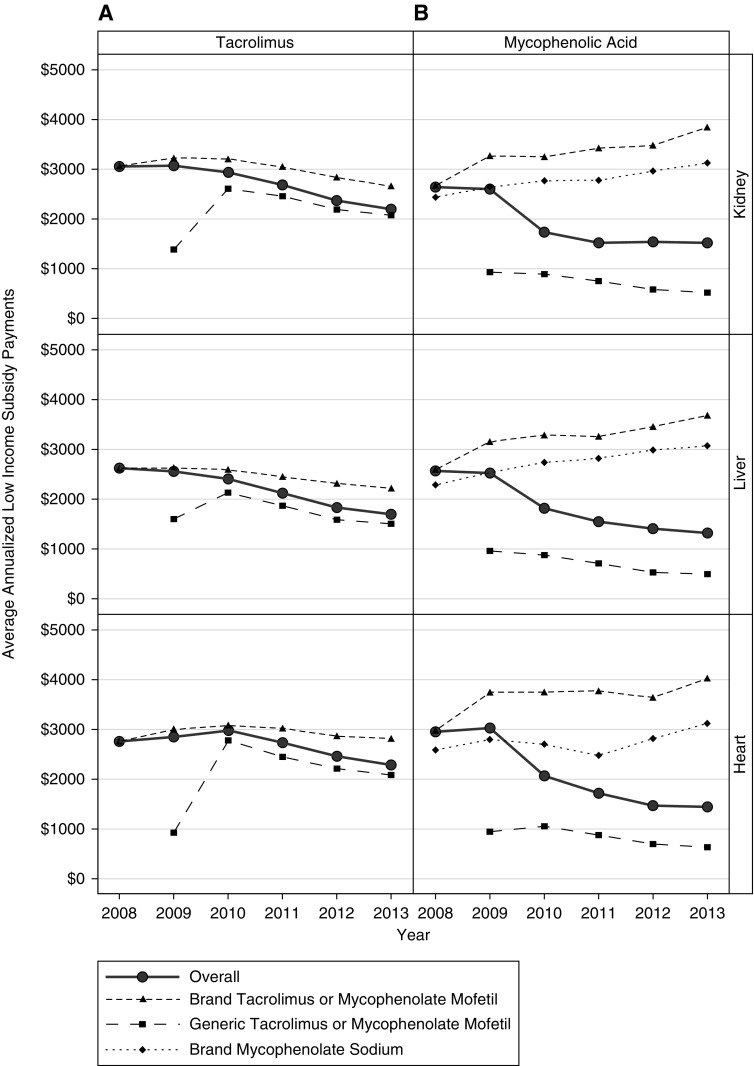
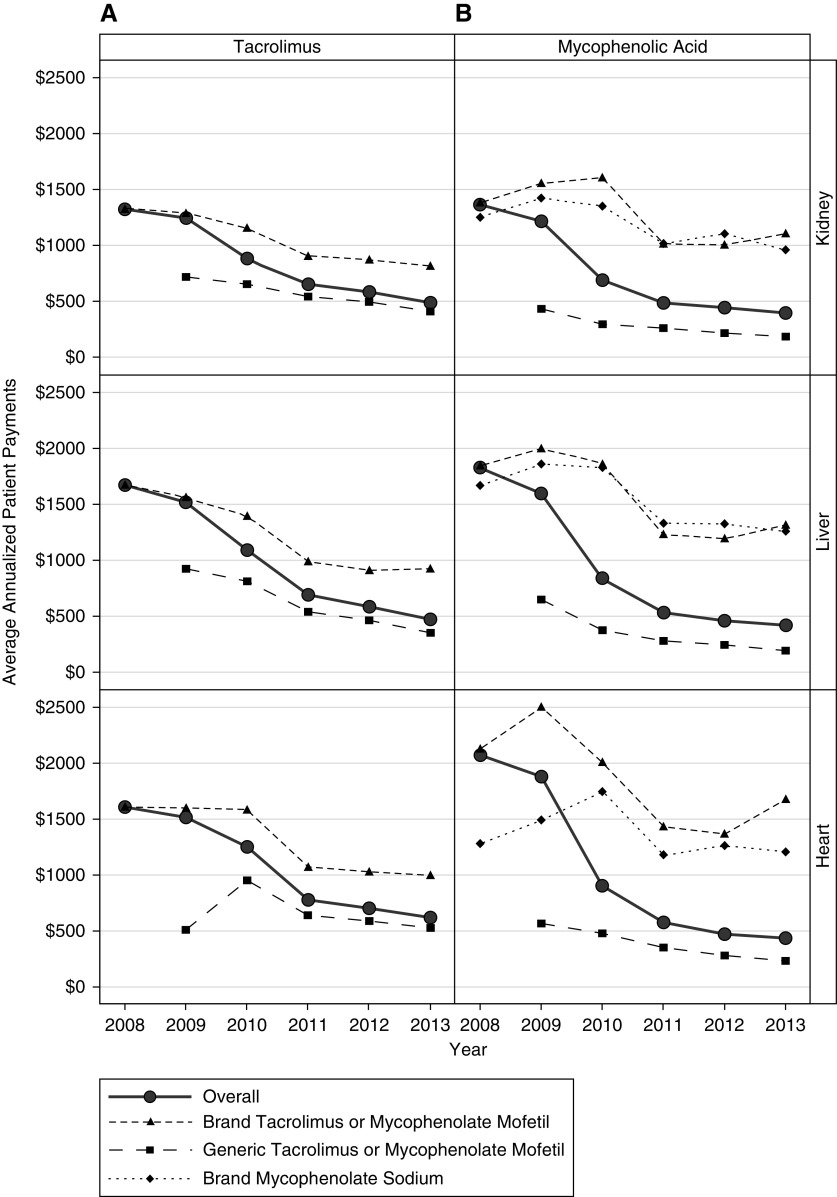
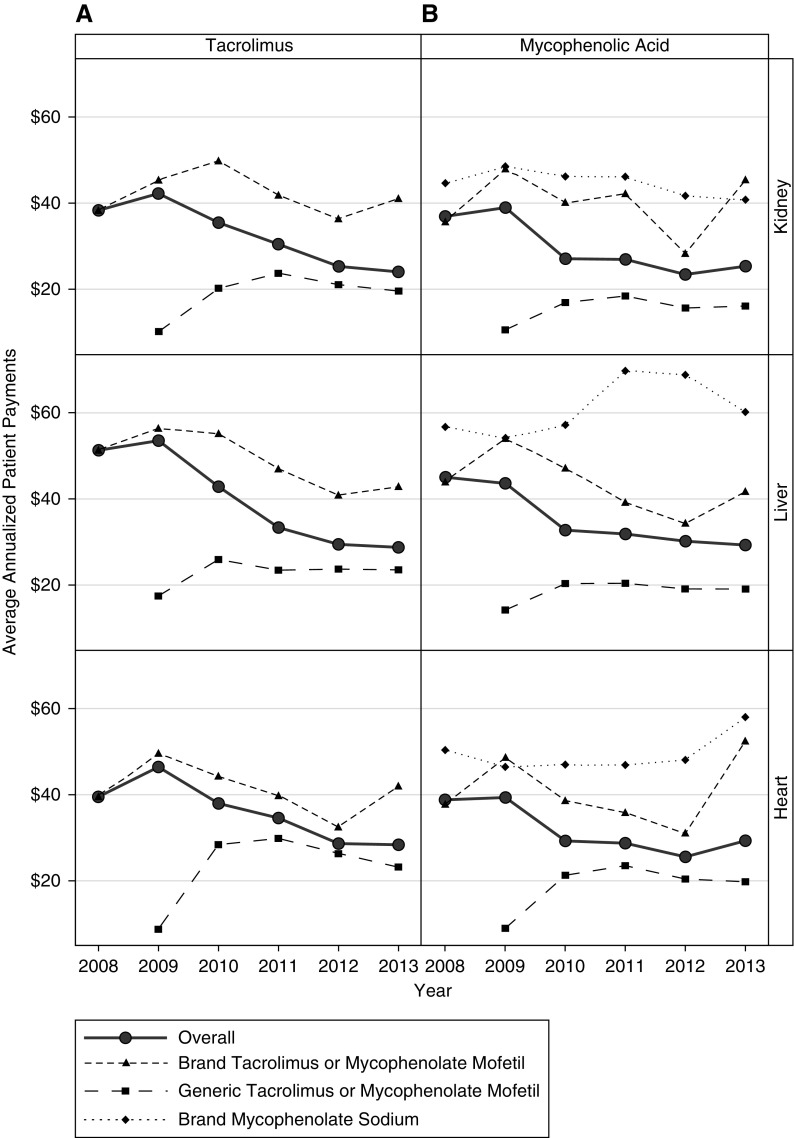
Results: Medicare Part D payments for two commonly used immunosuppressive medications, tacrolimus and mycophenolic acid (including mycophenolate mofetil and mycophenolate sodium), decreased overall by 48%-67% across organs and drugs from 2008 to 2013, reflecting decreasing payments for brand and generic tacrolimus (21%-54%), and generic mycophenolate (72%-74%). Low-income subsidy payments, which are additional payments made under Medicare Part D, also decreased during the study period. Out-of-pocket payments by patients who did not receive the low-income subsidy decreased by more than those who did receive the low-income subsidy (63%-79% versus 24%-44%).
Conclusions: The decline in payments by Medicare Part D and by transplant recipients for tacrolimus and mycophenolate between 2008 and 2013 suggests that the introduction of generic immunosuppressants during this period has resulted in substantial cost savings to Medicare and to patients, largely reflecting the transition from brand to generic products.
Keywords: Cost Savings; Drugs, Generic; Health Expenditures; Heart Transplantation; Immunosuppressive Agents; Insurance Carriers; Linear Models; Medicare Part D; Mycophenolic Acid; Prescription Drugs; Transplant Recipients; end-stage renal disease; heart disease; liver failure; tacrolimus; transplantation, kidney.
Copyright © 2019 by the American Society of Nephrology.
Figures
Comment in
-
Are Generic Immunosuppressive Drugs the Solution for Providing Lifelong Medication Coverage to Transplant Recipients?Clin J Am Soc Nephrol. 2019 Mar 7;14(3):327-329. doi: 10.2215/CJN.00960119. Epub 2019 Feb 28. Clin J Am Soc Nephrol. 2019. PMID: 30819668 Free PMC article. No abstract available.
-
Cost of Immunosuppressive Drugs and the Patient with a Kidney Transplant.Clin J Am Soc Nephrol. 2019 Mar 7;14(3):317-318. doi: 10.2215/CJN.00760119. Clin J Am Soc Nephrol. 2019. PMID: 30819669 Free PMC article. No abstract available.
References
-
- Loubeau PR, Loubeau JM, Jantzen R: The economics of kidney transplantation versus hemodialysis. Prog Transplant 11: 291–297, 2001 - PubMed
-
- Laupacis A, Keown P, Pus N, Krueger H, Ferguson B, Wong C, Muirhead N: A study of the quality of life and cost-utility of renal transplantation. Kidney Int 50: 235–242, 1996 - PubMed
-
- Kasiske BL, Cohen D, Lucey MR, Neylan JF; American Society of Transplantation : Payment for immunosuppression after organ transplantation. JAMA 283: 2445–2450, 2000 - PubMed
-
- El Hajj S, Kim M, Phillips K, Gabardi S: Generic immunosuppression in transplantation: Current evidence and controversial issues. Expert Rev Clin Immunol 11: 659–672, 2015 - PubMed
-
- FDA approval of tacrolimus, 2009. Available at: https://www.accessdata.fda.gov/drugsatfda_docs/appletter/2009/065461s000.... Accessed November 20, 2018
Publication types
MeSH terms
Substances
Grants and funding
LinkOut - more resources
Full Text Sources
Medical