Review
. 2019 Feb 19:13:4.
doi: 10.1186/s13036-018-0138-z. eCollection 2019.

Inhibition of bacterial toxin recognition of membrane components as an anti-virulence strategy

Affiliations
Review

Inhibition of bacterial toxin recognition of membrane components as an anti-virulence strategy

Eric Krueger et al. J Biol Eng. .

Abstract

Over recent years, the development of new antibiotics has not kept pace with the rate at which bacteria develop resistance to these drugs. For this reason, many research groups have begun to design and study alternative therapeutics, including molecules to specifically inhibit the virulence of pathogenic bacteria. Because many of these pathogenic bacteria release protein toxins, which cause or exacerbate disease, inhibition of the activity of bacterial toxins is a promising anti-virulence strategy. In this review, we describe several approaches to inhibit the initial interactions of bacterial toxins with host cell membrane components. The mechanisms by which toxins interact with the host cell membrane components have been well-studied over the years, leading to the identification of therapeutic targets, which have been exploited in the work described here. We review efforts to inhibit binding to protein receptors and essential membrane lipid components, complex assembly, and pore formation. Although none of these molecules have yet been demonstrated in clinical trials, the in vitro and in vivo results presented here demonstrate their promise as novel alternatives and/or complements to traditional antibiotics.

Keywords: Anti-virulence; Antibiotic resistance; Bacterial toxin; Cell membrane; Receptor decoys.


Conflict of interest statement

Not applicable.The manuscript has been approved by all authors for publication.The authors declare that they have no competing interests.Springer Nature remains neutral with regard to jurisdictional claims in published maps and institutional affiliations.

Figures
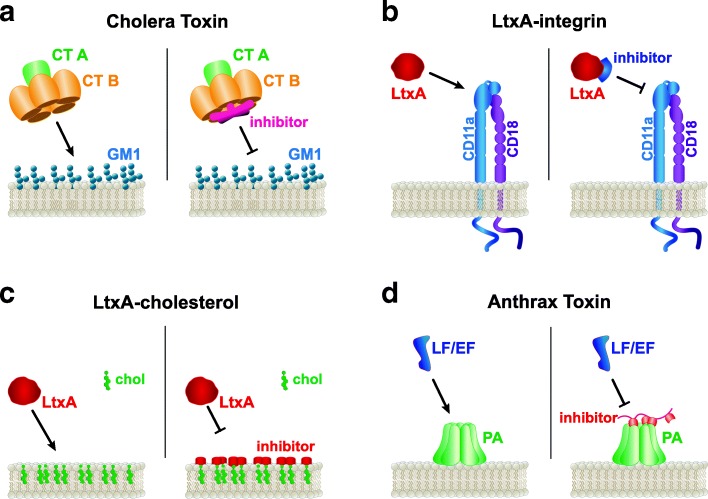
Fig. 1
Fig. 1
Receptor-based inhibitors. a An engineered multivalent ligand inhibits the CT B subunit from interacting with GM1 on the host cell membrane. b A small peptide based on the binding site of the integrin CD11a targeted by LtxA inhibits toxin binding to the receptor. c A peptide inhibitor based on the CRAC motif of LtxA shields cholesterol in the host membrane. d A polyvalent inhibitor blocks LF and EF from interacting with membrane-bound PA
Fig. 2
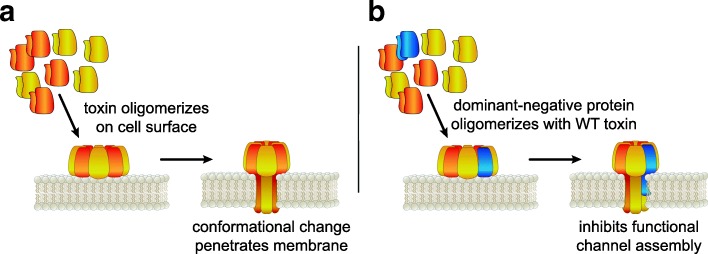
Fig. 2
Dominant-negative inhibitors. a WT toxin in solution forms an oligomer on the host cell surface. After a conformational change, the transmembrane domains assemble a channel in the plasma membrane. b Incorporation of a dominant-negative protein with WT toxin prevents cytotoxic activity by inhibiting the assembly of a functional channel
Fig. 3
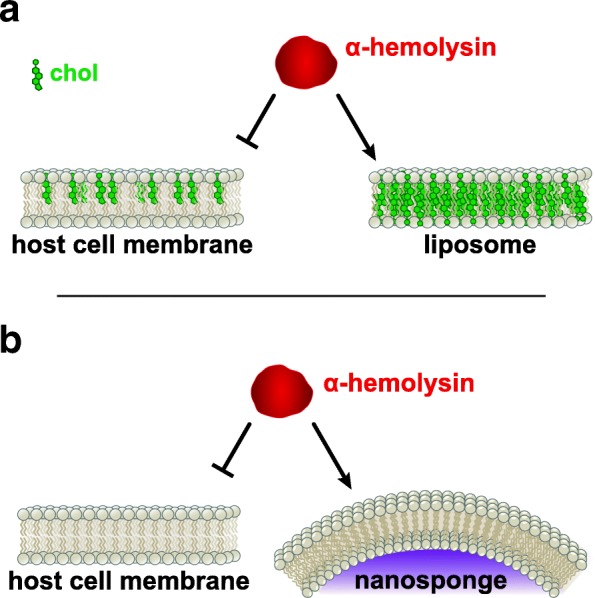
Fig. 3
Membrane-based inhibitors. a Many toxins, including S. aureus α-hemolysin, bind preferentially to cholesterol-containing membranes. A liposome with an unnaturally high cholesterol composition was demonstrated to absorb α-hemolysin, preventing its interaction with host cells. b A nanosponge was created in which a red blood cell membrane was fused to a PLGA nanoparticle core. This particle was more effective in inhibiting α-hemolysin from interacting with host cells than either liposomes or red blood cell membrane vesicles not fused to the polymer core
Fig. 4
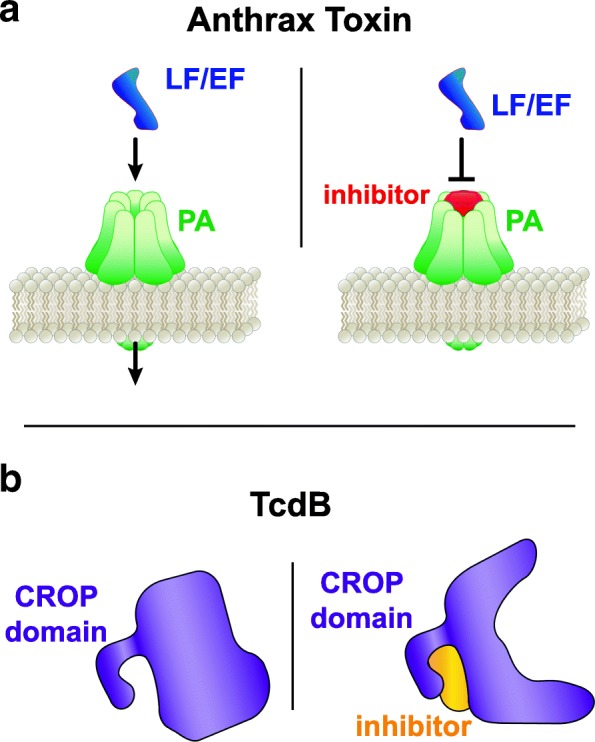
Fig. 4
Inhibition of pore formation and requisite conformational changes. a Blocking the pore formed from the anthrax PA toxin inhibits translocation of the enzymatic subunits (EF and LF) into the host cell. b A peptide inhibitor binds to the CROP domain of the TcdB toxin, destabilizing the protein by preventing the conformational changes required for cytotoxic activity
Fig. 5
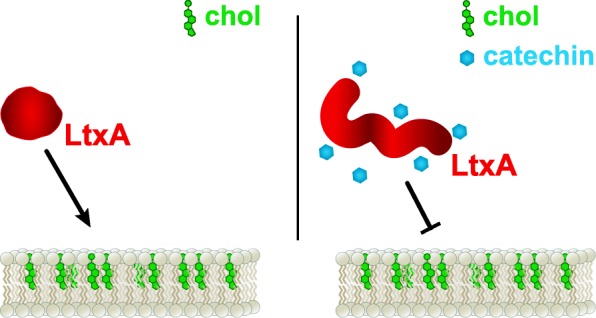
Fig. 5
Natural-product mediated conformational changes. EGCg induces significant conformational changes in LtxA, resulting in a substantial decrease in the ability of the toxin to bind cholesterol in the host cell plasma membrane, and as a result, inhibiting activity of the toxin

References

    1. Dye C. After 2015: infectious diseases in a new era of health and development. Phil Trans R Soc B. 2014;369(1645):20130426. doi: 10.1098/rstb.2013.0426. - DOI - PMC - PubMed
    1. Boucher HW, Talbot GH, Bradley JS, Edwards JE, Gilbert D, Rice LB, et al. Bad bugs, no drugs: no ESKAPE! An update from the Infectious Diseases Society of America. Clin Infect Dis. 2009;48:1–12. doi: 10.1086/595011. - DOI - PubMed
    1. Silver LL, Bostian KA. Discovery and development of new antibiotics: the problem of antibiotic resistance. Antimicrob Agents Chemother. 1993;37(3):377–383. doi: 10.1128/AAC.37.3.377. - DOI - PMC - PubMed
    1. World Health Organization . Antimicrobial resistance. Global report on surveillance. 2014.
    1. Hede K. An infectious arms race. Nature. 2014;509:S2–S3. doi: 10.1038/509S2a. - DOI - PubMed

LinkOut - more resources