Review
. 2019 Feb 28;24(5):866.
doi: 10.3390/molecules24050866.

Natural Products Containing 'Rare' Organophosphorus Functional Groups

Affiliations
Review

Natural Products Containing 'Rare' Organophosphorus Functional Groups

Janusz J Petkowski et al. Molecules. .

Abstract

Phosphorous-containing molecules are essential constituents of all living cells. While the phosphate functional group is very common in small molecule natural products, nucleic acids, and as chemical modification in protein and peptides, phosphorous can form P⁻N (phosphoramidate), P⁻S (phosphorothioate), and P⁻C (e.g., phosphonate and phosphinate) linkages. While rare, these moieties play critical roles in many processes and in all forms of life. In this review we thoroughly categorize P⁻N, P⁻S, and P⁻C natural organophosphorus compounds. Information on biological source, biological activity, and biosynthesis is included, if known. This review also summarizes the role of phosphorylation on unusual amino acids in proteins (N- and S-phosphorylation) and reviews the natural phosphorothioate (P⁻S) and phosphoramidate (P⁻N) modifications of DNA and nucleotides with an emphasis on their role in the metabolism of the cell. We challenge the commonly held notion that nonphosphate organophosphorus functional groups are an oddity of biochemistry, with no central role in the metabolism of the cell. We postulate that the extent of utilization of some phosphorus groups by life, especially those containing P⁻N bonds, is likely severely underestimated and has been largely overlooked, mainly due to the technological limitations in their detection and analysis.

Keywords: N-phosphorylation; P–C bond; P–N bond; P–S bond; S-phosphorylation; phosphinate; phosphine; phosphonate; phosphoramidate; phosphorothioate.


Conflict of interest statement

The authors declare no conflicts of interest.

Figures
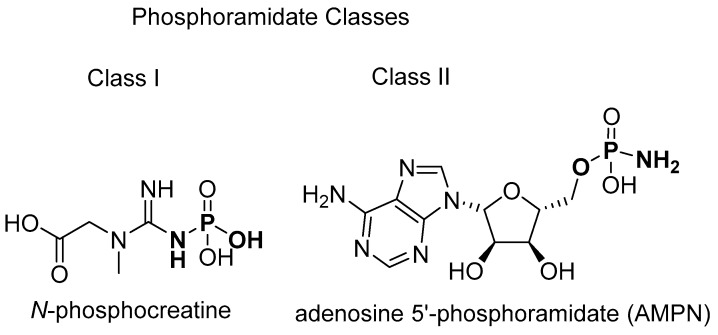
Figure 1
Figure 1
Phosphoramidates (bold font) are traditionally divided into two classes of compounds. Compounds of class I are characterized by the presence of terminal P–OH group (e.g., phosphagen—N-phosphocreatine). Compounds of class II are characterized by the presence of the accessible terminal P–NH2 group (e.g., adenosine 5′-phosphoramidate).
Figure 2
Figure 2
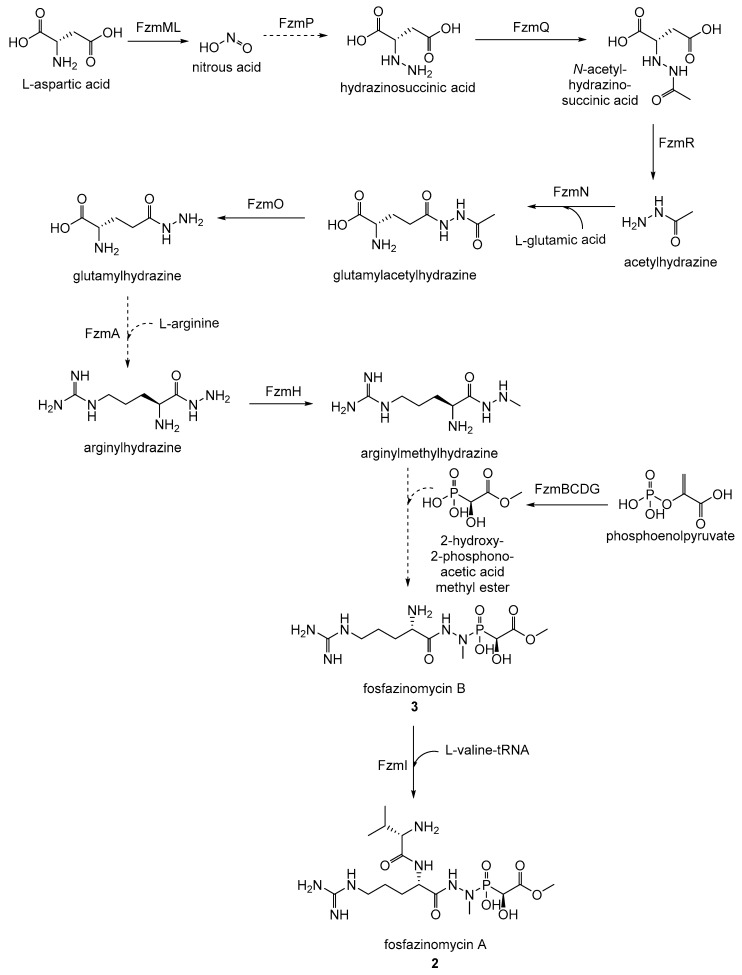
Biosynthetic pathways for fosfazinomycins A (2) and B (3) as proposed in recent studies by [10,11,12,15]. Putative steps are denoted by dashed lines.
Figure 3
Figure 3
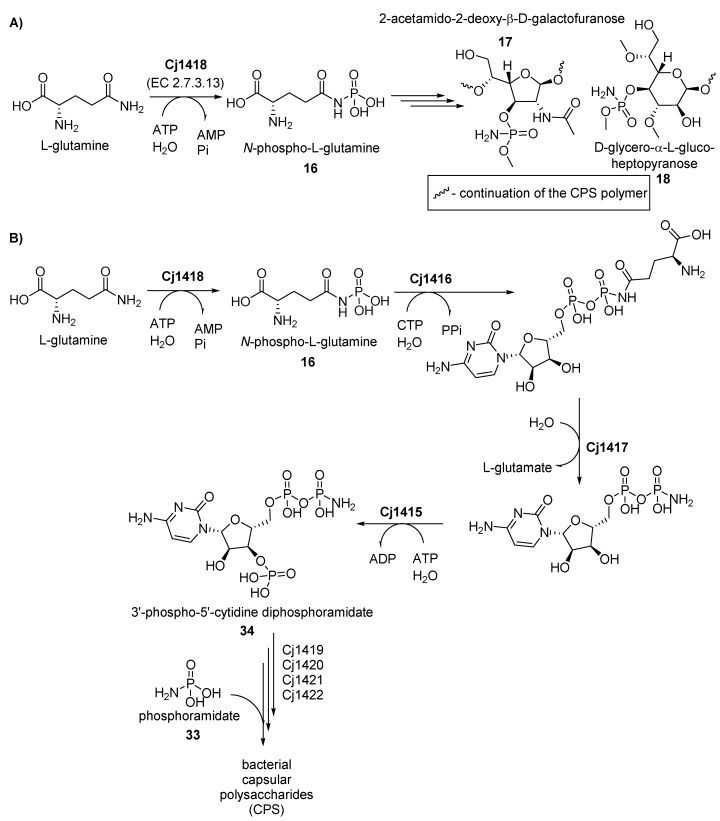
(A) The initial transformation in the biosynthetic pathway for the phosphoramidate modification of the sugar residues in the bacterial capsular polysaccharides (CPS) proceeds via direct phosphorylation of the amide nitrogen of l-glutamine with ATP by a specific L-glutamine kinase (EC 2.7.3.13) to form N-phospho-l-glutamine (16). (B) Compound 16 is a precursor for P–N bond-containing sugar residues (17, 18) of the CPS and it is proposed to undergo a series of transformations before the formation of the final CPS product (with the formation of inorganic phosphoramidate (33) and 3′-Phospho-5′-cytidine diphosphoramidate (34) as P–N bond-containing intermediates) [46,47,48,49]. Enzymes from Campylobacter jejuni CPS biosynthetic gene cluster with the known function in the CPS biosynthetic pathway are marked in bold font.
Scheme 1
Scheme 1
The last step of the phosphagens’ biosynthetic pathway.
Figure 4
Figure 4
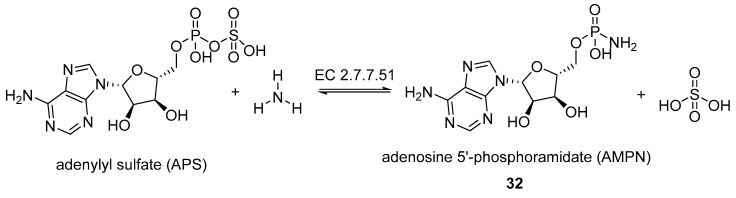
In vitro synthesis of AMPN compound by adenylyl transferase (EC 2.7.7.51) enzyme.

References

    1. Westheimer F. Why nature chose phosphates. Science. 1987;6:1173–1178. doi: 10.1126/science.2434996. - DOI - PubMed
    1. Hunter T. Why nature chose phosphate to modify proteins. Philos. Trans. R. Soc. B Biol. Sci. 2012;367:2513–2516. doi: 10.1098/rstb.2012.0013. - DOI - PMC - PubMed
    1. Kamerlin S.C.L., Sharma P.K., Prasad R.B., Warshel A. Why nature really chose phosphate. Q. Rev. Biophys. 2013;46:1–132. doi: 10.1017/S0033583512000157. - DOI - PMC - PubMed
    1. Rossomando E.F., Hadjimichael J. Characterization and cAMP inhibition of a lysyl-(N-epsilon-5′-phospho) adenosyl phosphoamidase in Dictyostelium discoideum. Int. J. Biochem. 1986;18:481–484. doi: 10.1016/0020-711X(86)90193-X. - DOI - PubMed
    1. Masako K., Tsuyoshi O., Hitoshi O., Akira K. Nucleoside monophosphoramidate hydrolase from rat liver: Purification and characterization. Int. J. Biochem. 1994;26:235–245. doi: 10.1016/0020-711X(94)90151-1. - DOI - PubMed

MeSH terms

LinkOut - more resources