Help from my friends-cooperation of BMAL1 with noncircadian transcription factors
- PMID: 30824531
- PMCID: PMC6411012
- DOI: 10.1101/gad.324046.119
Help from my friends-cooperation of BMAL1 with noncircadian transcription factors
Abstract
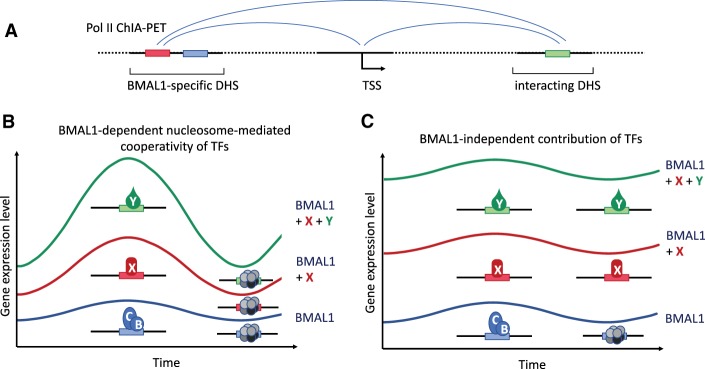
The circadian clock in the suprachiasmatic nucleus (SCN) of mammals drives 24-h rhythms of sleep/wake cycles. Peripheral clocks present in other organs coordinate local and global physiology according to rhythmic signals from the SCN and via metabolic cues. The core circadian clockwork is identical in all cells. However, there is only a small amount of overlap of the circadian transcriptomes in different organs and tissues. A novel study by Beytebiere and colleagues (pp. 294-309) indicates that the regulation of tissue-specific rhythmic gene expression involves the cooperation of the circadian transcription factor (TF) BMAL1:CLOCK with tissue-specific TFs (ts-TFs) and correlates with the potential of BMAL1:CLOCK to facilitate rhythmic enhancer-enhancer interactions.
Keywords: circadian clock; enhancer–enhancer interactions; tissue-specific cistromes; transcription.
© 2019 Shostak and Brunner; Published by Cold Spring Harbor Laboratory Press.
Figures
Comment on
-
Tissue-specific BMAL1 cistromes reveal that rhythmic transcription is associated with rhythmic enhancer-enhancer interactions.Genes Dev. 2019 Mar 1;33(5-6):294-309. doi: 10.1101/gad.322198.118. Epub 2019 Feb 25. Genes Dev. 2019. PMID: 30804225 Free PMC article.
References
-
- Beytebiere JR, Trott AJ, Greenwell B, Osborne CA, Vitet H, Spence J, Yoo S-H, Chen Z, Takahashi JS, Ghaffari N, et al. 2019. Tissue-specific BMAL1 cistromes reveal that rhythmic transcription is associated with rhythmic enhancer–enhancer interactions. Genes Dev (this issue). 10.1101/gad.322198.118. - DOI - PMC - PubMed
Publication types
MeSH terms
Substances
LinkOut - more resources
Full Text Sources
Miscellaneous