Long-term circulation of Zika virus in Thailand: an observational study
- PMID: 30826189
- PMCID: PMC6511259
- DOI: 10.1016/S1473-3099(18)30718-7
Long-term circulation of Zika virus in Thailand: an observational study
Erratum in
-
Correction to Lancet Infect Dis 2019; published online Feb 27. https://doi.org/10.1016/S1473-3099(18)30718-7.Lancet Infect Dis. 2019 Apr;19(4):e109. doi: 10.1016/S1473-3099(19)30104-5. Epub 2019 Mar 8. Lancet Infect Dis. 2019. PMID: 30858015 No abstract available.
Abstract
Background: Little is known about the historical and current risk of Zika virus infection in southeast Asia, where the mosquito vector is widespread and other arboviruses circulate endemically. Centralised Zika virus surveillance began in Thailand in January, 2016. We assessed the long-term circulation of Zika virus in Thailand.
Methods: In this observational study, we analysed data from individuals with suspected Zika virus infection who presented at hospitals throughout the country and had biological samples (serum, plasma, or urine) tested for confirmation with PCR at the National Institute of Health laboratories in Bangkok. We analysed the spatial and age distribution of cases, and constructed time-resolved phylogenetic trees using genomes from Thailand and elsewhere to estimate when Zika virus was first introduced.
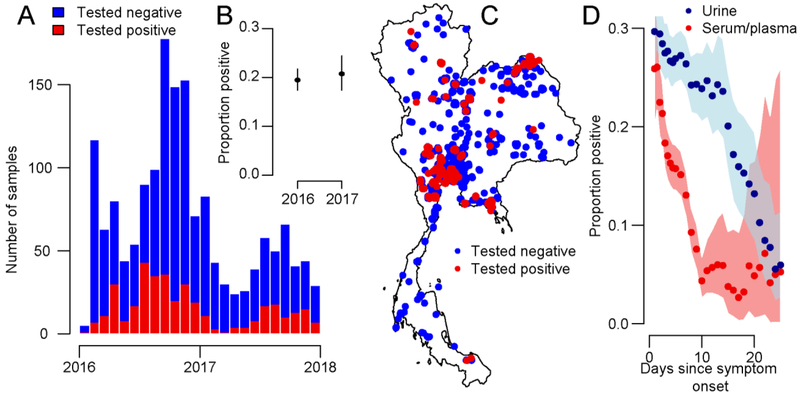
Findings: Of the 3089 samples from 1717 symptomatic individuals tested between January, 2016, and December, 2017, 368 were confirmed to have Zika virus infection. Cases of Zika virus infection were reported throughout the year, and from 29 of the 76 Thai provinces. Individuals had 2·8 times (95% CI 2·3-3·6) the odds of testing positive for Zika virus infection if they came from the same district and were sick within the same year of a person with a confirmed infection relative to the odds of testing positive anywhere, consistent with focal transmission. The probability of cases being younger than 10 years was 0·99 times (0·72-1·30) the probability of being that age in the underlying population. This probability rose to 1·62 (1·33-1·92) among those aged 21-30 years and fell to 0·53 (0·40-0·66) for those older than 50 years. This age distribution is consistent with that observed in the Zika virus epidemic in Colombia. Phylogenetic reconstructions suggest persistent circulation within Thailand since at least 2002.
Interpretation: Our evidence shows that Zika virus has circulated at a low but sustained level for at least 16 years, suggesting that Zika virus can adapt to persistent endemic transmission. Health systems need to adapt to cope with regular occurrences of the severe complications associated with infection.
Funding: European Research Council, National Science Foundation, and National Institutes of Health.
Copyright © 2019 Elsevier Ltd. All rights reserved.
Conflict of interest statement
Figures


Comment in
-
The genesis of the Ebola virus outbreak in west Africa.Lancet Infect Dis. 2019 Apr;19(4):348-349. doi: 10.1016/S1473-3099(19)30055-6. Epub 2019 Feb 21. Lancet Infect Dis. 2019. PMID: 30799253 No abstract available.
-
Endemic Zika virus transmission: implications for travellers.Lancet Infect Dis. 2019 Apr;19(4):349-351. doi: 10.1016/S1473-3099(18)30793-X. Epub 2019 Feb 27. Lancet Infect Dis. 2019. PMID: 30826191 Free PMC article. No abstract available.
-
Zika's passage to India.Lancet Infect Dis. 2019 May;19(5):469-470. doi: 10.1016/S1473-3099(19)30169-0. Lancet Infect Dis. 2019. PMID: 31034391 No abstract available.