. 2019 Mar 7;104(3):530-541.
doi: 10.1016/j.ajhg.2019.01.010. Epub 2019 Feb 28.

Missense Variants in the Histone Acetyltransferase Complex Component Gene TRRAP Cause Autism and Syndromic Intellectual Disability

Benjamin Cogné  1 Sophie Ehresmann  2 Eliane Beauregard-Lacroix  2 Justine Rousseau  2 Thomas Besnard  1 Thomas Garcia  2 Slavé Petrovski  3 Shiri Avni  4 Kirsty McWalter  5 Patrick R Blackburn  6 Stephan J Sanders  7 Kévin Uguen  8 Jacqueline Harris  9 Julie S Cohen  10 Moira Blyth  11 Anna Lehman  12 Jonathan Berg  13 Mindy H Li  14 Usha Kini  15 Shelagh Joss  16 Charlotte von der Lippe  17 Christopher T Gordon  18 Jennifer B Humberson  19 Laurie Robak  20 Daryl A Scott  21 Vernon R Sutton  22 Cara M Skraban  23 Jennifer J Johnston  24 Annapurna Poduri  25 Magnus Nordenskjöld  26 Vandana Shashi  27 Erica H Gerkes  28 Ernie M H F Bongers  29 Christian Gilissen  29 Yuri A Zarate  30 Malin Kvarnung  26 Kevin P Lally  31 Peggy A Kulch  32 Brina Daniels  30 Andres Hernandez-Garcia  33 Nicholas Stong  34 Julie McGaughran  35 Kyle Retterer  5 Kristian Tveten  36 Jennifer Sullivan  27 Madeleine R Geisheker  37 Asbjorg Stray-Pedersen  38 Jennifer M Tarpinian  39 Eric W Klee  40 Julie C Sapp  24 Jacob Zyskind  5 Øystein L Holla  36 Emma Bedoukian  39 Francesca Filippini  18 Anne Guimier  41 Arnaud Picard  42 Øyvind L Busk  36 Jaya Punetha  33 Rolph Pfundt  29 Anna Lindstrand  26 Ann Nordgren  26 Fayth Kalb  43 Megha Desai  5 Ashley Harmon Ebanks  31 Shalini N Jhangiani  44 Tammie Dewan  12 Zeynep H Coban Akdemir  33 Aida Telegrafi  5 Elaine H Zackai  23 Amber Begtrup  5 Xiaofei Song  33 Annick Toutain  45 Ingrid M Wentzensen  5 Sylvie Odent  46 Dominique Bonneau  47 Xénia Latypova  1 Wallid Deb  1 CAUSES Study  12 Sylvia Redon  8 Frédéric Bilan  48 Marine Legendre  48 Caitlin Troyer  19 Kerri Whitlock  49 Oana Caluseriu  49 Marine I Murphree  50 Pavel N Pichurin  50 Katherine Agre  50 Ralitza Gavrilova  51 Tuula Rinne  29 Meredith Park  52 Catherine Shain  53 Erin L Heinzen  34 Rui Xiao  54 Jeanne Amiel  41 Stanislas Lyonnet  41 Bertrand Isidor  1 Leslie G Biesecker  24 Dan Lowenstein  55 Jennifer E Posey  33 Anne-Sophie Denommé-Pichon  47 Deciphering Developmental Disorders study  56 Claude Férec  8 Xiang-Jiao Yang  57 Jill A Rosenfeld  33 Brigitte Gilbert-Dussardier  48 Séverine Audebert-Bellanger  58 Richard Redon  59 Holly A F Stessman  60 Christoffer Nellaker  61 Yaping Yang  54 James R Lupski  62 David B Goldstein  34 Evan E Eichler  63 Francois Bolduc  64 Stéphane Bézieau  1 Sébastien Küry  65 Philippe M Campeau  66
Affiliations

Missense Variants in the Histone Acetyltransferase Complex Component Gene TRRAP Cause Autism and Syndromic Intellectual Disability

Benjamin Cogné et al. Am J Hum Genet. .

Abstract

Acetylation of the lysine residues in histones and other DNA-binding proteins plays a major role in regulation of eukaryotic gene expression. This process is controlled by histone acetyltransferases (HATs/KATs) found in multiprotein complexes that are recruited to chromatin by the scaffolding subunit transformation/transcription domain-associated protein (TRRAP). TRRAP is evolutionarily conserved and is among the top five genes intolerant to missense variation. Through an international collaboration, 17 distinct de novo or apparently de novo variants were identified in TRRAP in 24 individuals. A strong genotype-phenotype correlation was observed with two distinct clinical spectra. The first is a complex, multi-systemic syndrome associated with various malformations of the brain, heart, kidneys, and genitourinary system and characterized by a wide range of intellectual functioning; a number of affected individuals have intellectual disability (ID) and markedly impaired basic life functions. Individuals with this phenotype had missense variants clustering around the c.3127G>A p.(Ala1043Thr) variant identified in five individuals. The second spectrum manifested with autism spectrum disorder (ASD) and/or ID and epilepsy. Facial dysmorphism was seen in both groups and included upslanted palpebral fissures, epicanthus, telecanthus, a wide nasal bridge and ridge, a broad and smooth philtrum, and a thin upper lip. RNA sequencing analysis of skin fibroblasts derived from affected individuals skin fibroblasts showed significant changes in the expression of several genes implicated in neuronal function and ion transport. Thus, we describe here the clinical spectrum associated with TRRAP pathogenic missense variants, and we suggest a genotype-phenotype correlation useful for clinical evaluation of the pathogenicity of the variants.

Keywords: TRRAP; autism spectrum disorder; congenital malformations; de novo variants; histone acetylation; intellectual disability; neurodevelopmental disorders.


Figures

Figure 1
Figure 1
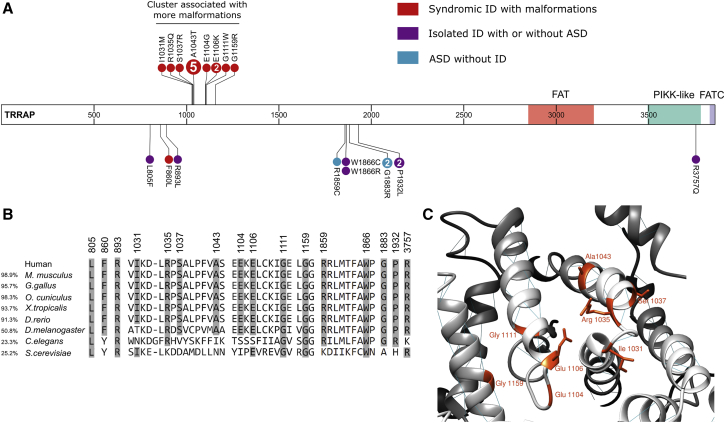
Genotype-Phenotype Correlation Associated with TRRAP Variants (A) Predicted de novo and apparently de novo variants in affected individuals are represented on the TRRAP protein. The variants in red represent individuals with apparent ID and malformations, the variants in purple represent individuals with isolated ID with or without ASD, and the variants in blue represent individuals with only ASD and an IQ above 70. If more than one individual was heterozygous for the variant, the number of affected individuals is indicated in the circle. Adapted from ProteinPaint. (B) Amino acid conservation of each mutated residue. The overall amino acid similarity with the human sequence is shown on the left. (C) Homology model of human TRRAP (GenBank: NP_001231509.1) predicted by PHYRE2 Protein Fold Recognition Server represented by UCSF Chimera. Mutated residues in the 1031–1159 cluster are shown. Abbreviations are as follows: FAT—FRAP, ATM, and TRRAP; PIKK-like—phosphatidylinositol 3-kinase-related protein kinase-like; and FATC—FRAP, ATM, and TRRAP C-terminal.
Figure 2
Figure 2
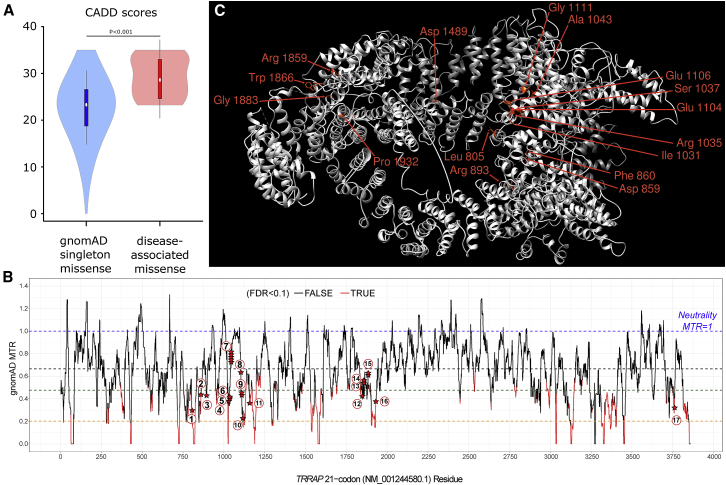
TRRAP Sequence Is Intolerant to Missense Variants (A) CADD scores of the 17 variants identified in affected individuals are compared to scores for gnomAD singleton missense variants. In order to avoid CADD training circularity, we compared the individuals’ variants to variants seen once in gnomAD. (B) TRRAP missense tolerance ratio (MTR) plot. The MTR is a statistic that quantifies the extent of purifying selection that has been acting specifically against missense variants in the human population. For TRRAP, we adopted the 21-codon sliding window and used exome-sequencing standing-variation data in the gnomAD database, version 2.0. MTR data were downloaded from Missense Tolerance Ratio (MTR) Gene Viewer (see Web Resources). An MTR = 1 (blue dashed line) represents neutrality (i.e., observing the same proportion of missense variants in the window as expected on the basis of the underlying sequence context). Red segments of the MTR plot have achieved exome-wide FDR<0.10 for a significance test of a window’s deviation from MTR = 1. The black dashed line signifies gene-specific median MTR, the brown dashed line signifies gene-specific 25th centile MTR, and the orange dashed line signifies gene-specific fifth centile MTR. The locations of our 23 case-ascertained de novo variants are denoted by red stars along TRRAP’s MTR plot. The 17 different variants are numbered within circles as follows: (1) p.Leu805Phe; (2) p.Phe860Leu; (3) p.Arg893Leu; (4) p.Ile1031Met; (5) p.Arg1035Gln; (6) p.Ser1037Arg; (7) p.Ala1043Thr; (8) p.Glu1104Gly; (9) p.Glu1106Lys; (10) p.Gly1111Trp; (11) p.Gly1159Arg; (12) p.Arg1859Cys; (13) p.Trp1866Arg; (14) p.Trp1866Cys; (15) p.Gly1883Arg; (16) p.Pro1932Leu; and (17) p.Arg3757Gln. We found that de novo variants were significantly enriched in the intolerant 50% of TRRAP’s protein-coding sequence; 18 (78%) of the 23 de novo events affected the most intolerant 50% of the TRRAP sequence (binomial exact test p = 0.01). Strikingly, only the most recurring de novo missense variant (GenBank: NM_001244580.1 p. Ala1043Thr) resided outside of the intolerant TRRAP sequence. (C) Localization of the mutated TRRAP residues on 3D protein models including 14 out of 17 likely pathogenic variants and two out of six additional variants of unknown significance are shown. The representation of the structure of human TRRAP (GenBank: NP_001231509.1) was predicted by PHYRE2 Protein Fold Recognition Server by comparison to its Saccharomyces cerevisiae ortholog, according to the cryo-EM structure of the SAGA (Spt-Ada-Gcn5-acetyltransferase) and NuA4 coactivator subunit Tra1 present in the protein data bank (PDB: 5OJS). Variants in regions non-homologous to Tra1 are not represented. Structure representation was made with UCSF Chimera.
Figure 3
Figure 3
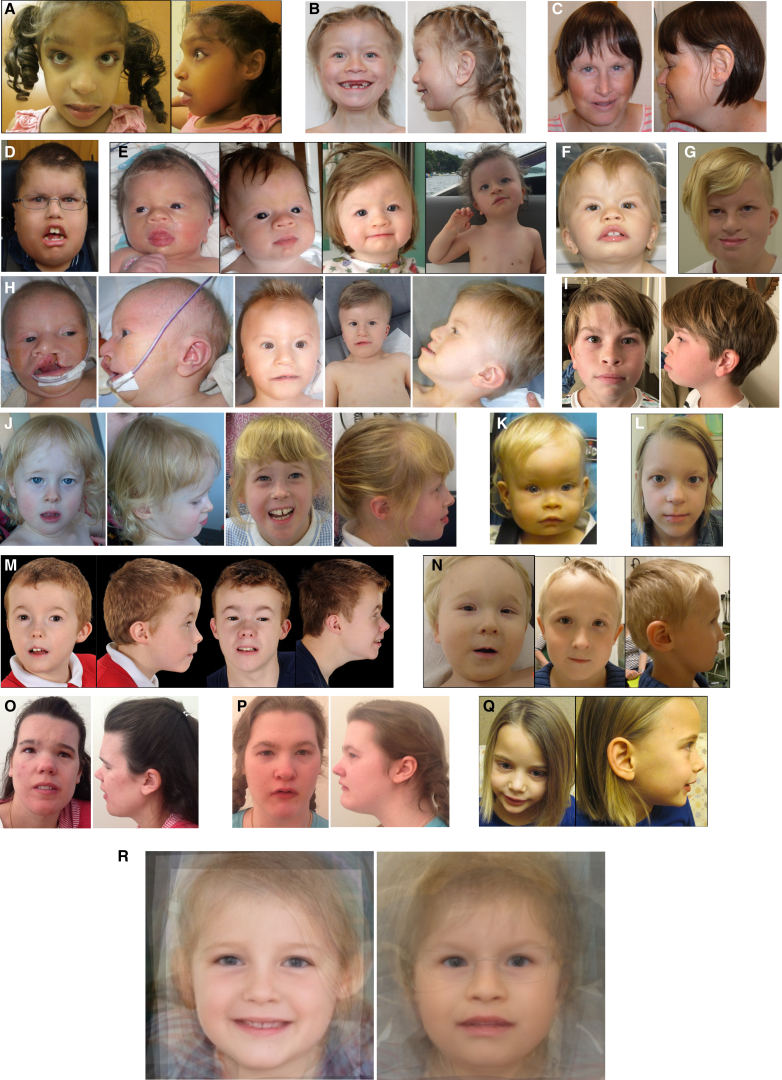
Photographs of Individuals with TRRAP Variants (A) Individual 1 at the age of 8 years. Note the telecanthus, broad nasal bridge, widely spaced eyes, relatively thin upper vermilion, flared eyebrows, and ectropion. (B) Individual 5 at the age of 8.5 years. Note the wide mouth, thin upper lip, and widely spaced eyes with a wide and depressed nasal bridge. (C) Individual 6 at the age of 29 years. Note the sparse eyebrows, upslanting palpebral fissures, smooth philtrum, thin upper lip, and low columella. (D) Individual 9 at the age of 11 years. Note the deeply set eyes, sparse eyebrows, and wide nasal bridge. (E) Individual 8. Note the telecanthus, low-set ears with upturned earlobes, and, on the fourth picture from the left, the single transverse palmar crease. (F) Individual 12 at the age of 5 years. Note the prominent forehead, arched eyebrows, short palpebral fissures, epicanthal folds, depressed nasal bridge, and thick upper vermilion. (G) Individual 13 at the age of 14 years. Note the upslanted palpebral fissures and prominent forehead. (H) Individual 10 at the ages of 1 month, 16 months, and 3 years. Note the cleft lip and palate, wide mouth, epicanthic fold, prognathism, and supernumerary nipples. (I) Individual 15 at the age of 12 years. Note the wide nasal bridge and upslanting palpebral fissures. (J) Individual 19 at the ages of 2.5 years and 8 years. Note folded-down upper eyelid and sparse medial eyebrows. (K) Individual 16 at the age of 2 years. Note the prominent forehead, epicanthic fold, telecanthus, flat nasal bridge, and low-set ears. (L) Individual 20 at the age of 10 years. Note the widely spaced eyes, telecanthus, wide nasal bridge and ridge, and thin upper vermilion. (M) Individual 18. Note the narrow nose, flared eyebrows, almond-shaped eyes with hypoplastic infraorbital ridges, telecanthus, smooth philtrum, and small, low-set, and posteriorly rotated ears. (N) Individual 21. Note the short palpebral fissures, epicanthal folds, and thin upper vermilion. (O) Individual 22 at the age of 24 years. Note the broad nasal bridge, deeply set eyes, upslanted palpebral fissures, widely spaced eyes, and posteriorly rotated ears. (P) Individual 23 at the age of 19 years. Note the deeply set eyes, upslanted palpebral fissures, widely spaced eyes, epicanthal folds, and posteriorly rotated ears. (Q) Individual 24. Note the smooth philtrum and wide nasal ridge. (R) Average facial gestalt visualization of nine healthy age- and gender-matched controls on the left; on the right, nine individuals with variants in the 1031–1159 cluster. Facial images are flipped and aligned to preserve bilateral asymmetry.

References

    1. Bowman G.D., Poirier M.G. Post-translational modifications of histones that influence nucleosome dynamics. Chem. Rev. 2015;115:2274–2295. - PMC - PubMed
    1. Venkatesh S., Workman J.L. Histone exchange, chromatin structure and the regulation of transcription. Nat. Rev. Mol. Cell Biol. 2015;16:178–189. - PubMed
    1. Hunt C.R., Ramnarain D., Horikoshi N., Iyengar P., Pandita R.K., Shay J.W., Pandita T.K. Histone modifications and DNA double-strand break repair after exposure to ionizing radiations. Radiat. Res. 2013;179:383–392. - PMC - PubMed
    1. Legube G., Trouche D. Regulating histone acetyltransferases and deacetylases. EMBO Rep. 2003;4:944–947. - PMC - PubMed
    1. Berndsen C.E., Denu J.M. Catalysis and substrate selection by histone/protein lysine acetyltransferases. Curr. Opin. Struct. Biol. 2008;18:682–689. - PMC - PubMed

Publication types

MeSH terms

Substances