


A Geometric Approach to Archetypal Analysis and Nonnegative Matrix Factorization
- PMID: 30828109
- PMCID: PMC6393938
- DOI: 10.1080/00401706.2016.1247017
A Geometric Approach to Archetypal Analysis and Nonnegative Matrix Factorization
Abstract
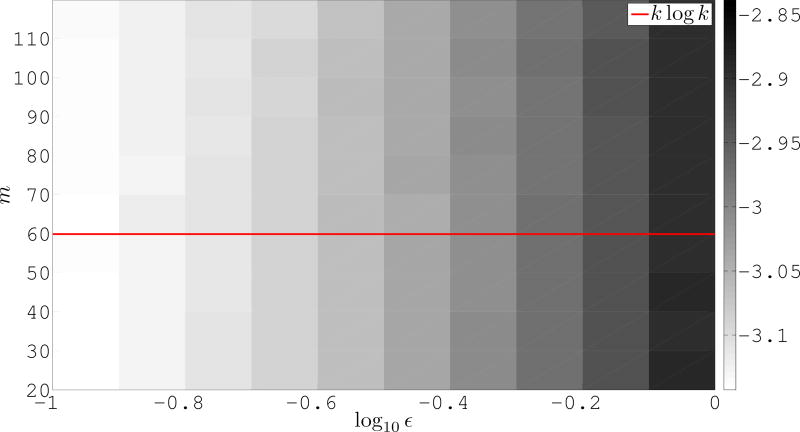
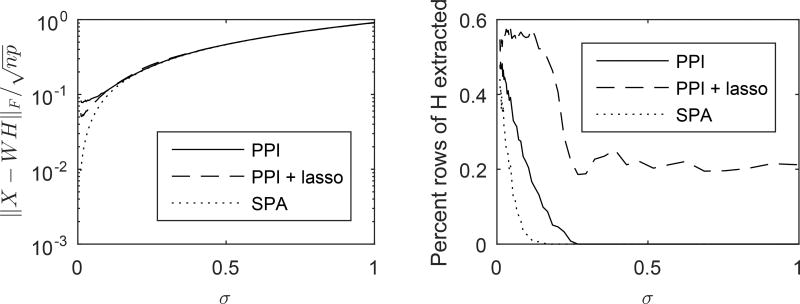
Archetypal analysis and non-negative matrix factorization (NMF) are staples in a statisticians toolbox for dimension reduction and exploratory data analysis. We describe a geometric approach to both NMF and archetypal analysis by interpreting both problems as finding extreme points of the data cloud. We also develop and analyze an efficient approach to finding extreme points in high dimensions. For modern massive datasets that are too large to fit on a single machine and must be stored in a distributed setting, our approach makes only a small number of passes over the data. In fact, it is possible to obtain the NMF or perform archetypal analysis with just two passes over the data.
Keywords: convex hull; group lasso; random projections.
Figures
References
-
- Arora S, Ge R, Kannan R, Moitra A. Computing a nonnegative matrix factorization – provably; Proceedings of the 44th symposium on Theory of Computing; 2012. pp. 145–162.
-
- Ball K. An elementary introduction to modern convex geometry. Flavors of geometry. 1997;31:1–58.
-
- Bittorf V, Recht B, Re C, Tropp J. Factoring nonnegative matrices with linear programs. Advances in Neural Information Processing Systems. 2012;25:1223–1231.
-
- Boardman J. Geometric mixture analysis of imaging spectrometry data. Geoscience and Remote Sensing Symposium (IGARSS) ’94. 1994;4:2369–2371. vol.4.
-
- Chang C-I, Plaza A. A fast iterative algorithm for implementation of pixel purity index. Geoscience and Remote Sensing Letters, IEEE. 2006;3:63–67.
Grants and funding
LinkOut - more resources
Full Text Sources
Other Literature Sources