


Time trends in prescribing of type 2 diabetes drugs, glycaemic response and risk factors: A retrospective analysis of primary care data, 2010-2017
- PMID: 30828962
- PMCID: PMC6618851
- DOI: 10.1111/dom.13687
Time trends in prescribing of type 2 diabetes drugs, glycaemic response and risk factors: A retrospective analysis of primary care data, 2010-2017
Abstract
Aim: To describe population-level time trends in prescribing patterns of type 2 diabetes therapy, and in short-term clinical outcomes (glycated haemoglobin [HbA1c], weight, blood pressure, hypoglycaemia and treatment discontinuation) after initiating new therapy.
Materials and methods: We studied 81 532 people with type 2 diabetes initiating a first- to fourth-line drug in primary care between 2010 and 2017 inclusive in United Kingdom electronic health records (Clinical Practice Research Datalink). Trends in new prescriptions and subsequent 6- and 12-month adjusted changes in glycaemic response (reduction in HbA1c), weight, blood pressure and rates of hypoglycaemia and treatment discontinuation were examined.
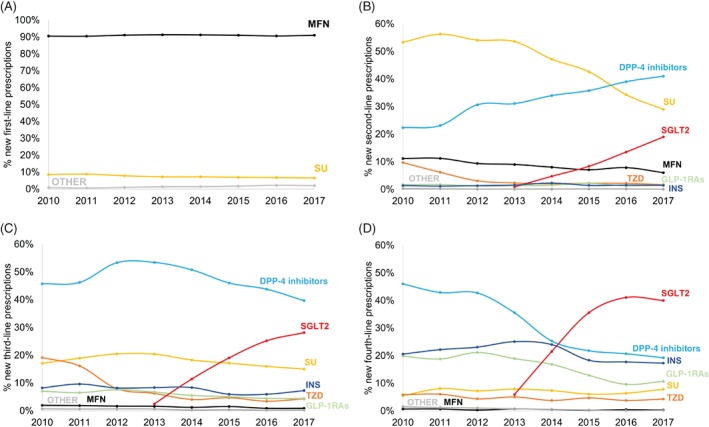
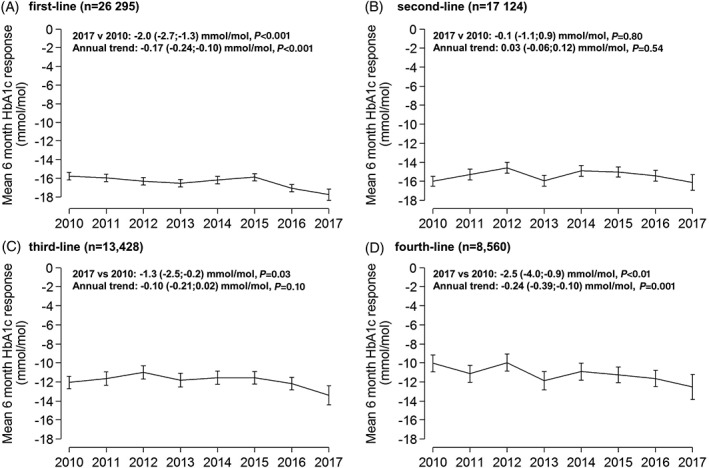
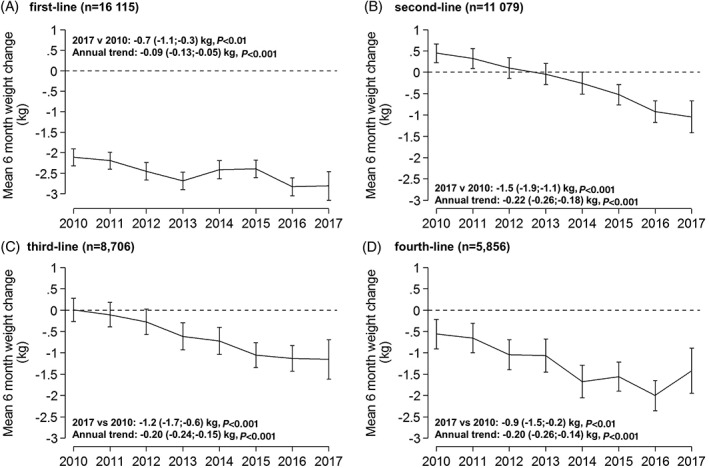
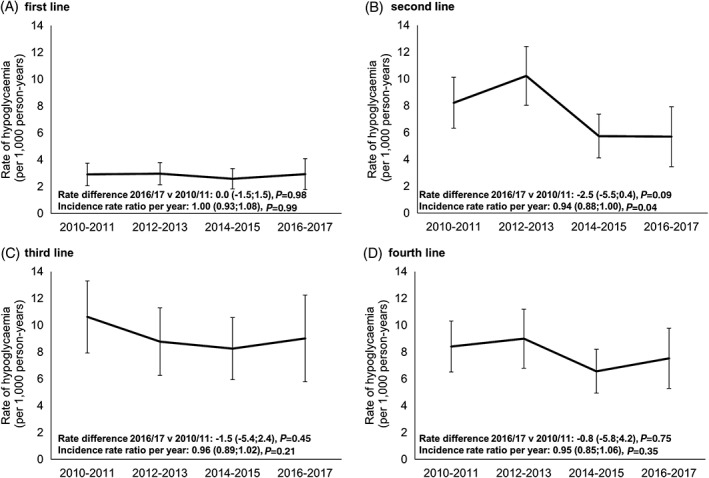
Results: Use of dipeptidyl peptidase-4 inhibitors as second-line therapy near doubled (41% of new prescriptions in 2017 vs. 22% in 2010), replacing sulphonylureas as the most common second-line drug (29% in 2017 vs. 53% in 2010). Sodium-glucose co-transporter-2 inhibitors, introduced in 2013, comprised 17% of new first- to fourth-line prescriptions by 2017. First-line use of metformin remained stable (91% of new prescriptions in 2017 vs. 91% in 2010). Over the study period there was little change in average glycaemic response and in the proportion of people discontinuing treatment. There was a modest reduction in weight after initiating second- and third-line therapy (improvement in weight change 2017 vs. 2010 for second-line therapy: -1.5 kg, 95% confidence interval [CI] -1.9, -1.1; P < 0.001), and a slight reduction in systolic blood pressure after initiating first-, second- and third-line therapy (improvement in systolic blood pressure change 2017 vs. 2010 range: -1.7 to -2.1 mmHg; all P < 0.001). Hypoglycaemia rates decreased over time with second-line therapy (incidence rate ratio 0.94 per year, 95% CI 0.88, 1.00; P = 0.04), mirroring the decline in use of sulphonylureas.
Conclusions: Recent changes in prescribing of therapy for people with type 2 diabetes have not led to a change in glycaemic response and have resulted in modest improvements in other population-level short-term clinical outcomes.
Keywords: SGLT2 inhibitor; glycaemic control; hypoglycaemia; primary care; type 2 diabetes; weight control.
© 2019 The Authors. Diabetes, Obesity and Metabolism published by John Wiley & Sons Ltd.
Conflict of interest statement
W.E.H. has received a grant from IQVIA. A.P.M. has received grants from Eli Lilly and Pfizer. E.R.P. has received personal fees from Eli Lilly, MSD and Novo Nordisk. N.A.S. has received personal fees from Amgen, Astra Zeneca, Boehringer Ingelheim, Eli Lilly, Janssen, Sanofi, Novo Nordisk, and a grant from Boehringer Ingelheim. R.H.H. has received personal fees from Bayer, Boehringer Ingelheim, Novartis, Amgen, Elcelyx, GSK, Jannsen, Servier and Takeda. Representatives from GSK, Takeda, Janssen, Quintiles, AstraZeneca and Sanofi attend meetings as part of the industry group involved with the MASTERMIND consortium. No industry representatives were involved in the writing of the manuscript or analysis of data. For all authors these fees/grant were outside the submitted work; no other relationships or activities that could appear to have influenced the submitted work are declared.
Figures
References
-
- National Institute for Health and Care Excellence. Type 2 diabetes in adults: management. NICE guideline (NG28). https://www.nice.org.uk/guidance/NG28. Published 2015. Accessed May 15, 2018.
-
- American Diabetes Association. 8. Pharmacologic Approaches to Glycemic Treatment. Diabetes Care. 2017;40(Suppl 1):S64‐S74. - PubMed
-
- Qaseem A, Barry MJ, Humphrey LL, Forciea MA. Clinical guidelines Committee of the American College of Physicians. Oral Pharmacologic treatment of type 2 diabetes mellitus: a clinical practice guideline update from the American College of Physicians. Ann Intern Med. 2017;166(4):279‐290. - PubMed
-
- Montvida O, Shaw J, Atherton JJ, Stringer F, Paul SK. Long‐term trends in antidiabetes drug usage in the U.S.: real‐world evidence in patients newly diagnosed with type 2 diabetes. Diabetes Care. 2018;41(1):69‐78. - PubMed
Publication types
MeSH terms
Substances
Grants and funding
LinkOut - more resources
Full Text Sources
Medical
Molecular Biology Databases
