


APRIL/BLyS Blockade Reduces Donor-specific Antibodies in Allosensitized Mice
- PMID: 30830041
- PMCID: PMC6594891
- DOI: 10.1097/TP.0000000000002686
APRIL/BLyS Blockade Reduces Donor-specific Antibodies in Allosensitized Mice
Abstract
Background: Highly sensitized candidates on the transplant waitlist remain a significant challenge, as current desensitization protocols have variable success rates of donor-specific antibody (DSA) reduction. Therefore, improved therapies are needed. A proliferation-inducing ligand (APRIL) and B-lymphocyte stimulator (BLyS) are critical survival factors for B-lymphocytes and plasma cells, which are the primary sources of alloantibody production. We examined the effect of APRIL/BLyS blockade on DSA in a murine kidney transplant model as a possible novel desensitization strategy.
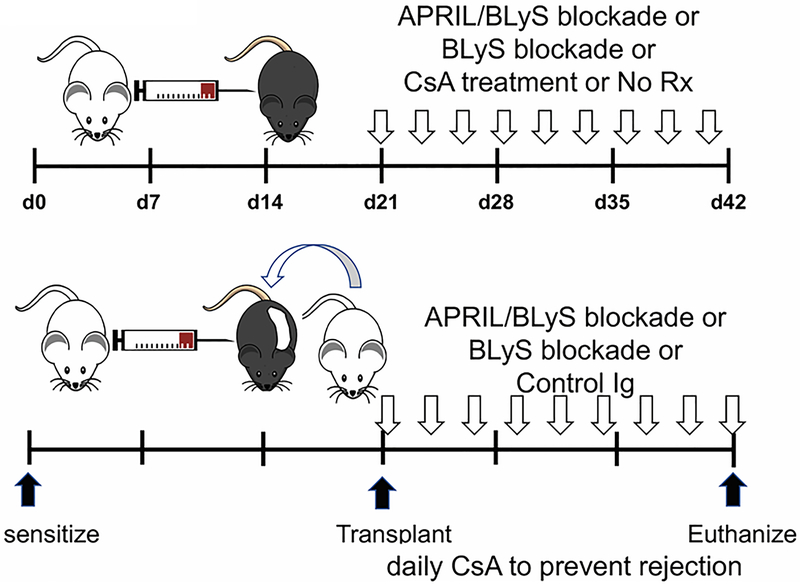
Methods: C57BL/6 mice were sensitized with intraperitoneal (IP) injections of 2 × 10 BALB/c splenocytes. Twenty-one days following sensitization, animals were treated with 100 μg of BLyS blockade (B-cell activating factor receptor-immunoglobulin) or APRIL/BLyS blockade (transmembrane activator and calcium modulator and cyclophilin ligand interactor-immunoglobulin), administered thrice weekly for an additional 21 days. Animals were then euthanized or randomized to kidney transplant with Control Ig, BLyS blockade, or APRIL/BLyS blockade. Animals were euthanized 7 days posttransplant. B-lymphocytes and DSA of BLyS blockade only or APRIL/BLyS blockade-treated mice were assessed by flow cytometry, immunohistochemistry, and enzyme-linked immunospot.
Results: APRIL/BLyS inhibition resulted in a significant reduction of DSA by flow crossmatch compared with controls (P < 0.01). APRIL/BLyS blockade also significantly depleted IgM- and IgG-secreting cells and B-lymphocyte populations compared to controls (P < 0.0001). APRIL/BLyS blockade in transplanted mice also resulted in decreased B-lymphocyte populations; however, no difference in rejection rates were seen between groups.
Conclusions: APRIL/BLyS blockade with transmembrane activator and calcium modulator and cyclophilin ligand interactor-immunoglobulin significantly depleted B-lymphocytes and reduced DSA in this sensitized murine model. APRIL/BLyS inhibition may be a clinically useful desensitization strategy for sensitized transplant candidates.
Conflict of interest statement
Disclosures and conflicts of interest:
Robert Redfield: Murine TACI-Ig and BAFFR-Ig were generously provided by Merck Serono. Outside the submitted work, grants and personal fees were received from Genentech, GlaxoSmithKline, Roche.
All other authors have no disclosures or conflicts of interest.
Figures
 ); sensitized d21 mice (
 ); sensitized untreated mice (
 ); sensitized mice treated with 30 mg/kg CsA daily (
 ); sensitized mice treated with BLyS blockade (
 ); sensitized mice treated with APRIL/BLyS blockade (
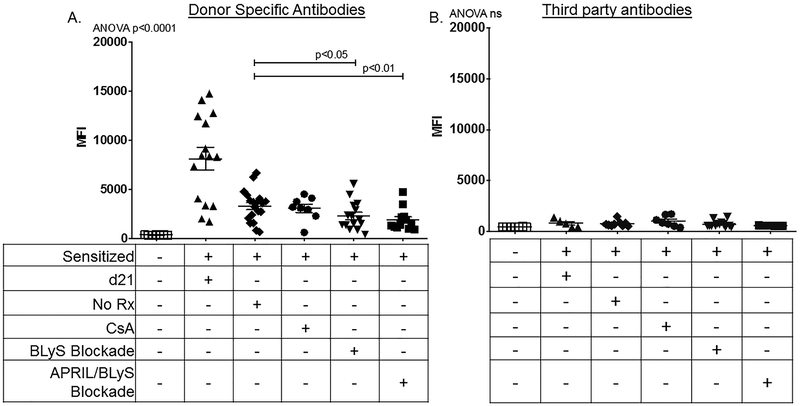
 ). A) Flow crossmatch was performed by incubating sera with BALB/c (H2d) splenocytes. In all figures, the tables below the figures indicate the treatments that were given to each group. No Rx means no treatment for 21 days after the 21 day sensitization period. We observed a significant decrease in circulating DSA in sensitized mice given APRIL/BLyS blockade compared with sensitized untreated mice (P < 0.01). We observed a significant decrease in DSA in BLyS blockade only treated mice when compared to sensitized untreated mice (P < 0.05). B) We tested for third party alloantibodies by repeating the flow crossmatch using CBA (H2k) splenocytes. Very little reactivity was observed, and none was significantly different between groups.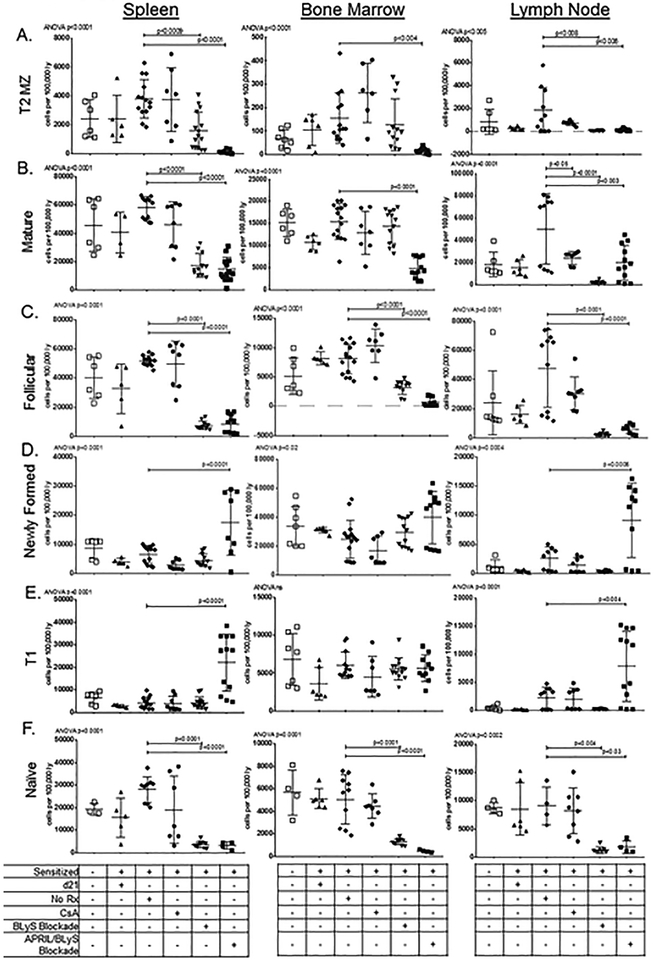
 ); sensitized d21 mice (
 ); sensitized untreated mice (
 ); sensitized mice treated with 30 mg/kg CsA daily (
 ); sensitized mice treated with BLyS blockade (
 ); sensitized mice treated with APRIL/BLyS blockade (
 ). Tissues were collected at time of euthanasia, 21 days after sensitization and after receiving 21 days of treatment. Control groups were held for the same amount of time, to ensure that they were age matched. Subsets are listed on the side, tissues are labeled on the top. All values are reported as number of cells per 100 000 lymphocytes. A) T2 MZ B-lymphocytes were significantly decreased in sensitized APRIL/BLyS blockade treated mice in spleen and BM when compared to sensitized untreated mice. Sensitized BLyS blockade-treated mice also had reduced numbers compared to untreated mice. B-C) BLyS and APRIL/BLyS blockade both depleted mature and Fo B-lymphocytes in spleen and BM compared to sensitized untreated mice. APRIL/BLyS blockade reduced mature and Fo B-lymphocytes in BM compared to sensitized untreated mice. D) Sensitized mice receiving APRIL/BLyS blockade had a significant increase in newly formed B-lymphocytes in spleen (P < 0.0001) and LN (P < 0.0006). E) Similarly, T1 B-lymphocytes were significantly increased in APRIL/BLyS blockade-treated mice in both spleen and LN when compared to sensitized untreated controls. F) Naive B cells were strongly depleted in spleen, BM and LN by both BLyS and APRIL/BLyS blockades.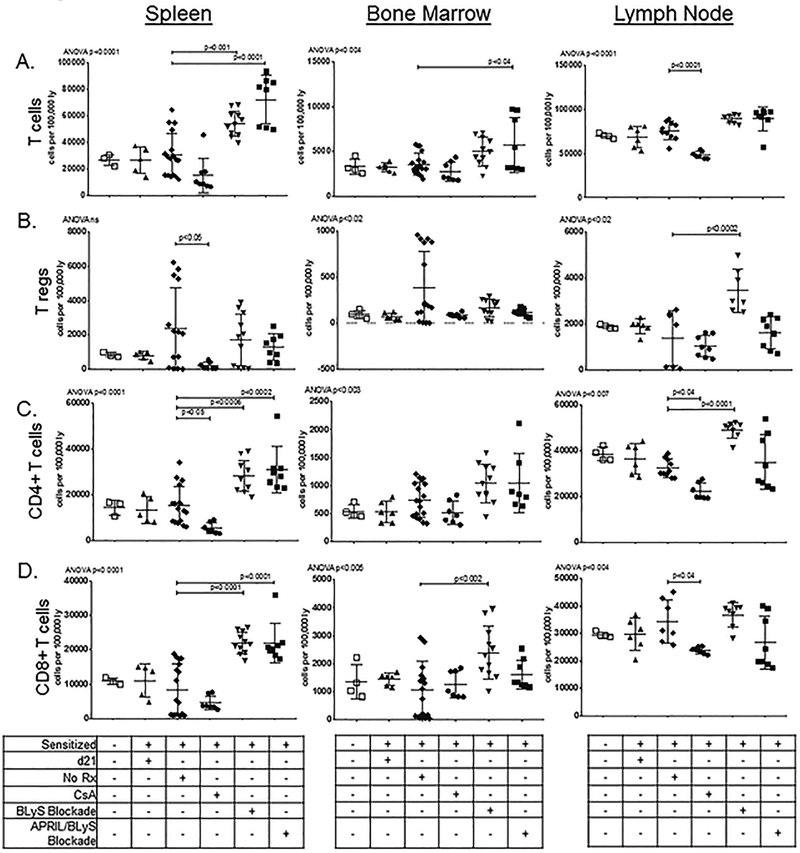
 ); sensitized d21 mice (
 ); sensitized untreated mice (
 ); sensitized mice treated with 30 mg/kg CsA daily (
 ); sensitized mice treated with BLyS blockade (
 ); sensitized mice treated with APRIL/BLyS blockade (
 ).We stained cells for CD3+, CD3+CD4+, CD3+CD8+, and for Tregs, CD25+FoxP3+ populations. A) Overall T cell populations were reduced in spleen and LNs of mice that were treated with CsA after 21d of sensitization. We also saw an overall increase in T cells in spleen with both BLyS blockade and APRIL/BLyS blockade. A less profound increase was also observed in BM of APRIL/BLyS blockade animals. In animals treated with CsA, a significant decrease in T cells was observed. B) Tregs were also depleted in splenocytes of animals that received CsA. Tregs were increased in sensitized mice treated with a BLyS blockade in LN. C) CD4+ T cells were increased in both BLyS and APRIL/BLyS blockades and decreased with CsA treatment in spleen, but only BLyS blockade increased CD4+ T cells in LNs. D) CD8+ T cells were likewise increased in both BLyS and APRIL/BLyS blockade in splenocytes, but only BLyS blockade increased CD8+ T cell populations in BM, no increase was seen in LN. A reduction in CD8+ T cells was observed in LN of CsA treated animals.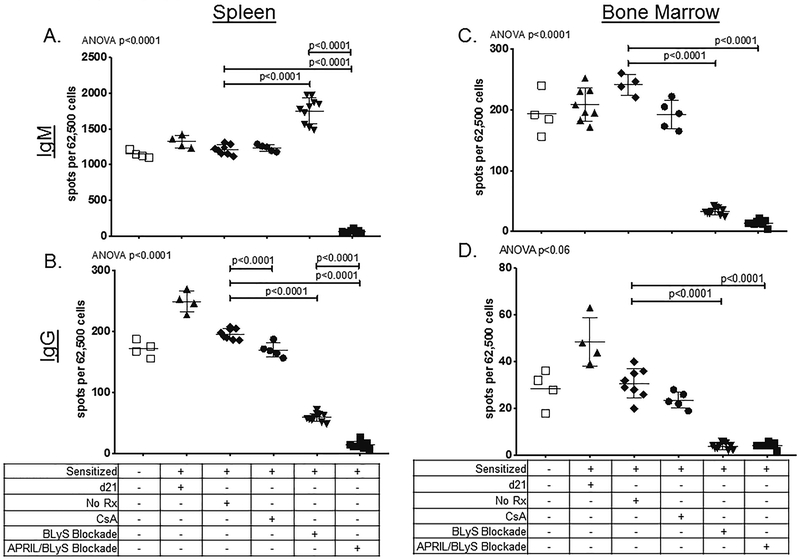
 ); sensitized d21 mice (
 ); sensitized untreated mice (
 ); sensitized mice treated with 30 mg/kg CsA daily (
 ); sensitized mice treated with BLyS blockade (
 ); sensitized mice treated with APRIL/BLyS blockade (
 ). A) In spleen, IgM secreting cells were significantly reduced by APRIL/BLyS blockade when compared to both sensitized untreated controls and BLyS blockade alone (P < 0.0001). BLyS blockade resulted in significantly increased spleen ASC producing IgM (P < 0.0001) compared to sensitized untreated. B) Both APRIL/BLyS blockade and BLyS blockade were able to significantly reduce spleen IgG secreting cells when compared to sensitized control (P < 0.0001). ASC from sensitized mice that received APRIL/BLyS blockade were also significantly reduced compared to BLyS blockade alone (P < 0.0001). C) Both APRIL/BLyS blockade and BLyS blockade significantly reduced IgM secreting cells in the BM (P < 0.0001). D) Both APRIL/BLyS and BLyS blockade were able to significantly decrease BM IgG secreting cells when compared to sensitized untreated controls (P < 0.0001, P < 0.0001).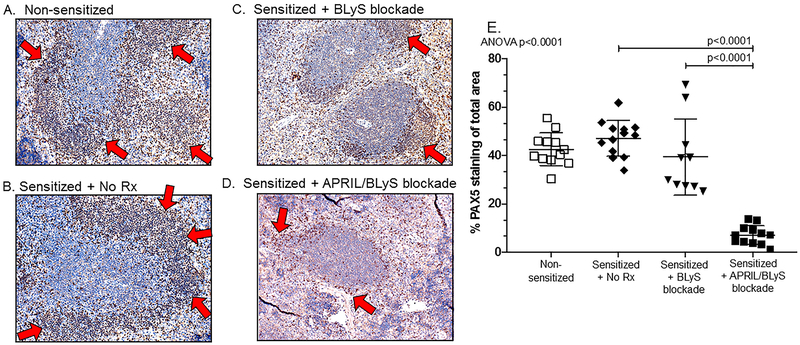
 ); sensitized untreated mice (
 ); sensitized mice treated with BLyS blockade (
 ); sensitized mice treated with APRIL/BLyS blockade (
 ). Animals treated with APRIL/BLyS blockade had a significant decrease in the number of B-lymphocytes compared to both sensitized untreated animals (P < 0.0001) as well as to BLyS blockade alone (P < 0.0001).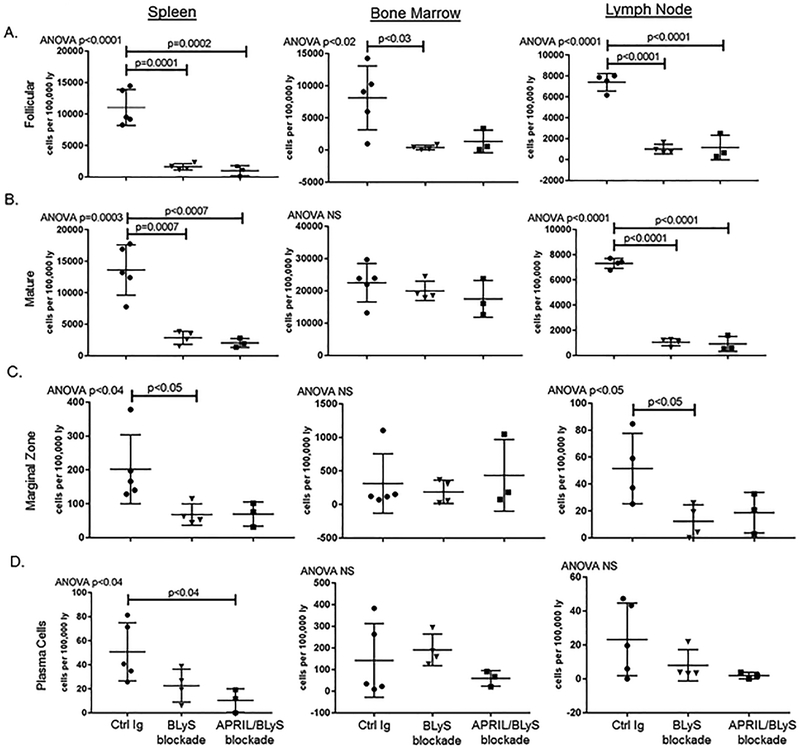
 ); BLyS blockade (
 ); or APRIL/BLyS blockade (
 ). All mice also received 30 mg/kg CsA daily after transplant. A) APRIL/BLyS blockade significantly reduced follicular B-lymphocyte subsets compared with Control Ig treated mice in spleen and LNs, but while BM follicular B-lymphocytes were reduced for both treatments, only BLyS blockade was significant. B) Mature B-lymphocytes were reduced in spleen and LNs in transplanted mice for both BLyS and APRIL/BLyS blockades, but not in BM. C) Marginal zone B-lymphocytes were reduced by both BLyS and APRIL/BLyS blockades, but only significantly for BLyS blockade. D) Plasma cells were significantly reduced in spleens of mice treated with APRIL/BLyS blockade.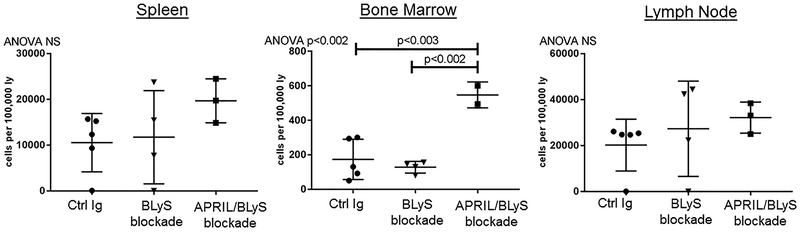
 ); BLyS blockade (
 );APRIL/BLyS blockade (
 ). All mice also received 30 mg/kg CsA daily after transplant. Treatment with APRIL/BLyS blockade increased BM CD3+CD4+T lymphocytes compared to Control Ig and BLyS blockade, but no other populations (total T cells, CD8+ T cells, or regulatory T cells) were changed by any treatment.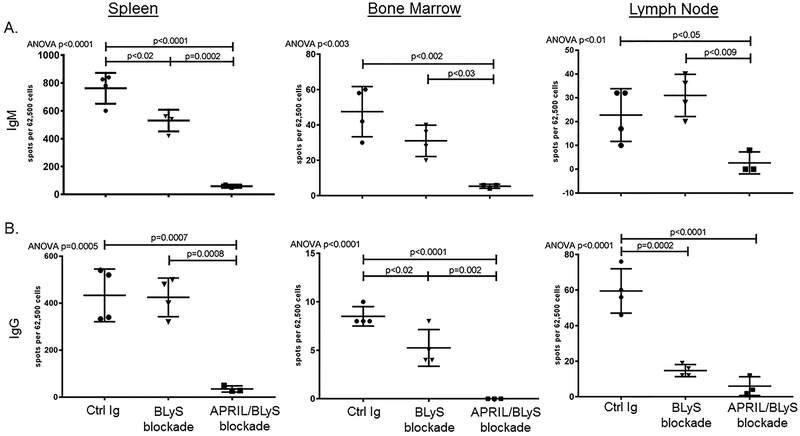
 ); BLyS blockade (
 ); APRIL/BLyS blockade (
 ). All mice also received 30 mg/kg CsA daily after transplant. A) Treatment with APRIL/BLyS blockade was more effective in reducing numbers of IgM secreting cells than BLyS blockade alone in spleen, BM and LNs. B). By contrast, IgG secreting cells were not significantly reduced in the spleen by BLyS blockade, although BLyS blockade was able to reduce antibody secreting cells in BM and LN. APRIL/BLyS blockade significantly reduced spleen and BM IgG secreting cells compared to BLyS blockade alone.
References
-
- Jordan SC, Choi J, Vo A. Kidney transplantation in highly sensitized patients. Br Med Bull. 2015;114(1):113–125. - PubMed
-
- Jordan SC, Vo AA. Donor-specific antibodies in allograft recipients: etiology, impact and therapeutic approaches. Curr Opin Organ Transplant. 2014;19(6):591–597. - PubMed
-
- Montgomery RA, Lonze BE, King KE, et al. Desensitization in HLA-incompatible kidney recipients and survival. N Engl J Med. 2011;365(4):318–326. - PubMed
-
- Manook M, Koeser L, Ahmed Z, et al. Post-listing survival for highly sensitised patients on the UK kidney transplant waiting list: a matched cohort analysis. Lancet. 2017;389(10070):727–734. - PubMed
Publication types
MeSH terms
Substances
Grants and funding
LinkOut - more resources
Full Text Sources
Medical
Miscellaneous
