


Cancer-Related Beliefs and Perceptions in Appalachia: Findings from 3 States
- PMID: 30830984
- PMCID: PMC7219572
- DOI: 10.1111/jrh.12359
Cancer-Related Beliefs and Perceptions in Appalachia: Findings from 3 States
Abstract
Background: Appalachians experience increased rates of cancer incidence and mortality compared to non-Appalachians. Many factors may contribute to the elevated cancer burden, including lack of knowledge and negative beliefs about the disease.
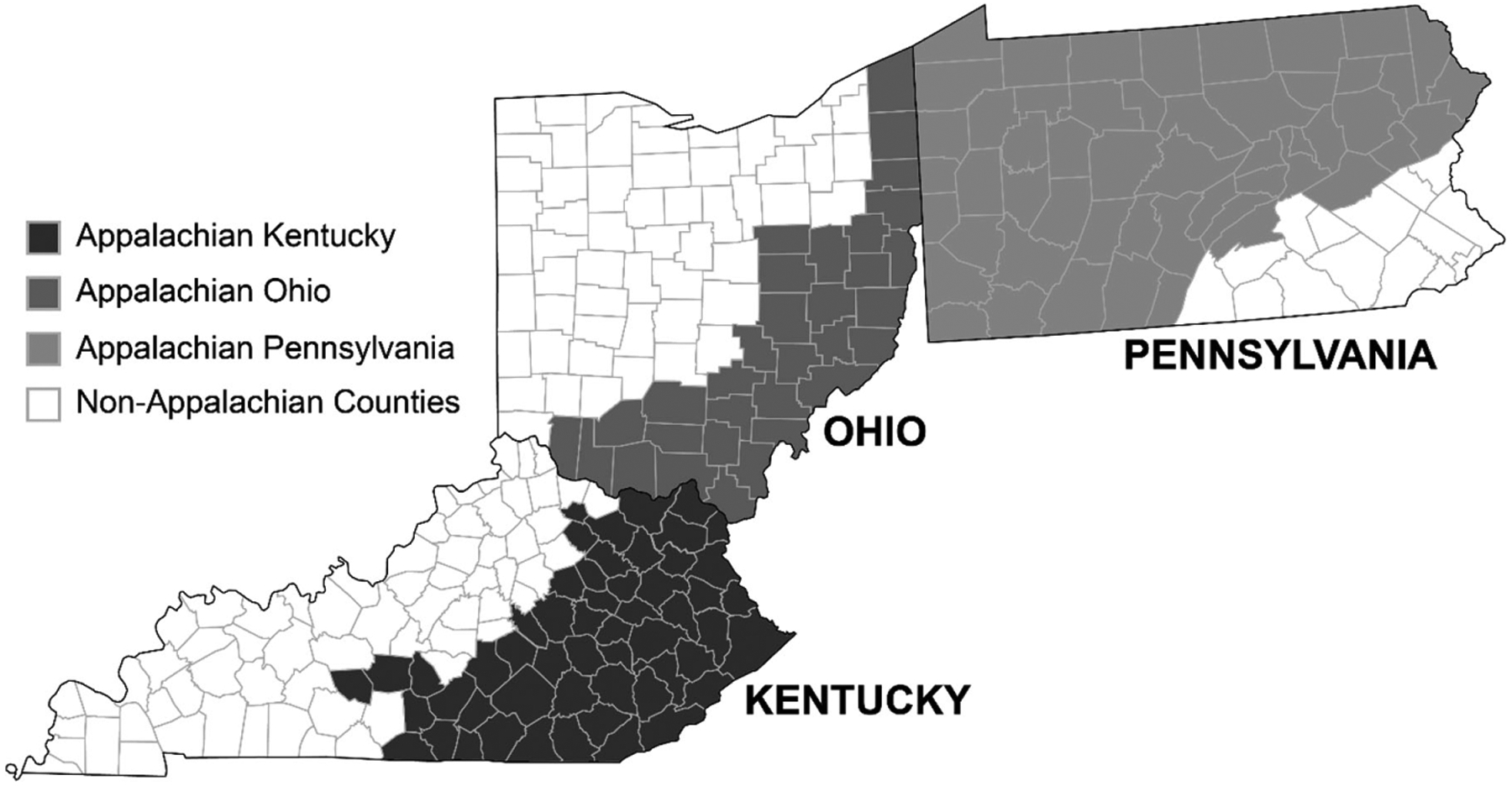
Methods: Three National Cancer Institute (NCI)-designated cancer centers with Appalachian counties in their respective population-based geographic service areas-Kentucky, Ohio, and Pennsylvania-surveyed their communities to better understand their health profiles, including 5 items assessing cancer beliefs. Weighted univariate and bivariate statistics were calculated for each of the 3 state's Appalachian population and for a combined Appalachian sample. Weighted multiple linear regression was used to identify factors associated with a cancer beliefs composite score. Data from the combined Appalachian sample were compared to NCI's Health Information National Trends Survey (HINTS).
Results: Data from 1,891 Appalachian respondents were included in the analysis (Kentucky = 798, Ohio = 112, Pennsylvania = 981). Significant differences were observed across the 3 Appalachian populations related to income, education, marital status, rurality, perceptions of present income, and body mass index (BMI). Four of 5 cancer beliefs were significantly different across the 3 states. Education, BMI, perceptions of financial security, and Kentucky residence were significantly associated with a lower composite score of cancer beliefs. When comparing the combined Appalachian population to HINTS, 3 of 5 cancer belief measures were significantly different.
Conclusions: Variations in cancer beliefs were observed across the 3 states' Appalachian populations. Interventions should be tailored to specific communities to improve cancer knowledge and beliefs and, ultimately, prevention and screening behaviors.
Keywords: Appalachia; cancer beliefs; fatalism; rural; survey research.
© 2019 National Rural Health Association.
Conflict of interest statement
Figures
References
-
- Appalachian Regional Commission. The Appalachian Region. Available at: https://www.arc.gov/appalachian_region/TheAppalachianRegion.asp. Accessed August 3, 2018.
-
- Pollard K, Jacobsen L. The Appalachian Region: A Data Overview From the 2012–2016 American Community Survey. Washington, DC: Appalachian Regional Commission; 2018.
-
- PDA Inc, Cecil G. Sheps Center for Health Services Research, and the Appalachian Regional Commission. Health Disparities in Appalachia. Raleigh, NC (PDA Inc.), Chapel Hill, NC (Sheps Center), Washington, DC (ARC); 2017.
-
- Yao N, Alcala HE, Anderson R, Balkrishnan R. Cancer disparities in rural Appalachia: incidence, early detection, and survivorship. J Rural Health. 2017;33(4):375–381. - PubMed
Publication types
MeSH terms
Grants and funding
LinkOut - more resources
Full Text Sources
