


How Prebiotic Chemistry and Early Life Chose Phosphate
- PMID: 30832398
- PMCID: PMC6462974
- DOI: 10.3390/life9010026
How Prebiotic Chemistry and Early Life Chose Phosphate
Abstract
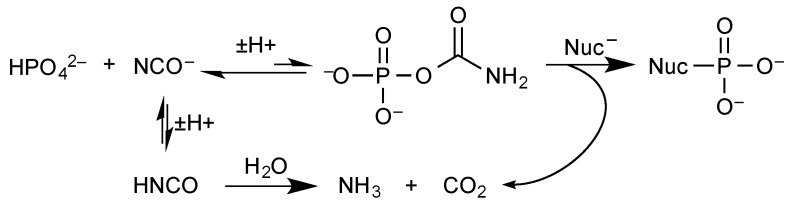
The very specific thermodynamic instability and kinetic stability of phosphate esters and anhydrides impart them invaluable properties in living organisms in which highly efficient enzyme catalysts compensate for their low intrinsic reactivity. Considering their role in protein biosynthesis, these properties raise a paradox about early stages: How could these species be selected in the absence of enzymes? This review is aimed at demonstrating that considering mixed anhydrides or other species more reactive than esters and anhydrides can help in solving the paradox. The consequences of this approach for chemical evolution and early stages of life are analysed.
Keywords: energy currency; metabolism; mixed anhydride; phosphoryl transfer.
Conflict of interest statement
The authors declare no conflict of interest.
Figures




References
-
- Lipmann F. Metabolic generation and utilization of phosphate bond energy. Adv. Enzymol. Relat. Areas Mol. Biol. 1941;1:99–162.
-
- Lipmann F. In: Phosphorus Metabolism. McElroy W.D., Glass H.B., editors. Volume 1. Johns Hopkins Press; Baltimore, MD, USA: 1951. p. 521.
-
- Kumler W.D., Eiler J.J. The Acid Strength of Mono and Diesters of Phosphoric Acid. The n-Alkyl Esters from Methyl to Butyl, the Esters of Biological Importance, and the Natural Guanidine Phosphoric Acids. J. Am. Chem. Soc. 1943;65:2355–2361. doi: 10.1021/ja01252a028. - DOI
-
- Wolfenden R., Ridgway C., Young G. Spontaneous hydrolysis of ionized phosphate monoesters and diesters and the proficiencies of phosphatases and phosphodiesterases as catalysts. J. Am. Chem. Soc. 1998;120:833–834. doi: 10.1021/ja9733604. - DOI
Publication types
Grants and funding
LinkOut - more resources
Full Text Sources
