


A Systematic Review of the Effect of Neurofeedback in Cancer Patients
- PMID: 30832518
- PMCID: PMC6416750
- DOI: 10.1177/1534735419832361
A Systematic Review of the Effect of Neurofeedback in Cancer Patients
Abstract
Introduction: Neurofeedback (NF) or electroencephalogram (EEG)-Biofeedback is a drug-free form of brain training to directly alter the underlying neural mechanisms of cognition and behavior. It is a technique that measures a subject's EEG signal, processes it in real time, with the goal to enable a behavioral modification by modulating brain activity. The most common application of the NF technology is in epilepsies, migraine, attention-deficit/hyperactivity disorder, autism spectrum disorder, affective disorders, and psychotic disorders. Few studies have investigated the use of NF in context of psychosomatic illnesses. Little is known about the use in cancer patients or postcancer survivors despite the high number of this patient group.
Objectives: We here provide a systematic review of the use and effect of NF on symptoms and burden in cancer patients and long-term cancer survivors.
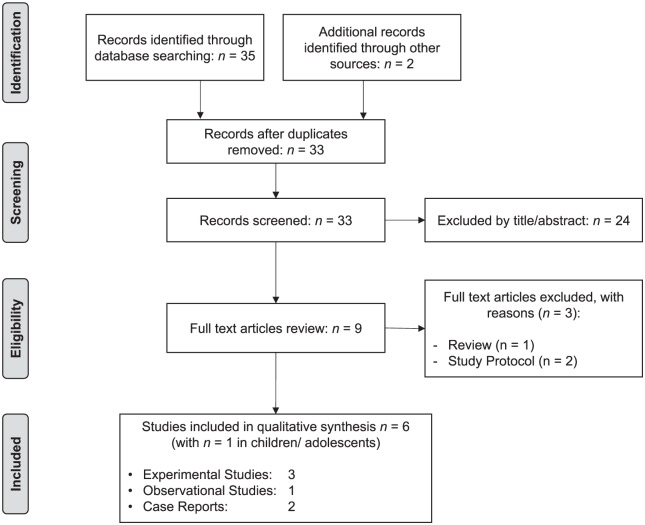
Methods: In conducting this systematic review, we followed the guidelines of the Preferred Reporting Items for Systematic Reviews and Meta-analyses (PRISMA) Statement.
Results: Our search resulted in only 3 experimental studies, 1 observational study, and 2 case reports. Given the heterogeneity of the intervention systems and protocols, no meta-analysis was conducted.
Conclusion: Altogether, there is initial evidence that NF is a complementary, drug-free, and noninvasive therapy that has the potential to ameliorate symptoms in this patient group, such as pain, fatigue, depression, and sleep. Further studies are highly needed.
Keywords: EEG biofeedback; cancer patients; neurofeedback; postcancer survivors; psycho-oncology.
Conflict of interest statement
Figures
References
-
- Collura TF. Technical Foundations of Neurofeedback. 1st ed. (Routledge Monograph Series on Neurotherapy and QEEG Neuroscience Techniques). New York, NY: Routledge; 2014.
Publication types
MeSH terms
LinkOut - more resources
Full Text Sources
Medical
