


Multiple radiations of spiny mice (Rodentia: Acomys) in dry open habitats of Afro-Arabia: evidence from a multi-locus phylogeny
- PMID: 30832573
- PMCID: PMC6399835
- DOI: 10.1186/s12862-019-1380-9
Multiple radiations of spiny mice (Rodentia: Acomys) in dry open habitats of Afro-Arabia: evidence from a multi-locus phylogeny
Abstract
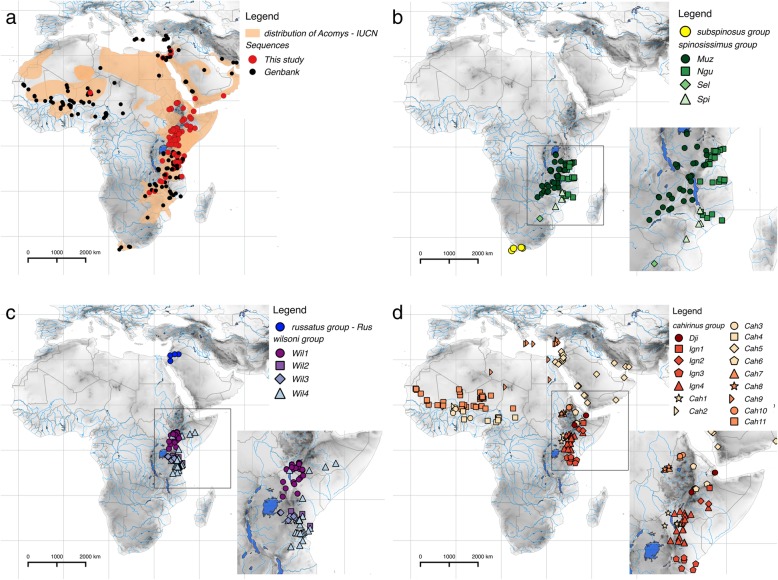
Background: Spiny mice of the genus Acomys are distributed mainly in dry open habitats in Africa and the Middle East, and they are widely used as model taxa for various biological disciplines (e.g. ecology, physiology and evolutionary biology). Despite their importance, large distribution and abundance in local communities, the phylogeny and the species limits in the genus are poorly resolved, and this is especially true for sub-Saharan taxa. The main aims of this study are (1) to reconstruct phylogenetic relationships of Acomys based on the largest available multilocus dataset (700 genotyped individuals from 282 localities), (2) to identify the main biogeographical divides in the distribution of Acomys diversity in dry open habitats in Afro-Arabia, (3) to reconstruct the historical biogeography of the genus, and finally (4) to estimate the species richness of the genus by application of the phylogenetic species concept.
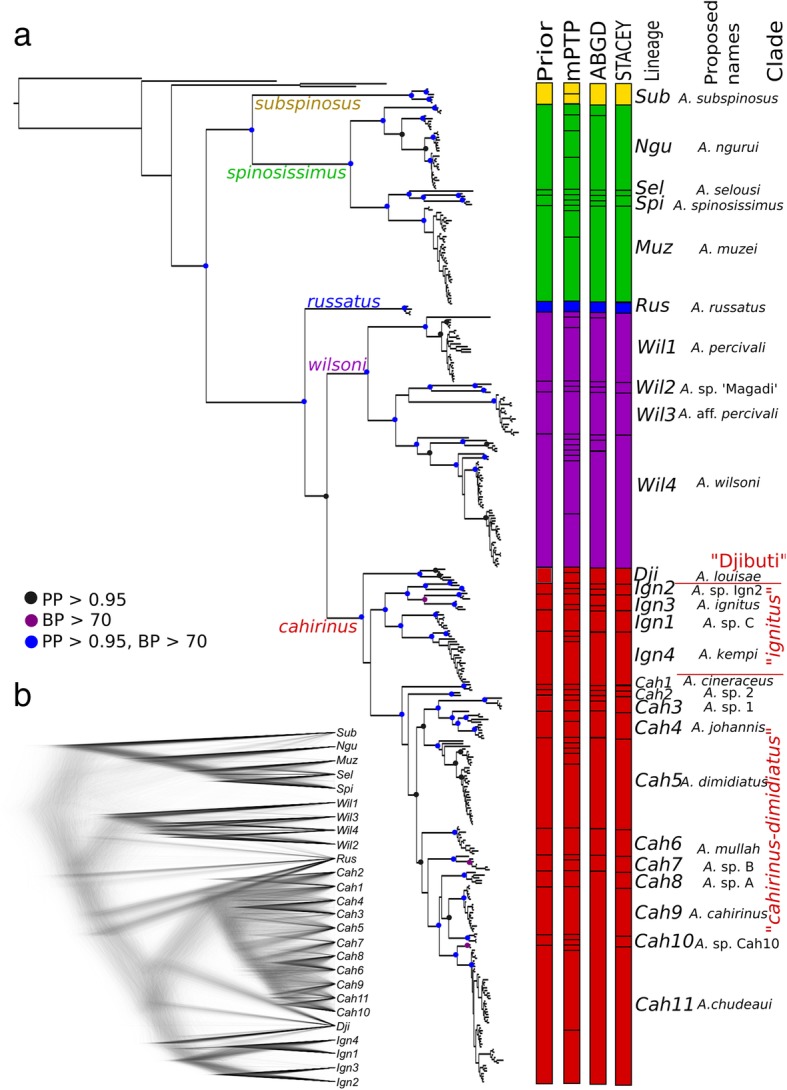
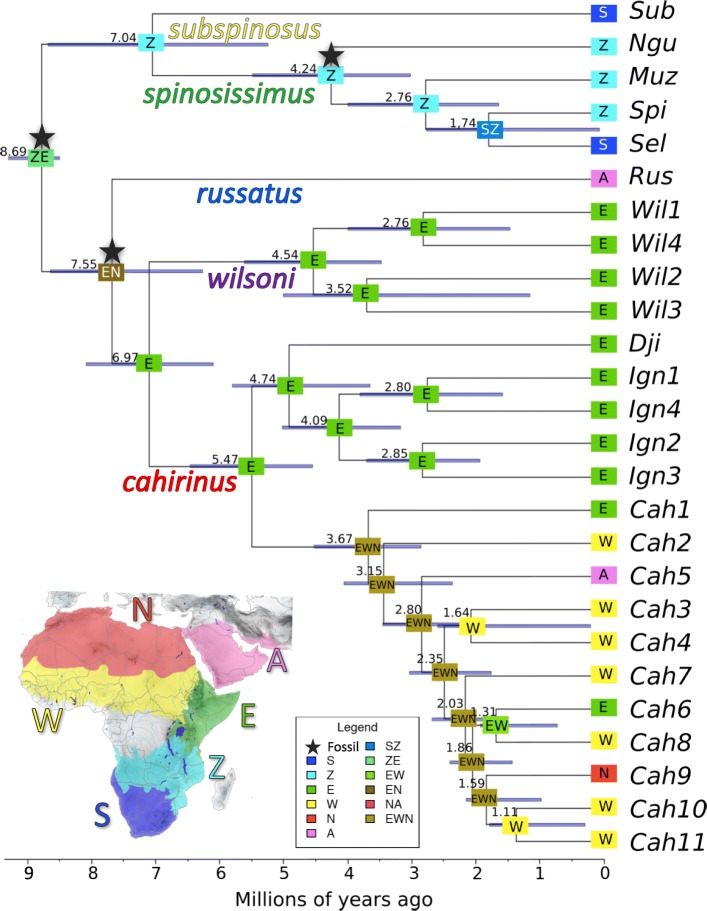
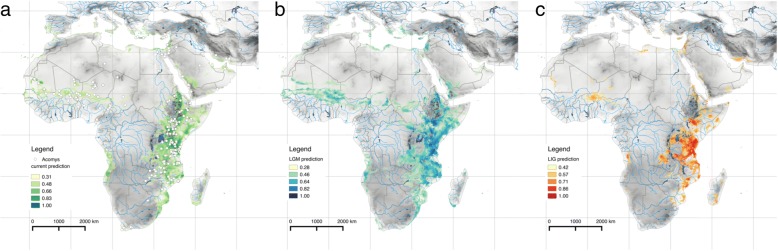
Results: The multilocus phylogeny based on four genetic markers shows presence of five major groups of Acomys called here subspinosus, spinosissimus, russatus, wilsoni and cahirinus groups. Three of these major groups (spinosissimus, wilsoni and cahirinus) are further sub-structured to phylogenetic lineages with predominantly parapatric distributions. Combination of alternative species delimitation methods suggests the existence of 26 molecular operational taxonomic units (MOTUs), potentially corresponding to separate species. The highest genetic diversity was found in Eastern Africa. The origin of the genus Acomys is dated to late Miocene (ca. 8.7 Ma), when the first split occurred between spiny mice of eastern (Somali-Masai) and south-eastern (Zambezian) savannas. Further diversification, mostly in Plio-Pleistocene, and the current distribution of Acomys were influenced by the interplay of global climatic factors (e.g., Messinian salinity crisis, intensification of Northern Hemisphere glaciation) with local geomorphology (mountain chains, aridity belts, water bodies). Combination of divergence dating, species distribution modelling and historical biogeography analysis suggests repeated "out-of-East-Africa" dispersal events into western Africa, the Mediterranean region and Arabia.
Conclusions: The genus Acomys is very suitable model for historical phylogeographic and biogeographic reconstructions of dry non-forested environments in Afro-Arabia. We provide the most thorough phylogenetic reconstruction of the genus and identify major factors that influenced its evolutionary history since the late Miocene. We also highlight the urgent need of integrative taxonomic revision of east African taxa.
Keywords: Acomys; Africa; Arabia; Biogeography; Plio-Pleistocene; Sahara; Savanna; Somali-Masai; Zambezian savanna.
Conflict of interest statement
Ethics approval and consent to participate
We are indebted to many local authorities for providing permits to carry out the research (including the ethics approval, when applicable), especially the Zambia Wildlife Authority (ZAWA), the National Directorate for Protected Areas (DINAC – Mozambique), the National Research Council and Forestry Department in Malawi, Sokoine University of Agriculture in Morogoro (Tanzania), the Kenyan Forest Service and the Kenyan Wildlife Service (Kenya), the Ethiopian Wildlife Conservation Authority (EWCA), Government of Ethiopia and the Oromia Forest and Wildlife Enterprise (OFWE) in Ethiopia. Furthermore, Josef Bryja is holder of the certificate of competency on Protection of Animals against Cruelty (reg. no. V/1/2005/05) and all manipulations with animals, i.e. when captured in life traps, followed the specific rules for working with alive animals as specified by the Central Commission for Animal Welfare of Ministry of Agriculture of the Czech Republic, and the general protocols were approved by the Committee for Animal Welfare of the Czech Academy of Sciences. Newly analysed material from other countries has been collected in last decades within other research projects and we are indebted to museum curators for allowing us to study the tissue samples in their care.
Consent for publication
Not applicable.
Competing interests
The authors declare that they have no competing interests.
Publisher’s Note
Springer Nature remains neutral with regard to jurisdictional claims in published maps and institutional affiliations.
Figures
References
-
- Mayaux P, Bartholomé E, Fritz S, Belward A. A new land-cover map of Africa for the year 2000. J Biogeogr. 2004;31:861–877.
-
- Sayre R, Comer P, Hak J, Josse C, Bow J, Warner H, Larwanou M, Kelbessa E, Bekele T, Kehl H, Amena R, Andriamasimanana R, Ba T, Benson L, Boucher T, Brown M, Cress J, Dassering O, Friesen B, Gachathi F, Houcine S, Keita M, Khamala E, Marangu D, Mokua F, Morou B, Mucina L, Mugisha S, Mwavu E, Rutherford M, Sanou P, Syampungani S, Tomor B, Vall A, Weghe JV, Wangui E, Waruingi L. A new map of standardized terrestrial ecosystems of Africa. Washington DC: Association of American Geographers; 2013.
-
- Linder HP, de Klerk HM, Born J, Burgess ND, Fjeldså J, Rahbek C. The partitioning of Africa: statistically defined biogeographical regions in sub-Saharan Africa. J Biogeogr. 2012;39:1189–1205.
-
- Maslin MA, Trauth MH. Plio-Pleistocene east African pulsed climate variability and its influence on early human evolution. In: Grine FE, Leakey RE, Fleagle JG, editors. The first humans - origins of the genus homo. New York: Springer Verlag; 2009. pp. 151–158.
-
- Kingston JD, Deino AL, Edgar RK, Hill A. Astronomically forced climate change in the Kenyan Rift Valley 2.7–2.55 Ma: implications for the evolution of early hominin ecosystems. J Hum Evol. 2007;53:487–503. - PubMed
Publication types
MeSH terms
Substances
LinkOut - more resources
Full Text Sources
