


Testing means to scale early childhood development interventions in rural Kenya: the Msingi Bora cluster randomized controlled trial study design and protocol
- PMID: 30832624
- PMCID: PMC6399811
- DOI: 10.1186/s12889-019-6584-9
Testing means to scale early childhood development interventions in rural Kenya: the Msingi Bora cluster randomized controlled trial study design and protocol
Abstract
Background: Forty-three percent of children under five in low and middle-income countries (LMICs) experience compromised cognitive and psychosocial development. Early childhood development (ECD) interventions that promote parent-child psychosocial stimulation and nutrition activities can help remediate early disadvantages in child development and health outcomes, but are difficult to scale. Key questions are: 1) how to maximize the reach and cost-effectiveness of ECD interventions; 2) what pathways connect interventions to parental behavioral changes and child outcomes; and 3) how to sustain impacts long-term.
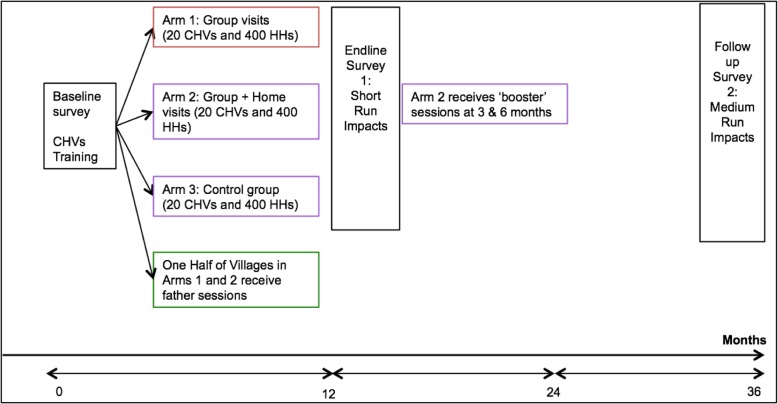
Methods: Msingi Bora ("good foundation" in Swahili) is a multi-arm cluster randomized controlled trial across 60 villages and 1200 households in rural Western Kenya that tests different, potentially cost-effective and scalable models to deliver an ECD intervention in biweekly sessions lasting 7 months. The curriculum integrates child psychosocial stimulation with hygiene and nutrition education. The multi-arm study will test the cost-effectiveness of two models of delivery: a group-based model versus a mixed model combining group sessions with personalized home visits. Households in a third study arm will serve as a control group. Each arm will have 20 villages and 400 households with a child aged 6-24 months at baseline. Primary outcomes are child cognitive and socioemotional development and home stimulation practices. In a 2 × 2 design among the 40 treatment villages, we will also test the role of including fathers in the intervention. We will estimate intention-to-treat and local average treatment effects, and examine mediating pathways using Mediation Analysis. One treatment arm will receive quarterly booster visits for 6 months following the end of the sessions. A follow-up survey 2 years after the end of the main intervention period will examine sustainability of outcomes and any spillover impacts onto younger siblings. Study protocols have been approved by the Maseno Ethics Review Committee (MUERC) in Kenya (00539/18) and by RAND's institutional review board. This study is funded by the National Institute for Child Health and Human Development (R01HD090045).
Discussion: Results can provide policymakers with rigorous evidence of how best to design ECD interventions in low-resource rural settings.
Trial registration: Clinical Trial NCT03548558 registered June 7, 2018 at clinicaltrials.gov; AEA-RCT registry AEARCTR-0002913.
Keywords: Child developmental outcomes; Community health volunteers; Early childhood development; Kenya; Parenting behaviors; Village-based curriculum.
Conflict of interest statement
Ethics approval and consent to participate
Study protocols have been reviewed and approved by the RAND Human Subjects Protection Committee with study ID 2017–0061, and the local Kenyan review board at the Maseno University Ethics Review Committee (MUERC) Approval 00539/18. We will obtain written and verbal consent from all study participants prior to enrollment. Important protocol modifications will be submitted to all IRBs for approval as amendments.
Consent for publication
Not applicable.
Competing interests
The authors declare that they have no competing interests.
Publisher’s Note
Springer Nature remains neutral with regard to jurisdictional claims in published maps and institutional affiliations.
Figures
References
-
- Walker SP, Wachs TD, Grantham-McGregor S, Black MM, Nelson CA, Huffman SL, et al. Inequality in early childhood: risk and protective factors for early child development. Lancet. 2011;378(9799):1325–1338. - PubMed
-
- Engle PL, Fernald LC, Alderman H, Behrman J, O’Gara C, Yousafzai A, et al. Strategies for reducing inequalities and improving developmental outcomes for young children in low-income and middle-income countries. Lancet. 2011;378(9799):1339–1353. - PubMed
