. 2019 Mar 4;10(1):1030.
doi: 10.1038/s41467-019-08993-6.

A genome-wide association analysis identifies 16 novel susceptibility loci for carpal tunnel syndrome

Affiliations

A genome-wide association analysis identifies 16 novel susceptibility loci for carpal tunnel syndrome

Akira Wiberg et al. Nat Commun. .

Abstract

Carpal tunnel syndrome (CTS) is a common and disabling condition of the hand caused by entrapment of the median nerve at the level of the wrist. It is the commonest entrapment neuropathy, with estimates of prevalence ranging between 5-10%. Here, we undertake a genome-wide association study (GWAS) of an entrapment neuropathy, using 12,312 CTS cases and 389,344 controls identified in UK Biobank. We discover 16 susceptibility loci for CTS with p < 5 × 10⁻⁸. We identify likely causal genes in the pathogenesis of CTS, including ADAMTS17, ADAMTS10 and EFEMP1, and using RNA sequencing demonstrate expression of these genes in surgically resected tenosynovium from CTS patients. We perform Mendelian randomisation and demonstrate a causal relationship between short stature and higher risk of CTS. We suggest that variants within genes implicated in growth and extracellular matrix architecture contribute to the genetic predisposition to CTS by altering the environment through which the median nerve transits.


Conflict of interest statement

The authors declare no competing interests.

Figures
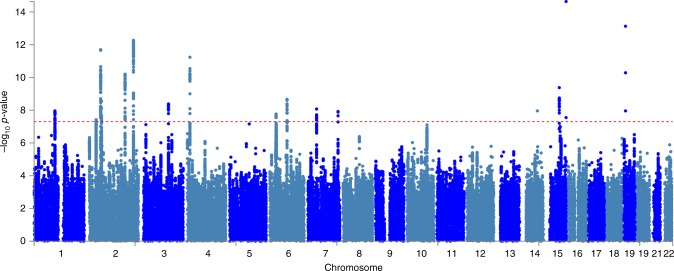
Fig. 1
Fig. 1
SNP associations with carpal tunnel syndrome. Manhattan plot showing -log10 p values for SNP associations, produced in FUMA. The horizontal red line represents p = 5 × 10-8. SNP, single-nucleotide polymorphism
Fig. 2
Fig. 2
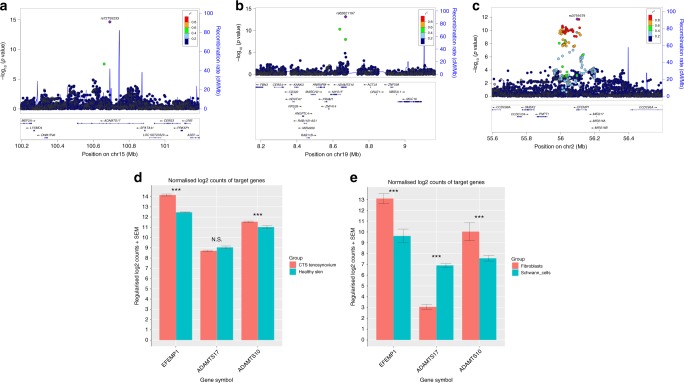
Regional association plots for three GWAS loci and the expression of target genes from RNA-Seq. a Chromosome 15q26.3 (the site of missense variant in ADAMTS17). b Chromosome 19p13.2 (the site of missense variant in ADAMTS10). c Chromosome 2p16.1 (the site of intronic variant in EFEMP1). SNP position is shown on the x-axis, and the strength of association on the y-axis. The linkage disequilibrium (LD) relationship between the lead SNP and the surrounding SNPs is indicated by the colour. In the lower panel of each figure, genes within 500 kb of the index SNP are shown. The position on each chromosome is shown in relation to Human Genome build hg19. d Comparison of gene expression between tenosynovium of 41 CTS cases and the index finger skin of six healthy individuals. e Comparison of gene expression between human cultured fibroblasts and Schwann cells from Weiss et al.. Error bars represent the standard error of the mean of the regularised log2 counts. p Value was determined using Wald test and was FDR adjusted. ***p Value < 0.01; NS = not significant. Source data are provided as a Source Data file. CTS, carpal tunnel syndrome; FDR, false discovery rate; GWAS, genome-wide association study; RNA-Seq, RNA sequencing; SNP, single-nucleotide polymorphism
Fig. 3
Fig. 3
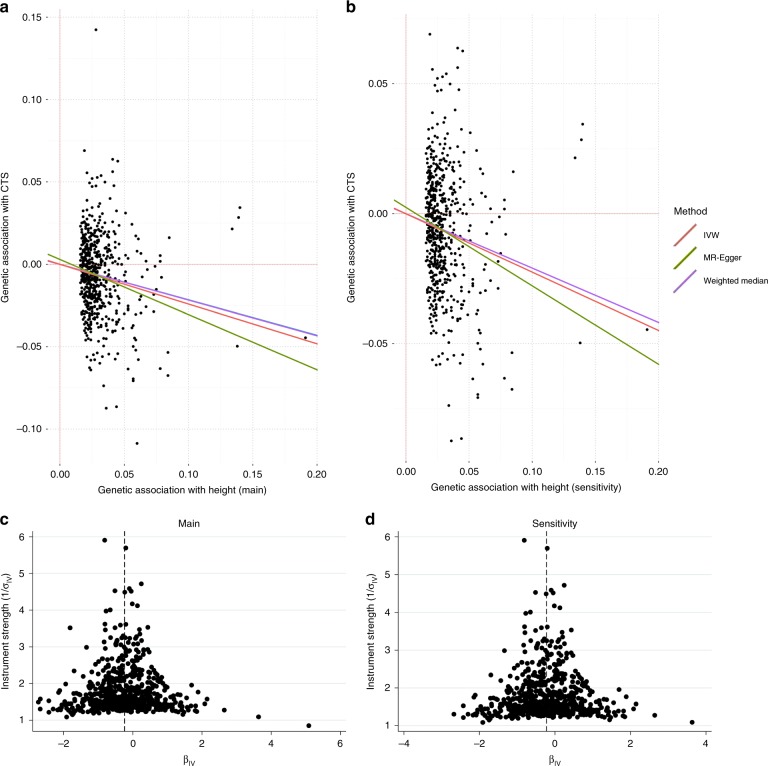
Mendelian randomisation (MR) analysis of height and CTS. a MR plots for the main analysis (601 SNPs) using IVW, MR-Egger and weighted median methods. b MR plots for the sensitivity analysis (596 SNPs), with 5 SNPs that were significantly associated with both height and CTS removed. c Funnel plot of instrument strength vs effect size for the main analysis and d the sensitivity analysis. The removal of rs724016 (which is the only SNP with a 1/SE value of ~6 in plots (c, d)) had no material effect on the MR estimates using IVW. Odds ratio for CTS per 1-SD higher height in the main analysis was 0.79 (95% CI 0.75–0.85) and in sensitivity analysis was 0.81 (95% CI 0.76–0.85). CTS, carpal tunnel syndrome; IVW, inverse variance-weighted; SNP, single-nucleotide polymorphism

References

    1. Atroshi I, et al. Prevalence of carpal tunnel syndrome in a general population. JAMA. 1999;282:153–158. - PubMed
    1. de Krom MC, et al. Carpal tunnel syndrome: prevalence in the general population. J. Clin. Epidemiol. 1992;45:373–376. - PubMed
    1. Ferry S, Pritchard T, Keenan J, Croft P, Silman AJ. Estimating the prevalence of delayed median nerve conduction in the general population. Br. J. Rheumatol. 1998;37:630–635. - PubMed
    1. Bland JDP. Carpal tunnel syndrome. BMJ. 2007;335:343–346. - PMC - PubMed
    1. Bland JDP. Treatment of carpal tunnel syndrome. Muscle Nerve. 2007;36:167–171. - PubMed

Publication types