. 2019 Mar 4;9(1):3415.
doi: 10.1038/s41598-019-40156-x.

Large-scale data from wearables reveal regional disparities in sleep patterns that persist across age and sex

Affiliations

Large-scale data from wearables reveal regional disparities in sleep patterns that persist across age and sex

Ju Lynn Ong et al. Sci Rep. .

Abstract

Prior reports on geographical differences in sleep duration have relied on samples collected at different time points with a variety of subjective instruments. Using sleep data from a total of 553,559 nights from 23,680 Fitbit users (aged 15-80y), we found objective evidence for regional disparities in sleep duration of 32-43 min between Oceanian and East Asian users on weekdays. This was primarily driven by later bedtimes in East Asians. Although users in all countries extended sleep on weekends, East Asians continued to sleep less than their Oceanian counterparts. Women generally slept more than men, and older users slept less than younger users. Reasons for shorter sleep duration in East Asians on both weekdays and weekends, across the lifespan and in both sexes remain to be investigated.


Conflict of interest statement

The authors declare no competing interests.

Figures
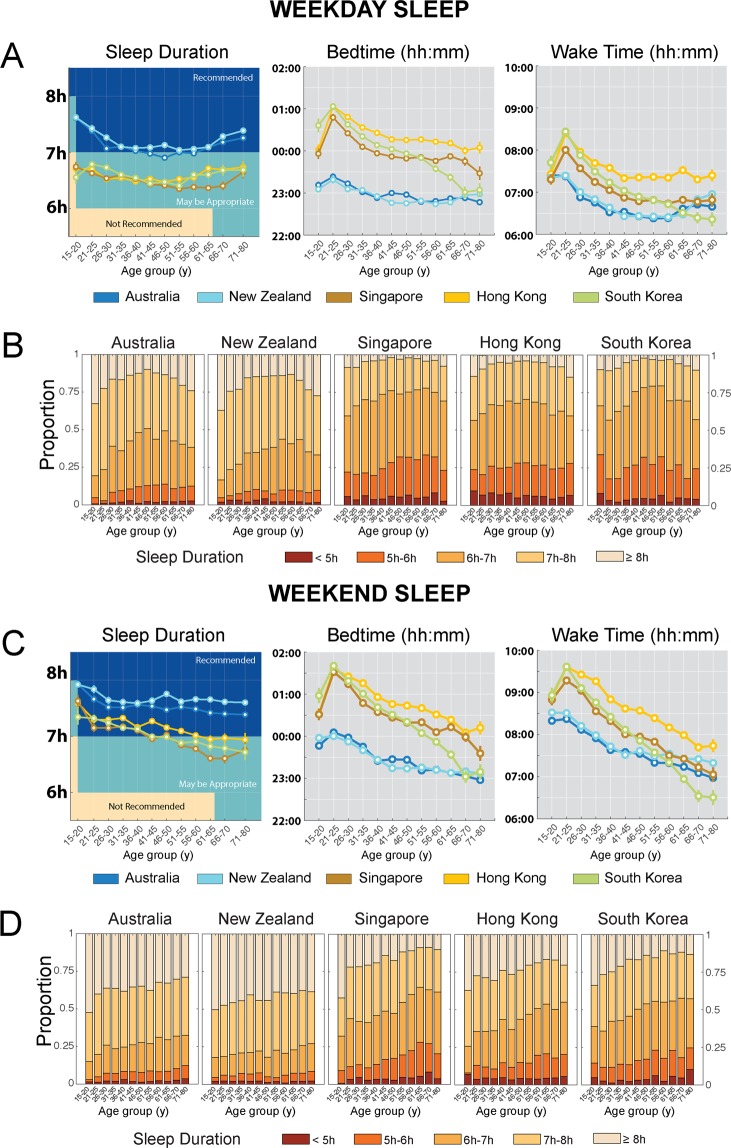
Figure 1
Figure 1
Regional differences in sleep patterns by age group. (A) Estimated marginal means and standard errors of sleep duration, bedtimes and wake times by country and age group for weekdays. Sleep duration recommendations from the National Sleep Foundation (14) are overlaid on sleep duration plots for comparison. (B) Proportion of users sleeping <5 h, 5–6 h, 6–7 h, 7–8 h and ≥8 h a night by country and age group on weekdays. (C) Estimated marginal means and standard errors of sleep duration, bedtimes and wake times by country and age group for weekends. Sleep duration recommendations from the National Sleep Foundation (14) are overlaid on sleep duration plots for comparison. (D) Proportion of users sleeping <5 h, 5–6 h, 6–7 h, 7–8 h and ≥8 h a night by country and age group on weekends. Large differences between Oceanian and East Asian users were consistently observed across all age groups on both weekdays and weekends.
Figure 2
Figure 2
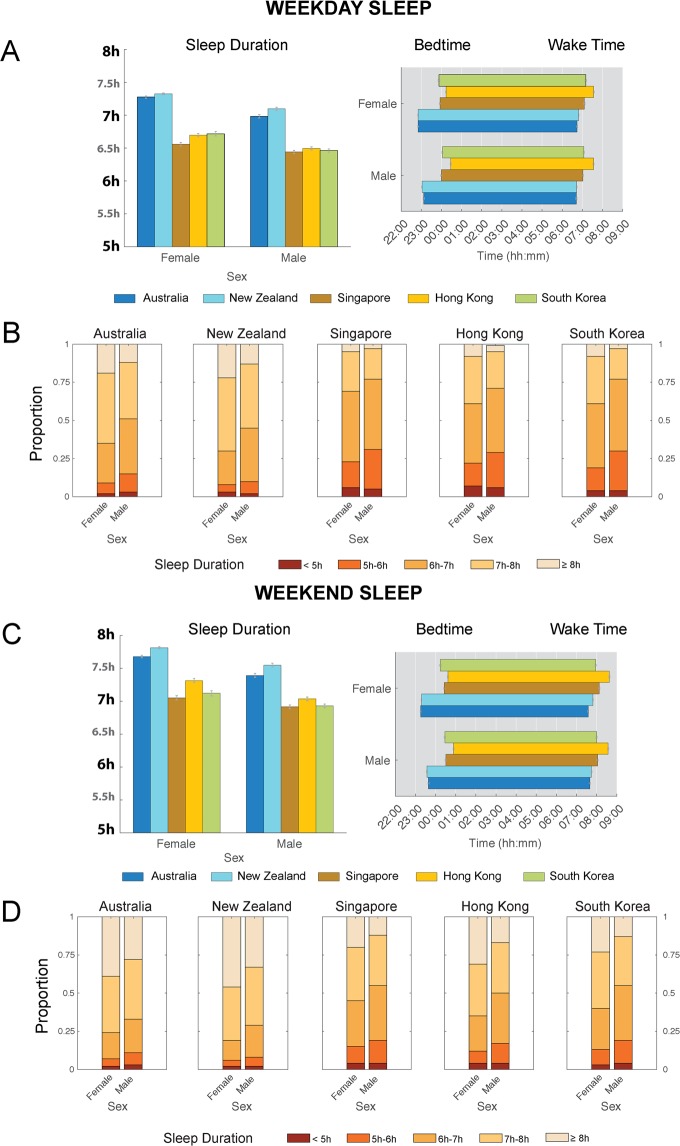
Regional differences in sleep patterns by sex. (A) Estimated marginal means and standard errors of sleep duration, bedtimes and wake times by country and sex for weekdays. (B) Proportion of users sleeping <5 h, 5–6 h, 6–7 h, 7–8 h and ≥8 h a night by country and sex on weekdays. (C) Estimated marginal means and standard errors of sleep duration, bedtimes and wake times by country and sex for weekends. (D) Proportion of users sleeping <5 h, 5–6 h, 6–7 h, 7–8 h and ≥8 h a night by country and sex on weekends. Large differences between Oceanian and East Asian users were consistently observed across both sexes on both weekdays and weekends.
Figure 3
Figure 3
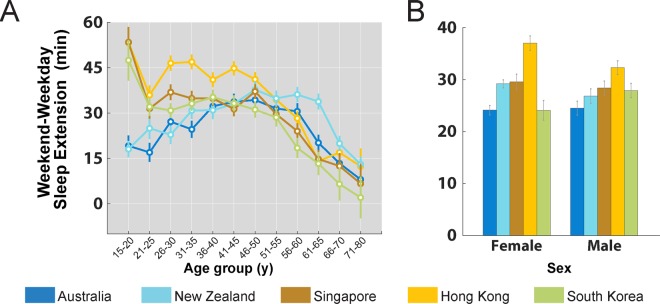
Weekday-weekend sleep extension. Estimated marginal means and standard errors of sleep extension (weekend – weekday sleep duration) by country and (A) age group, and (B) sex.

References

    1. Cappuccio FP, D’Elia L, Strazzullo P, Miller MA. Sleep duration and all-cause mortality: a systematic review and meta-analysis of prospective studies. Sleep. 2010;33:585–592. doi: 10.1093/sleep/33.5.585. - DOI - PMC - PubMed
    1. International Data Corporation (IDC) (Q4 2017). Worldwide Quarterly Wearable Device Tracker. [online]Available at, https://www.idc.com [Accessed Aug 2018].
    1. Olds T, Blunden S, Petkov J, Forchino F. The relationships between sex, age, geography and time in bed in adolescents: a meta-analysis of data from 23 countries. Sleep Med Rev. 2010;14:371–378. doi: 10.1016/j.smrv.2009.12.002. - DOI - PubMed
    1. Walch OJ, Cochran A, Forger DB. A global quantification of “normal” sleep schedules using smartphone data. Sci Adv. 2016;2:e1501705. doi: 10.1126/sciadv.1501705. - DOI - PMC - PubMed
    1. Gradisar M, Gardner G, Dohnt H. Recent worldwide sleep patterns and problems during adolescence: a review and meta-analysis of age, region, and sleep. Sleep Med. 2011;12:110–118. doi: 10.1016/j.sleep.2010.11.008. - DOI - PubMed

Publication types