. 2019 Mar 4;9(1):3358.
doi: 10.1038/s41598-019-40041-7.

Pathologist-level classification of histologic patterns on resected lung adenocarcinoma slides with deep neural networks

Affiliations

Pathologist-level classification of histologic patterns on resected lung adenocarcinoma slides with deep neural networks

Jason W Wei et al. Sci Rep. .

Abstract

Classification of histologic patterns in lung adenocarcinoma is critical for determining tumor grade and treatment for patients. However, this task is often challenging due to the heterogeneous nature of lung adenocarcinoma and the subjective criteria for evaluation. In this study, we propose a deep learning model that automatically classifies the histologic patterns of lung adenocarcinoma on surgical resection slides. Our model uses a convolutional neural network to identify regions of neoplastic cells, then aggregates those classifications to infer predominant and minor histologic patterns for any given whole-slide image. We evaluated our model on an independent set of 143 whole-slide images. It achieved a kappa score of 0.525 and an agreement of 66.6% with three pathologists for classifying the predominant patterns, slightly higher than the inter-pathologist kappa score of 0.485 and agreement of 62.7% on this test set. All evaluation metrics for our model and the three pathologists were within 95% confidence intervals of agreement. If confirmed in clinical practice, our model can assist pathologists in improving classification of lung adenocarcinoma patterns by automatically pre-screening and highlighting cancerous regions prior to review. Our approach can be generalized to any whole-slide image classification task, and code is made publicly available at https://github.com/BMIRDS/deepslide .


Conflict of interest statement

The authors declare no competing interests.

Figures
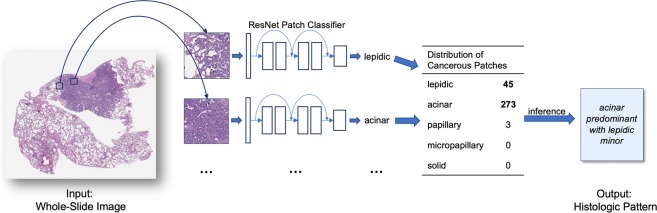
Figure 1
Figure 1
Overview of whole-slide classification of histologic patterns. We used a sliding window approach on the whole slide to generate small patches, classified each patch with a residual neural network, aggregated the patch predictions, and used a heuristic to determine predominant and minor histologic patterns for the whole slide. Patch predictions were made independently of adjacent patches and relative location in the whole-slide image.
Figure 2
Figure 2
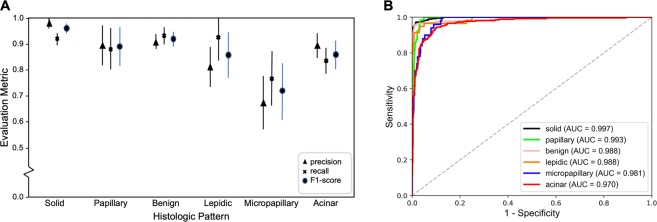
Model’s performance on the 1,068 classic samples for histologic patterns. (A) patch classification results with 95% confidence intervals. (B) ROC curves and their area under the curves (AUC’s) on this development set.
Figure 3
Figure 3
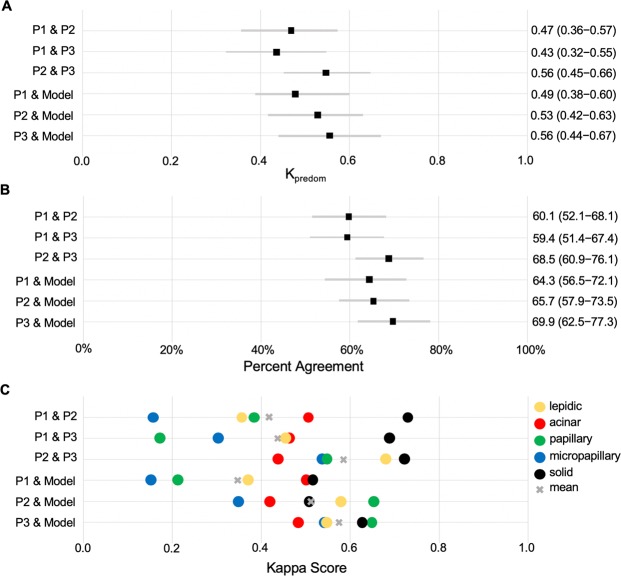
Model’s classification of 143 whole-slide images in the test set compared to those of three pathologists. (A) The kappa score of the predominant classification among all pairs of annotations. (B) Agreement percentages of predominant classification among all pairs of annotations. (C) Kappa scores for each histologic pattern among all pairs of annotations regardless of predominant or minor subtypes. P1, P2, and P3 are Pathologist 1, Pathologist 2, and Pathologist 3 respectively.
Figure 4
Figure 4
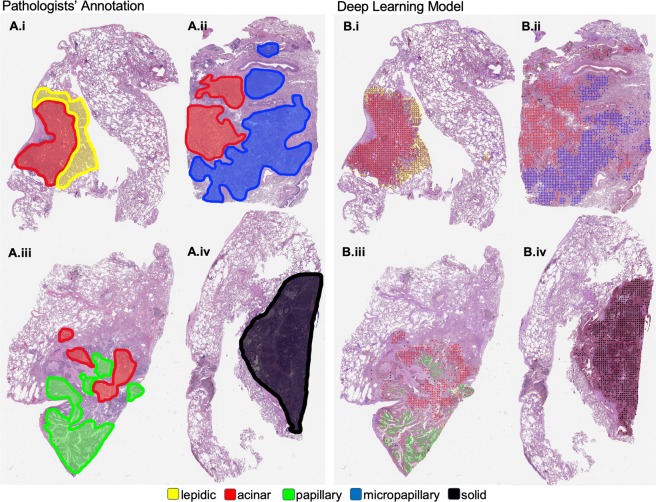
Visualization of the histologic patterns annotated by pathologists (A.i–iv), compared to those detected by our model (B.i–iv).

References

    1. Torre LA, Siegel RL, Jemal A. Lung cancer statistics. Adv Exp Med Biol. 2015;893:1–19. - PubMed
    1. Meza R, Meernik C, Jeon J, Cote ML. Lung cancer incidence trends by gender, race, and histology in the United States. PLoS ONE. 2015;10:3. doi: 10.1371/journal.pone.0121323. - DOI - PMC - PubMed
    1. Travis WD, et al. The 2015 World Health Organization classification of lung tumors. J Thorac Oncol. 2015;9:1243–1260. doi: 10.1097/JTO.0000000000000630. - DOI - PubMed
    1. Travis WD, et al. International association for the Study of Lung Cancer/American Thoracic Society/European Respiratory Society international multidisciplinary classification of lung adenocarcinoma. J Thorac Oncol. 2011;6:244–285. doi: 10.1097/JTO.0b013e318206a221. - DOI - PMC - PubMed
    1. Kadota K, et al. Prognostic significance of adenocarcinoma in situ, minimally invasive adenocarcinoma, and nonmucinous lepidic predominant invasive adenocarcinoma of the lung in patients with stage I disease. Am J Surg Pathol. 2014;38:448–460. doi: 10.1097/PAS.0000000000000134. - DOI - PMC - PubMed