


Health and Wellness Coaching Implemented by Trainees: Impact in Worksite Wellness
- PMID: 30834178
- PMCID: PMC6393823
- DOI: 10.1177/2164956119831226
Health and Wellness Coaching Implemented by Trainees: Impact in Worksite Wellness
Erratum in
-
Corrigendum.Glob Adv Health Med. 2019 Apr 23;8:2164956119847784. doi: 10.1177/2164956119847784. eCollection 2019. Glob Adv Health Med. 2019. PMID: 31041145 Free PMC article.
Abstract
Background: Lifestyle change programs have demonstrated encouraging improvements in the overall well-being of participants in clinical, worksite, and university settings. However, the majority of published research utilizes accredited, professional health coaches. This study seeks to establish the efficacy of health and wellness coaching implemented by coaching trainees in a workplace/university framework.
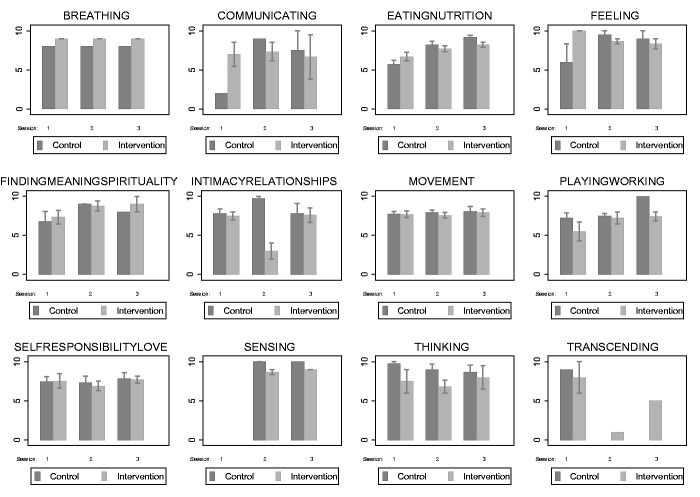
Methods: University faculty, staff, and students were recruited (n = 74) to participate in an 8-week health and wellness coaching program comprised of 3 coaching sessions. The wellness coaches were undergraduate students enrolled in a university Health and Wellness Coaching practicum course. Participants reported satisfaction in 12 wellness dimensions. Their satisfaction scores were used as proxy to encourage them to focus their behavior change within 1 or more of 12 wellness dimensions. The self-reported wellness dimension scores were recorded at baseline, and subsequent changes in the selected dimension scores were evaluated. The control group received telephonic and video conference-based coaching, while the intervention group participants were also offered face-to-face coaching and social-embedded support.
Results: Participants most frequently selected to work on 2 of the 12-wellness dimensions. No differences between groups were found in the initial wellness scores. A statistical analysis was performed on dimensions with 20 or more responses to determine whether the intervention (social support), coaching session, and other variables had a significant impact. A mixed model adjusted on group, coaching session, coaching trainee, and participant was performed. The eating/nutrition and thinking wellness dimensions exhibited a significant positive change in wellness scores in both groups (P < .001 and P < .0143, respectively).
Discussion: An increase in eating/nutrition and thinking wellness scores in both groups suggests that the coaching trainees were effective in motivating change to boost participants' well-being. The results justify further research to evaluate the cost-effectiveness, approaches, and efficacy of coaching trainees in worksite wellness programs.
Keywords: health and wellness coaching; health dimensions; social embeddedness; trainees; university setting.
Figures
References
-
- National Center for Chronic Disease Prevention and Health Promotion (NCCDPHP). Centers for Disease Control and Prevention https://www.cdc.gov/chronicdisease/about/costs/index.htm. [Online] Published April 2017. Accessed February 4, 2019.
-
- Clark MM, Bradley KL, Jenkins SM, et al. Improvements in health behaviors, eating self-efficacy, and goal-setting skills following participation in wellness coaching. Am J Health Promot. 2016; 30(6):458–464. - PubMed
-
- Clark MM, Bradley KL, Jenkins SM, et al. The effectiveness of wellness coaching for improving quality of life. Mayo Clin Proc. 2014; 89(11):1537–1544. - PubMed
LinkOut - more resources
Full Text Sources
