


Association between sublingual microcirculation, tissue perfusion and organ failure in major trauma: A subgroup analysis of a prospective observational study
- PMID: 30835764
- PMCID: PMC6400441
- DOI: 10.1371/journal.pone.0213085
Association between sublingual microcirculation, tissue perfusion and organ failure in major trauma: A subgroup analysis of a prospective observational study
Abstract
Introduction: Previous studies described impaired microvascular perfusion and tissue oxygenation as reliable predictors of Multiple Organ Failure in major trauma. However, this relationship has been incompletely investigated. The objective of this analysis is to further evaluate the association between organ dysfunction and microcirculation after trauma.
Materials and methods: This is a retrospective subgroup analysis on 28 trauma patients enrolled for the Microcirculation DAIly MONitoring in critically ill patients study (NCT 02649088). Patients were divided in two groups according with their Sequential Organ Failure Assessment (SOFA) score at day 4. At admission and every 24 hours, the sublingual microcirculation was evaluated with Sidestream Darkfield Imaging (SDF) and peripheral tissue perfusion was assessed with Near Infrared Spectroscopy (NIRS) and Vascular Occlusion Test (VOT). Simultaneously, hemodynamic, clinical/laboratory parameters and main organ supports were collected.
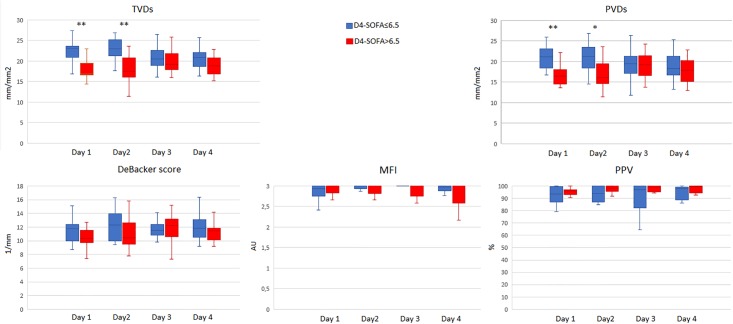
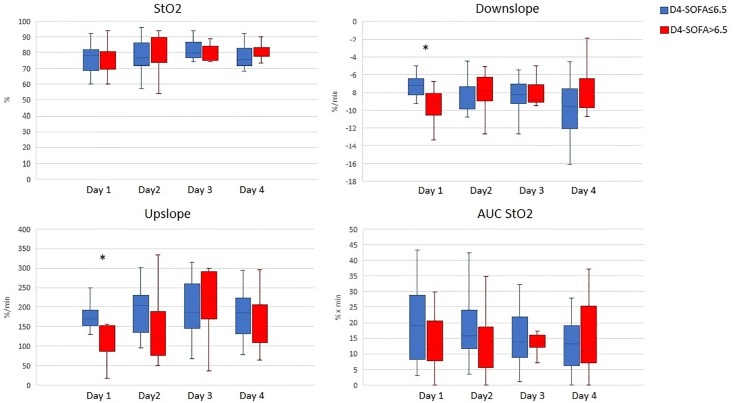
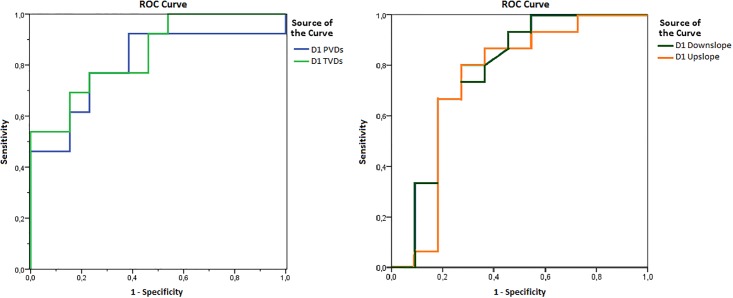
Results: Median SOFA score at Day 4 was 6.5. Accordingly, patients were divided in two groups: D4-SOFA ≤6.5 and D4-SOFA >6.5. The Length of Stay in Intensive Care was significantly higher in patients with D4-SOFA>6.5 compared to D4-SOFA≤6.5 (p = 0.013). Total Vessel Density of small vessels was significantly lower in patients with high D4-SOFA score at Day 1 (p = 0.002) and Day 2 (p = 0.006) after admission; the Perfused Vessel Density was lower in patients with high D4-SOFA score at Day 1 (p = 0.007) and Day 2 (p = 0.033). At Day 1, NIRS monitoring with VOT showed significantly faster tissue oxygen saturation downslope (p = 0.018) and slower upslope (p = 0.04) in patients with high D4-SOFA.
Discussion: In our cohort of major traumas, sublingual microcirculation and peripheral microvascular reactivity were significantly more impaired early after trauma in those patients who developed more severe organ dysfunctions. Our data would support the hypothesis that restoration of macrocirculation can be dissociated from restoration of peripheral and tissue perfusion, and that microvascular alterations can be associated with organ failure.
Conflict of interest statement
The authors have declared that no competing interests exist.
Figures
References
-
- Fröhlich M, Lefering R, Probst C, Paffrath T, Schneider MM, Maegele M, et al. Epidemiology and risk factors of multiple-organ failure after multiple trauma: an analysis of 31,154 patients from the TraumaRegister DGU. J Trauma Acute Care Surg. 2014. April; 76(4):921–7; discussion 927–8. 10.1097/TA.0000000000000199 - DOI - PubMed
-
- Moore FA, McKinley BA, Moore EE, Nathens AB, West M, Shapiro MB, et al. Inflammation and the host response to injury, a large-scale collaborative project: patient-oriented research core–standard operating procedures for clinical care. III. Guidelines for shock resuscitation. J Trauma. 2006; 61:82–9. 10.1097/01.ta.0000225933.08478.65 - DOI - PubMed
-
- Kern JW, Shoemaker WC. Meta-analysis of hemodynamic optimization in high-risk patients. Crit Care Med. 2002; 30:1686–92. - PubMed
Publication types
MeSH terms
LinkOut - more resources
Full Text Sources
Medical
