


Fatty Acid Profiles and Production in Marine Phytoplankton
- PMID: 30836652
- PMCID: PMC6471065
- DOI: 10.3390/md17030151
Fatty Acid Profiles and Production in Marine Phytoplankton
Abstract
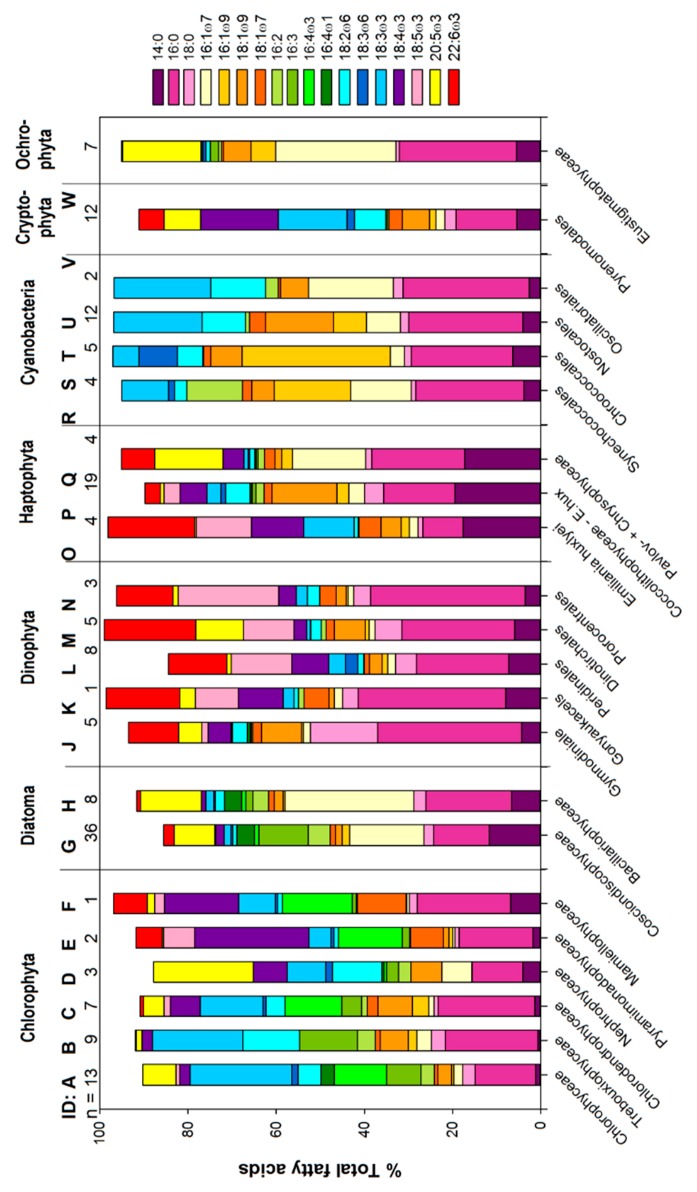
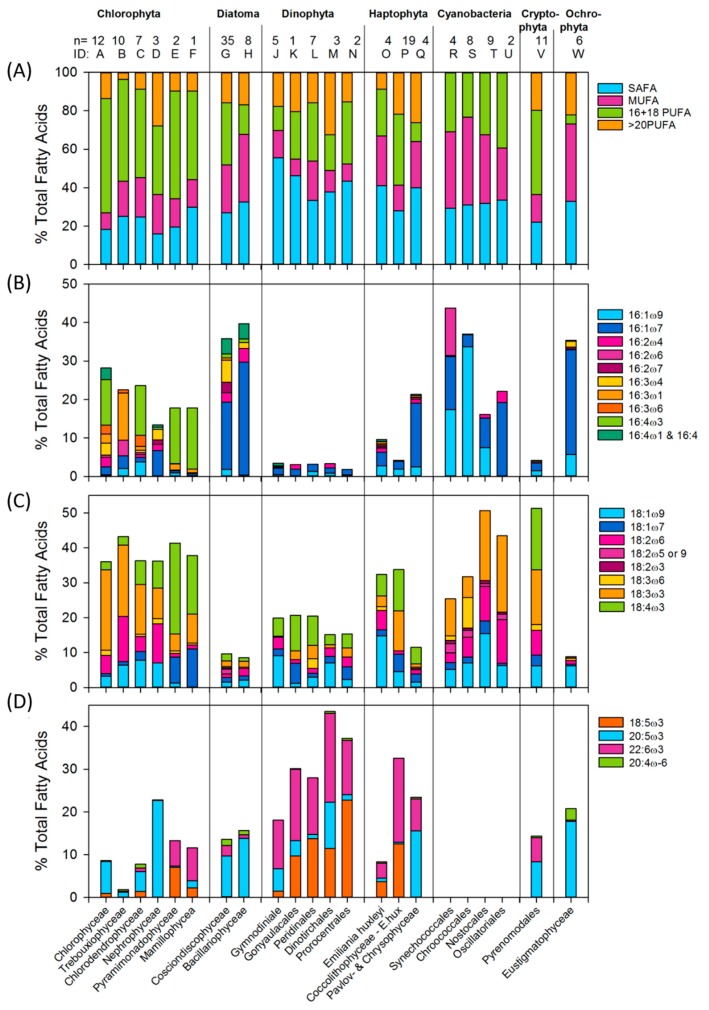
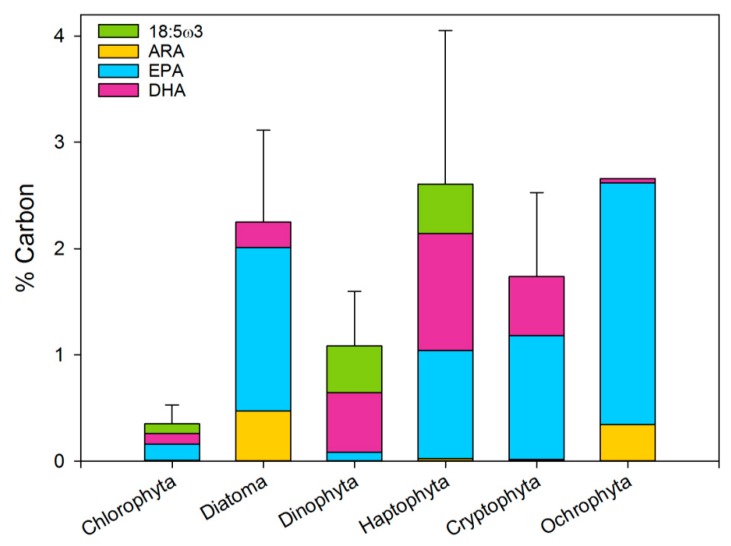
Microalgae are the primary producers of carbon in marine ecosystems, fixing carbon and subsequently generating various biomolecules such as carbohydrates, proteins and lipids. Most importantly, microalgae are the generators and main suppliers of ω3 polyunsaturated fatty acids (ω3PUFA) in the marine ecosystem, which have a fundamental importance for the functioning and quality of the whole marine food web. A meta-analysis of over 160 fatty acid profiles of 7 marine phytoplankton phyla reveals not only a phyla-specific, but also a highly class-specific PUFA production of marine phytoplankton. The highest EPA (Eicosapentaenoic acid; 20:5ω3) production per total fatty acids was found in 2 classes of Haptophyta and in Ochrophyta, while Dinophyta and the Haptophyte Emiliana huxleyi show the highest production of DHA (Docosahexaenoic acid; 22:6ω3). An important precursor for EPA, Stearidonic acid (SDA, 18:4ω3) is found in high proportions in Cryptophyta and the Chlorophta class Pyramimonadophyceae. Per unit of carbon, Chlorophyta and Cyanobacteria were the poorest producers of highly unsaturated fatty acids (HUFA). The remaining phyla had a similar HUFA contribution per unit of carbon but with different compositions. The nutritional and environmental effects on the phytoplankton PUFA production is summarized and shows a lowering of the PUFA content under stressful environmental conditions.
Keywords: DHA; EPA; PUFA synthesis; SDA; environmental effects; fatty acid synthesis; fatty acids; marine phytoplankton.
Conflict of interest statement
The author declares no conflict of interest.
Figures
References
-
- Lee R.F., Nevenzel J.C., Paffenhöfer G.-A. Importance of wax esters and other lipids in the marine food chain: Phytoplankton and copepods. Mar. Biol. 1971;9:99–108. doi: 10.1007/BF00348249. - DOI
-
- Graeve M., Kattner G., Hagen W. Diet-induced changes in the fatty acid composition of Arctic herbivorous copepods: Experimental evidence of trophic markers. J. Exp. Mar. Biol. Ecol. 1994;182:97–110. doi: 10.1016/0022-0981(94)90213-5. - DOI
-
- Sargent J.R., Falk-Petersen S. The lipid biochemistry of calanoid copepods. Hydrobiologia. 1988;167–168:101–114. doi: 10.1007/BF00026297. - DOI
-
- Marshall S., Orr A. On the biology of Calanus finmarchicus. VII. Factors affecting egg production. J. Mar. Biol. Assoc. UK. 1952;30:527–547. doi: 10.1017/S0025315400012959. - DOI
-
- Checkley D.M.D. The egg production of a marine planktonic copepod in relation to its food supply: Laboratory studies. Limnol. Oceanogr. 1980;25:430–446. doi: 10.4319/lo.1980.25.3.0430. - DOI
Publication types
MeSH terms
Substances
LinkOut - more resources
Full Text Sources
Research Materials
