


Effects of adding psychosocial stimulation for children of lactating mothers using an unconditional cash transfer platform on neurocognitive behavior of children in rural Bangladesh: protocol for a cluster randomized controlled trial
- PMID: 30836984
- PMCID: PMC6402152
- DOI: 10.1186/s40359-019-0289-9
Effects of adding psychosocial stimulation for children of lactating mothers using an unconditional cash transfer platform on neurocognitive behavior of children in rural Bangladesh: protocol for a cluster randomized controlled trial
Abstract
Background: There is sufficient evidence that psychosocial stimulation (PS) benefits children's neurocognitive behavior, however, there is no information on how it works when delivered through an Unconditional Cash Transfer (UCT) platform for poor rural population in developing countries. The objective of this study is to measure effects of adding PS for children of lactating mothers enrolled to receive UCT with health education (HE) on neurocognitive behavior of children in rural Bangladesh.
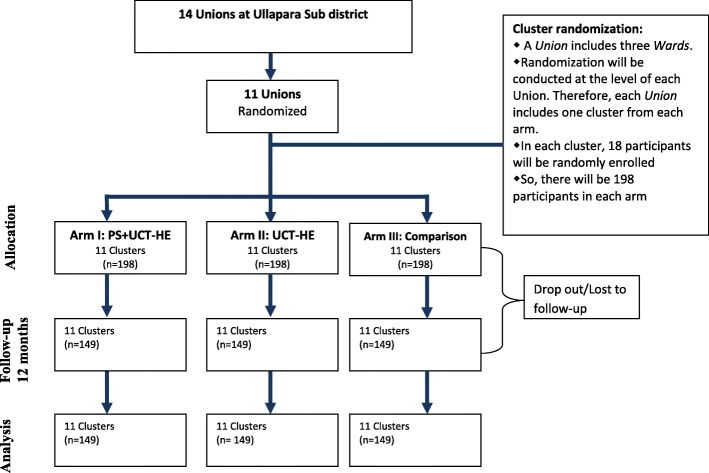
Methods: The study will be conducted at 11 unions of Ullapara sub-district in Bangladesh. The study is a cluster randomized controlled trial with three-arms; (i) PS and UCT with HE (ii) UCT with HE and iii) Comparison arm. The cluster will be considered as an old Ward of a Union, the lowest tier of local government system in rural Bangladesh. There are three old Wards in a union. These three clusters will be randomized to one of the three arms. Similarly, randomization will be done for each 11 Unions and then 11 clusters will be assigned to an arm. Eighteen participants will be recruited from each cluster randomly (n = 196 in each arm). The intervention designed for one year includes UCT with HE for the poor as a safety net program in rural Bangladesh with or without PS. An age-based curriculum of PS is already available for Bangladeshi children and this will be administered by trained local women; play leaders (PL) in intervention clusters. The government of Bangladesh is providing UCT of taka 500 ($6.25) as maternity allowance per month with HE. The primary outcomes will be cognitive, motor and language composite scores measured by Bayley-III and behavior using Wolke's behavior rating scale. The secondary outcomes will be children and mothers' growth, family food security status, health seeking behavior, mothers' depressive symptoms and self-esteem and violence against mothers.
Discussion: The study will provide a unique opportunity to assess an integrated early childhood development intervention using UCT platform to mitigate developmental delays in poor vulnerable children of rural Bangladesh.
Trial registration number: ClinicalTrials.gov NCT03281980, registered on September 13, 2017.
Keywords: Bangladesh; Behavior; Cognitive; Development; Language; Motor; Psychosocial stimulation; Unconditional cash transfer.
Conflict of interest statement
Ethics approval and consent to participate
Necessary administrative permission of GOB will be obtained to access and use the information of the study participants before field implementation. Prior to submission of this protocol for funding, a discussion was held with GOB officials. Participation will be completely voluntary and at any time the participants can withdraw participation. Before enrolment, objectives, process, importance, risk and benefits of the study will be explained to all participants and their written informed consent will be obtained.
If we find any disability of the participants during our study, we will inform the parents by a clinical psychologist confidentially and refer the child to a proper health centre for treatment.
All participants will have unique identification number to conceal participants’ address. The hard copies will be under lock and key and will be accessed by designated person only. The results of this study will be disseminated in aggregates and identification of individual participants will not be disclosed.
This study has been approved by the International Centre for Diarrhoeal Disease Research Bangladesh (icddr,b) Institutional Review Board (PR-17009).
Consent for publication
Not applicable.
Competing interests
The authors declare that they have no competing interests.
Publisher’s Note
Springer Nature remains neutral with regard to jurisdictional claims in published maps and institutional affiliations.
Figures
References
-
- Adato M, Hoddinott J. Conditional cash transfer programs: a" magic bullet" for reducing poverty? 2007.
-
- Fiszbein A, Schady NR. Conditional cash transfers: reducing present and future poverty: World Bank publications. 2009.
-
- Rawlings LB, Rubio GM. Evaluating the impact of conditional cash transfer programs. The World Bank Research Observer. 2005;20(1):29–55. doi: 10.1093/wbro/lki001. - DOI
